Bajel Projects Secures Major Gujarat Power Transmission Project
Source:solarquarter ↗
Why It Matters
Highlights the role of institutional investments (like NIIF) and the TBCB mechanism in expanding India's power transmission infrastructure, which is a critical prerequisite for integrating large-scale renewable energy and meeting national climate targets.
Summary
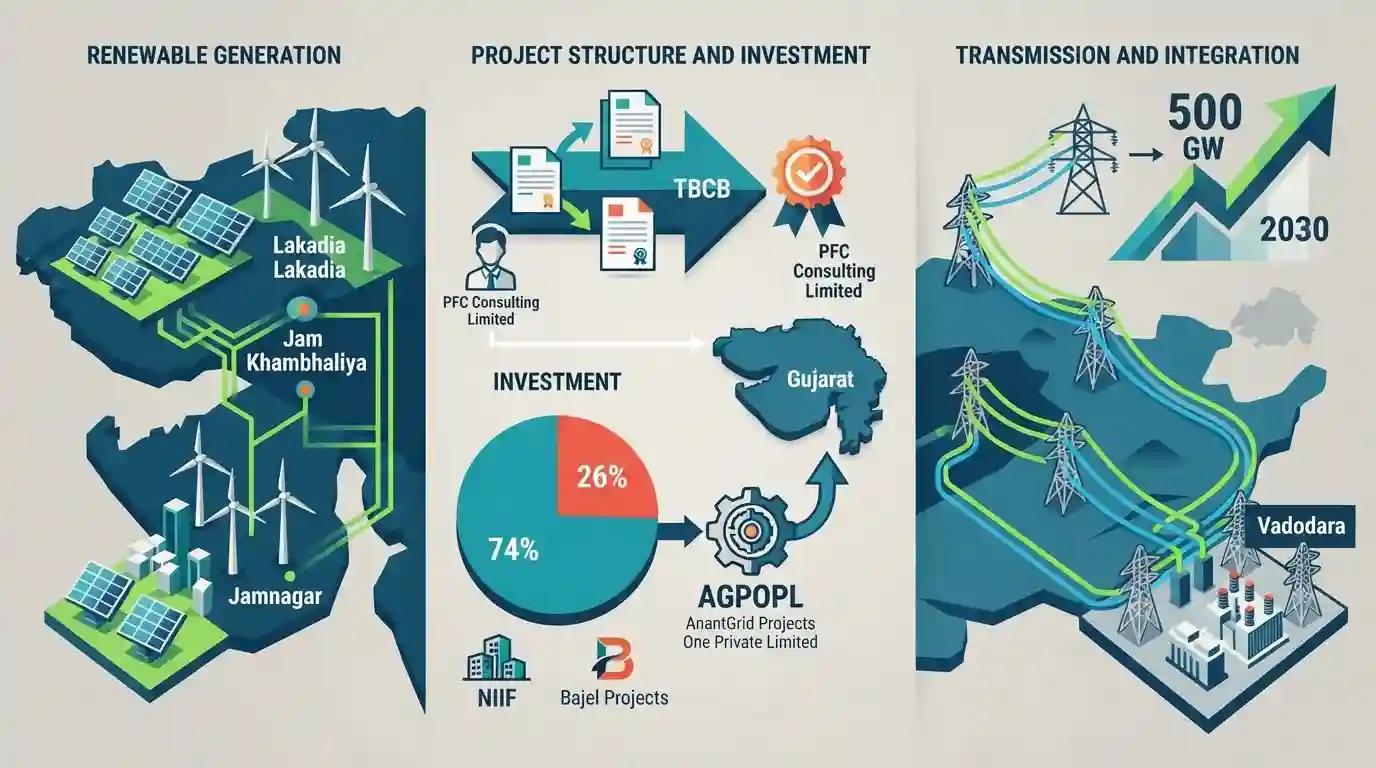
Bajel Projects’ associate entity, AnantGrid Projects One Private Limited (AGPOPL), has secured a major power transmission project in Gujarat under the Tariff-Based Competitive Bidding (TBCB) framework. Facilitated by PFC Consulting Limited, the project involves constructing 270 km of 765 kV double-circuit transmission lines from Halvad to Vadodara. AGPOPL, a joint venture between the National Investment and Infrastructure Fund (NIIF) (74%) and Bajel Projects (26%), will use this infrastructure to evacuate renewable energy from Lakadia, Jam Khambhaliya, and Jamnagar. The project is strategically vital for integrating renewable power into the grid, aligning with India's ambitious goal of achieving 500 GW of renewable energy capacity by 2030.
Key Points
- AnantGrid Projects One Private Limited (AGPOPL) secured a project under the Tariff-Based Competitive Bidding (TBCB) route to develop 270 km of 765 kV double-circuit transmission lines in Gujarat.
- The project connects Halvad to Vadodara and is designed to evacuate renewable energy from major hubs like Lakadia, Jam Khambhaliya, and Jamnagar.
- AGPOPL is jointly owned by the National Investment and Infrastructure Fund (NIIF) with a 74% stake and Bajel Projects with a 26% stake.
- This infrastructure development is a key step towards achieving India's target of 500 GW of renewable energy capacity by 2030.
Important Terms
Tariff-Based Competitive Bidding (TBCB) Framework

A Ministry of Power framework for transparently procuring electricity and transmission services. It utilizes online e-reverse auctions where developers submit progressively lower bids to ensure cost-efficient infrastructure development and fair tariffs.
UPSC context
Crucial for Paper-3 (Economy/Infrastructure). It tests understanding of market-driven models reducing government fiscal burden and lowering consumer electricity costs.
National Investment and Infrastructure Fund (NIIF)
Established in 2015 as India’s sovereign-anchored investment platform. Registered as a Category II Alternative Investment Fund, it mobilizes long-term domestic and global capital into vital economic and social infrastructure.
UPSC context
Highly relevant for Paper-3 (Investment Models). Highlights how India finances large-scale developmental and renewable energy projects.
AnantGrid Projects One Private Limited (AGPOPL)
A special purpose vehicle (SPV) jointly owned by NIIF (74%) and Bajel Projects (26%). It successfully secured the project to develop a 270 km, 765 kV transmission corridor in Gujarat.
UPSC context
Useful for Paper-3 (Energy) and current affairs. Demonstrates institutional private-public collaboration expediting India's 500 GW renewable energy evacuation targets.
PFC Consulting Limited (PFCCL)
A wholly-owned subsidiary of Power Finance Corporation. It acts as the Bid Process Coordinator for the Ministry of Power, conducting surveys, acquiring land, and managing competitive bidding for transmission projects.
UPSC context
Important for Paper-2 (Governance). Shows the institutional mechanism behind pre-clearing structural bottlenecks for infrastructure developers.
Prelims Trap
"The National Investment and Infrastructure Fund (NIIF) is a sovereign wealth fund wholly owned by the Government of India."
The Government of India holds a 49% minority stake in NIIF, making it a sovereign-anchored fund. It operates commercially and is not a wholly-owned sovereign wealth fund.
Static Concepts Connected
What is the structure and mandate of the National Investment and Infrastructure Fund (NIIF)?
- Category II AIF: Registered with SEBI as a Category II Alternate Investment Fund (AIF) with the Government of India holding a 49% stake.
- Three Fund Structure: It primarily operates through three funds: the Master Fund, the Fund of Funds, and the Strategic Opportunities Fund.
- Core Mandate: Designed to attract domestic and international capital for commercially viable greenfield and brownfield infrastructure projects in India.
How does the Tariff-Based Competitive Bidding (TBCB) framework work in power transmission?
- Shift from Cost-Plus: Introduced to replace the older cost-plus mechanism, it encourages private sector investment and ensures transparency in transmission projects.
- Reverse Auction Mechanism: Bidders compete in a reverse auction by offering the lowest transmission tariff for a specified concession period.
- Tariff Discovery: Helps discover the lowest cost of power evacuation, which is critical for maintaining affordable tariffs as India integrates 500 GW of RE.
Cross-Topic Patterns
Green Energy Corridors & Grid Integration
Large-scale RE generation in Gujarat (like Khavda) requires robust 765kV transmission. This connects directly to MNRE's Green Energy Corridor (GEC) scheme for intra/inter-state grid synchronization.
NIIF & Sovereign-Anchored Capex
NIIF taking a 74% majority stake in a state-level utility project highlights a trend of sovereign-anchored capital crowding in private players (Bajel) via PPP models.

NIIF ownership structure, TBCB vs cost-plus models, and Gujarat's RE evacuation infrastructure are ripe for multi-statement Prelims MCQs.
Linked PYQs · 3
Linked PYQs · 3
- 2026GPSC_PRELIMSGS1
Which of the following statement/s is/are correct regarding Renewable Energy Installed Capacity in India? 1. Wind energy is second only to solar energy in the Indian renewable sector. 2. Biomass power capacity accounts for around 30% of India's total renewable energy. 3. India ranks among the top three countries in the world in Hydropower Installed Capacity. Choose the correct option from the following.
- 2025GPSC_PRELIMSGS1
Under the Green Open Access Rules, 2022, the minimum size of the renewable energy project eligible for open access is
- 2025GPSC_PRELIMSGS1
Which of the following statement(s) is / are true? (i) Ministry of Power has established National Mission on the use of biomass in thermal power plants known as SAMARTH (ii) The policy on biomass utilization for power generation through co-firing in coal-based power plants, mandates all thermal power plants in the country to use 5 - 10% biomass for power production.
