India Mining Hazards and Safety Deficits in Unregulated Quarries
Source:The Hindu ↗
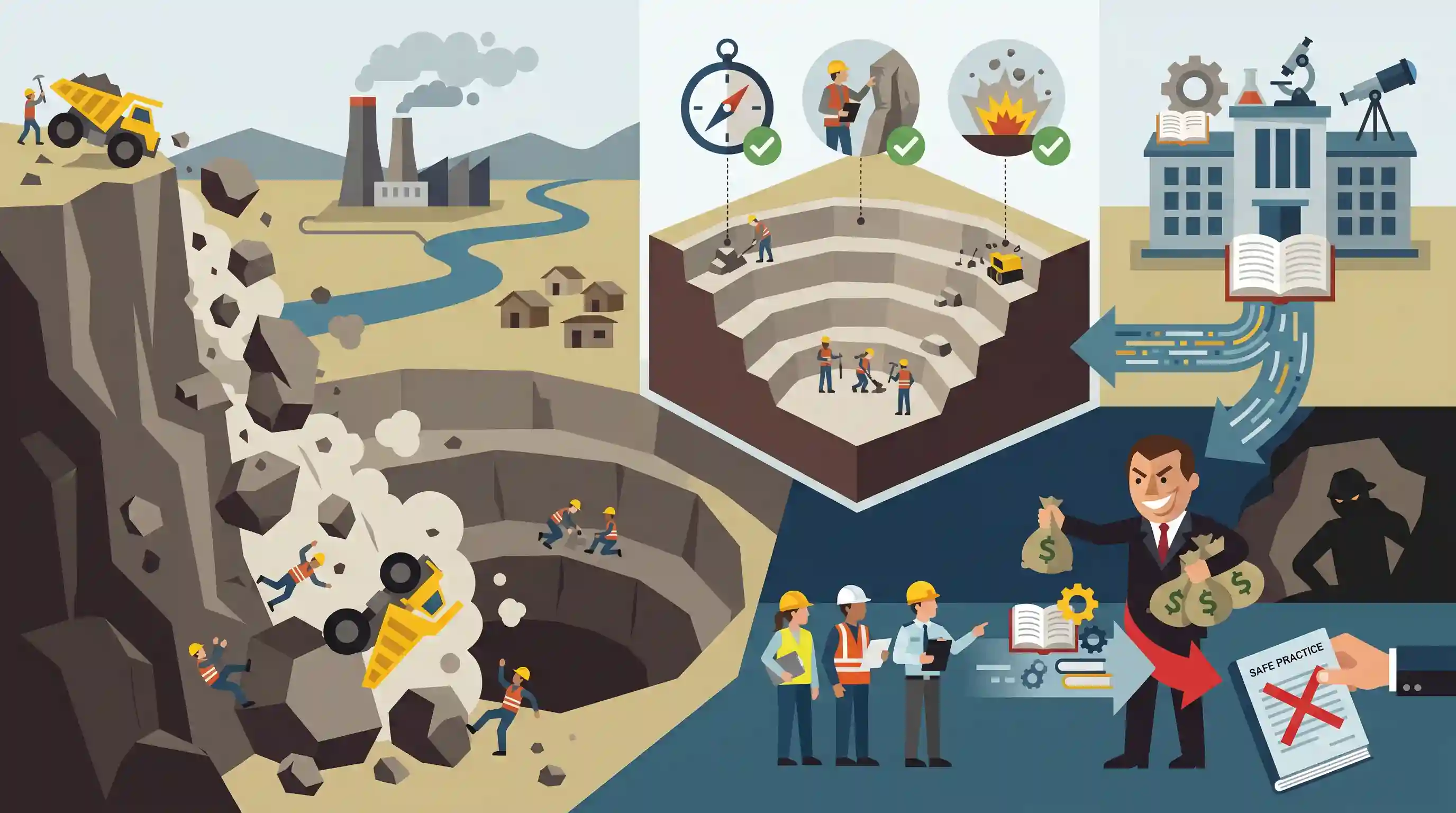
Why It Matters
The article bridges topics across GS1 (distribution of key natural resources) and GS3 (disaster management, environmental hazards). The 'resource curse' in central India and the need for scientific, sustainable mining practices are highly testable areas in Mains, reflecting the balance between economic development and human security.
Summary
The editorial examines the persistent hazards in India's quarrying and mining industries, catalyzed by a recent fatal stone quarry collapse in Sonbhadra, Uttar Pradesh. It highlights the stark paradox of the region, which serves as India's energy capital and holds vast mineral wealth yet struggles with acute poverty and unsafe working conditions. The author advocates for the strict enforcement of scientific mining practices, such as benching and pre-blasting geological assessments. Ultimately, the article argues that while India possesses the technical expertise (such as that at IIT ISM Dhanbad) to prevent such tragedies, a lack of political will allows illegal and unscientific mining to thrive at the cost of human lives.
Key Points
- A recent stone quarry collapse in Obra, Sonbhadra district, Uttar Pradesh, underscores the chronic lack of safety and structural protocols in India's mining sector.
- Despite its status as India's 'energy capital' with massive coal-plant capacity, the Sonbhadra region—and the contiguous mineral belt spanning central and eastern states—suffers from deep human development deficits (the 'resource curse').
- Unscientific and illegal quarrying bypasses essential safety measures, such as proper blasting design, micro-geological studies, and 'benching' (creating horizontal plateaus) in open-cast mines.
- While institutions like IIT (ISM) Dhanbad possess the requisite technological expertise for safe mining, implementing these solutions requires strong political will to overcome vested interests.
Important Terms
Scientific Mining

An extraction method utilizing geological assessments, technical engineering, and environmental clearances to ensure worker safety, resource efficiency, and minimal ecological impact.
UPSC context
Relevant for GS Paper 3 (Disaster Management/Industry) regarding sustainable resource extraction and prevention of mining accidents.
Directorate General of Mines Safety (DGMS)
The statutory regulatory authority under the Ministry of Labour & Employment responsible for ensuring the occupational safety, health, and welfare of workers in Indian mines.
UPSC context
Tests knowledge of regulatory bodies under GS Paper 2 (Statutory Bodies) and GS Paper 3 (Mining Safety).
Benching
A safety technique in open-pit mining or quarrying where vertical walls are cut into horizontal steps (benches) to prevent slope failure and cave-ins.
UPSC context
Technical term related to Disaster Management and industrial safety in GS Paper 3.
IIT (ISM) Dhanbad
A premier technical university in Jharkhand specializing in mining and mineral engineering, providing the research and expertise necessary for safe and efficient mining.
UPSC context
Significant as an Institution of National Importance contributing to India's mineral security and safety standards.
Sonbhadra
A mineral-rich district in Uttar Pradesh known as the 'Energy Capital of India'; it serves as a case study for the paradox of plenty.
UPSC context
Important for GS Paper 1 (Geography) and Paper 3 (Economy) regarding resource distribution and regional development.
Prelims Trap
"The Central Government grants mining leases and frames rules for minor minerals like stone and sand."
Under the MMDR Act, States frame rules and grant leases for minor minerals. The Centre only holds the power to notify/declare a mineral as 'minor'.
Static Concepts Connected
Who regulates minor and major minerals under the MMDR Act?
- Minor Minerals: State governments exclusively regulate, frame rules, and grant mining leases for minor minerals (e.g., building stones, sand, gravel).
- Notification Power: The Central Government retains the sole authority to notify or declare which minerals fall under the 'minor' category.
- Major Minerals: Regulated primarily by the Central Government, though State governments execute the leases and collect royalties for them.
What is the "Resource Curse" in Indian economic geography?
- The Paradox: Regions with abundant natural resources (like coal or iron) experience lower economic growth and poorer human development than resource-scarce regions.
- Indian Examples: The mineral-rich contiguous belt spanning Jharkhand, Chhattisgarh, Odisha, and Sonbhadra (UP) suffers from acute poverty despite immense wealth.
- Key Drivers: Driven by displacement, environmental degradation, lack of economic diversification, and systemic exploitation without local reinvestment.
Cross-Topic Patterns
Resource Curse + Internal Security
The geographical overlap of India's mineral-rich districts with Left Wing Extremism (LWE) hotspots illustrates the socio-political fallout of unscientific mining and tribal displacement.
DMFs + PMKKKY Scheme
District Mineral Foundations (DMFs) under PMKKKY were instituted specifically to address mining inequities, ensuring royalties fund local welfare and mitigate the resource curse in districts like Sonbhadra.

A 2026 Prelims multi-statement question is highly likely to test the MMDR Act's division of powers regarding minor vs major minerals.
Linked PYQs · 3
Linked PYQs · 3
- 2025MainsGS3
Mineral resources are fundamental to the country's economy and these are exploited by mining. Why is mining considered an environmental hazard? Explain the remedial measures required to reduce the environmental hazard due to mining.
- 2018PrelimsGS1
Consider the following statements: 1. In India, State Governments do not have the power to auction non-coal mines. 2. Andhra Pradesh and Jharkhand do not have gold mines. 3. Rajasthan has iron ore mines. Which of the statements given above is/are correct?
- 2019MainsGS3
Disaster preparedness is the first step in any disaster management process. Explain how hazard zonation mapping will help disaster mitigation in the case of landslides.
