Protest Suppression and State Action on Dissent in India
Source:The Hindu ↗
Why It Matters
Provides a critical contemporary example for GS-2 answers regarding the erosion of civil liberties, the criminalization of peaceful dissent, and federal friction (inter-state police standoffs). It underscores the tension between state security apparatuses and constitutionally guaranteed fundamental rights.
Summary
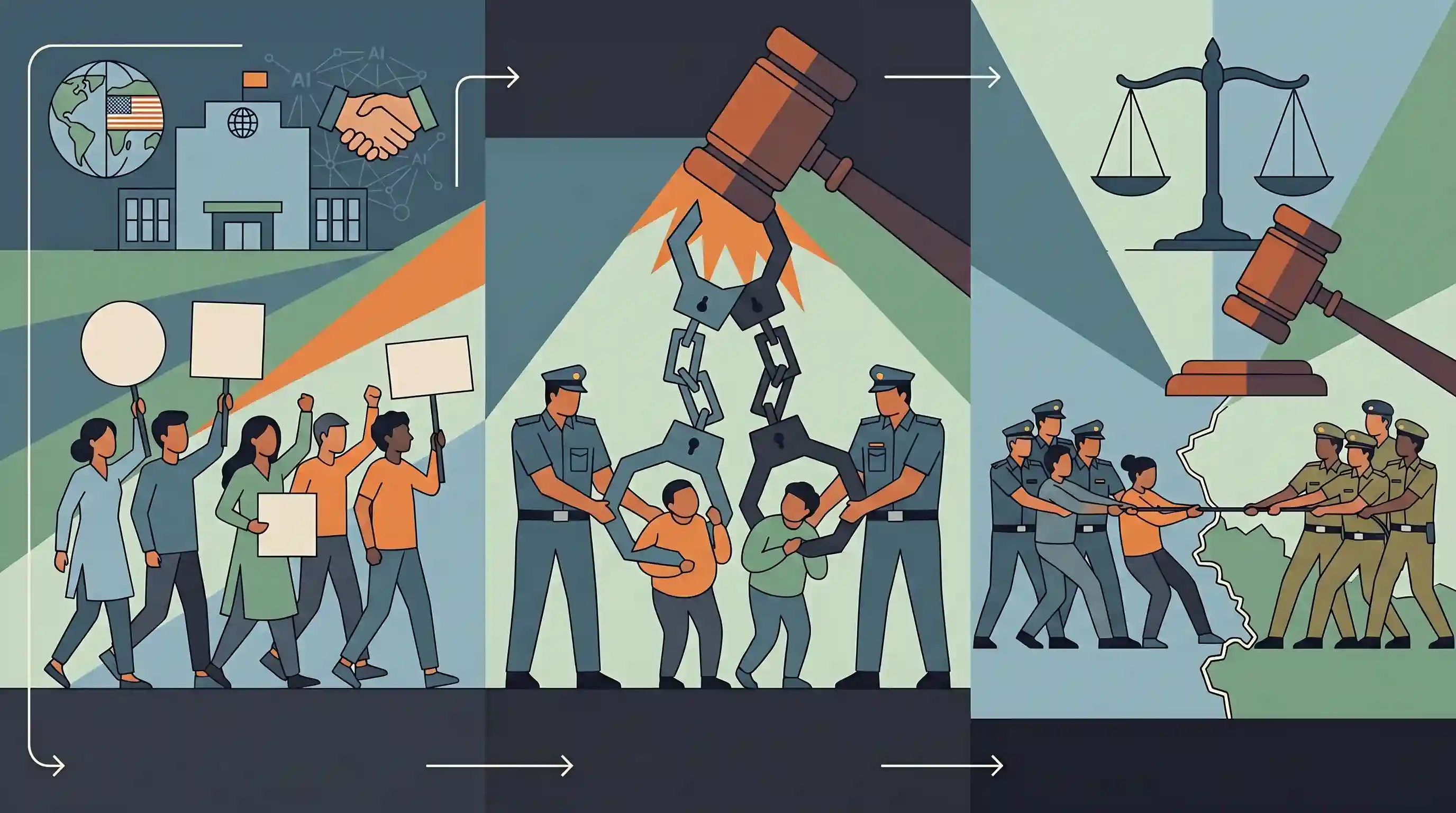
The editorial criticizes the heavy-handed approach of the Delhi Police against Indian Youth Congress activists who peacefully protested the India-U.S. interim trade deal during the India AI Impact Summit 2026. The severe charges levied against the protesters and the resulting jurisdictional standoff with the Himachal Pradesh police highlight a troubling government trend of using draconian laws to criminalize peaceful dissent. The article underscores that dissent is an essential component of a healthy democracy and urges the judiciary to intervene against the misuse of law enforcement.
Key Points
- The India AI Impact Summit 2026 witnessed peaceful protests by Indian Youth Congress activists against the India-U.S. interim trade deal.
- Delhi Police responded with disproportionate severity, slapping charges like rioting, promoting enmity, and criminal conspiracy on the protesters.
- The detentions triggered an unprecedented jurisdictional standoff between the Delhi Police and Himachal Pradesh Police in Shimla.
- The editorial decries a growing trend by the state to conflate peaceful dissent with violent crime, citing similar crackdowns during the CAA protests.
- It argues that peaceful dissent is a vital pillar of Indian democracy and urges the judiciary to quickly quash outrageous FIRs aimed at muzzling opposition.
Important Terms
India-U.S. interim trade deal

A 2026 framework agreement aimed at reducing tariffs on industrial and agricultural goods while enhancing technology trade and supply chain cooperation between India and the United States.
UPSC context
GS Paper II: Bilateral agreements and their impact on India's interests; GS Paper III: International trade and economic policy.
Indian Youth Congress
The youth wing of the Indian National Congress (INC) that engages in political mobilization and acts as a pressure group for youth-centric issues.
UPSC context
GS Paper II: Role of political parties and pressure groups in a democracy.
Delhi Police
The law enforcement agency for the National Capital Territory of Delhi, unique for being under the administrative control of the Union Ministry of Home Affairs.
UPSC context
GS Paper II: Federalism and administrative structure of Union Territories; Police reforms.
Himachal Pradesh Police
The state police force of Himachal Pradesh, operating under the state government's jurisdiction as per the Seventh Schedule of the Indian Constitution.
UPSC context
GS Paper II: Inter-state coordination and federal friction in law enforcement.
Union government
The central executive authority of India, responsible for the nation's governance, foreign policy, and administration of Union Territories like Delhi.
UPSC context
GS Paper II: Executive branch functions and center-state relations.
Congress party
One of India's two major political parties, currently in the opposition, advocating for the protection of national interests and rights of marginalized groups.
UPSC context
GS Paper II: Political parties and their role in parliamentary democracy.
Prelims Trap
Police is a Concurrent List subject, which allows forces to cross state borders for arrests.
'Police' is strictly a State subject (List II). Inter-state arrests are allowed via BNSS/CrPC provisions, but they mandate transit remand from local magistrates, not concurrent constitutional jurisdiction.
Static Concepts Connected
What are the Constitutional and legal safeguards during inter-state arrests?
- Article 22(2): Under Article 22(2), an accused must be produced before the nearest magistrate within 24 hours of arrest, excluding journey time.
- Transit Remand: Arresting officers must obtain this from the local magistrate of the state where the arrest occurs to legally transport the accused back.
- Local Intimation: Courts mandate that the visiting police inform the local police station before conducting operations, preventing arbitrary extra-territorial actions.
Under which Constitutional provisions is the right to protest governed?
- Derived Right: It is implicitly derived from Article 19(1)(a) (speech and expression) and Article 19(1)(b) (peaceable assembly without arms).
- Reasonable Restrictions: Protests are subject to restrictions under Article 19(2) & (3) on grounds like public order, sovereignty, and integrity of India.
- SC Ruling: In the Shaheen Bagh case (2020), the Supreme Court ruled that public spaces cannot be occupied indefinitely for protests.
Cross-Topic Patterns
Weaponization of inter-state policing
Jurisdictional clashes between state police forces reflect growing federal friction, where agencies cross borders to arrest dissidents, testing the limits of cooperative federalism and BNSS transit remand safeguards.
Global tech summits as protest venues
High-profile global events like AI summits are increasingly becoming flashpoints for protests against unrelated macroeconomic policies, such as trade deals, triggering disproportionate security and public order responses.

A multi-statement question linking Art 19(1)(b) assembly limits with BNSS transit remand and State police jurisdiction is highly probable.
Linked PYQs · 3
Linked PYQs · 3
- 2014MainsGS2
What do you understand by the concept "freedom of speech and expression"? Does it cover hate speech also ? Why do the films in India stand on a slightly different plane from other forms of expression ? Discuss.
- 2017MainsGS2
Examine the scope of Fundamental Rights in the light of the latest judgement of the Supreme Court on Right to Privacy.
- 2019MainsGS2
From the resolution of contentious issues regarding distribution of legislative powers by the courts, 'Principle of Federal Supremacy' and 'Harmonious Construction' have emerged. Explain.
