Asiatic lioness Sunaina dies at Udaipur biological park
Source:etvbharat ↗
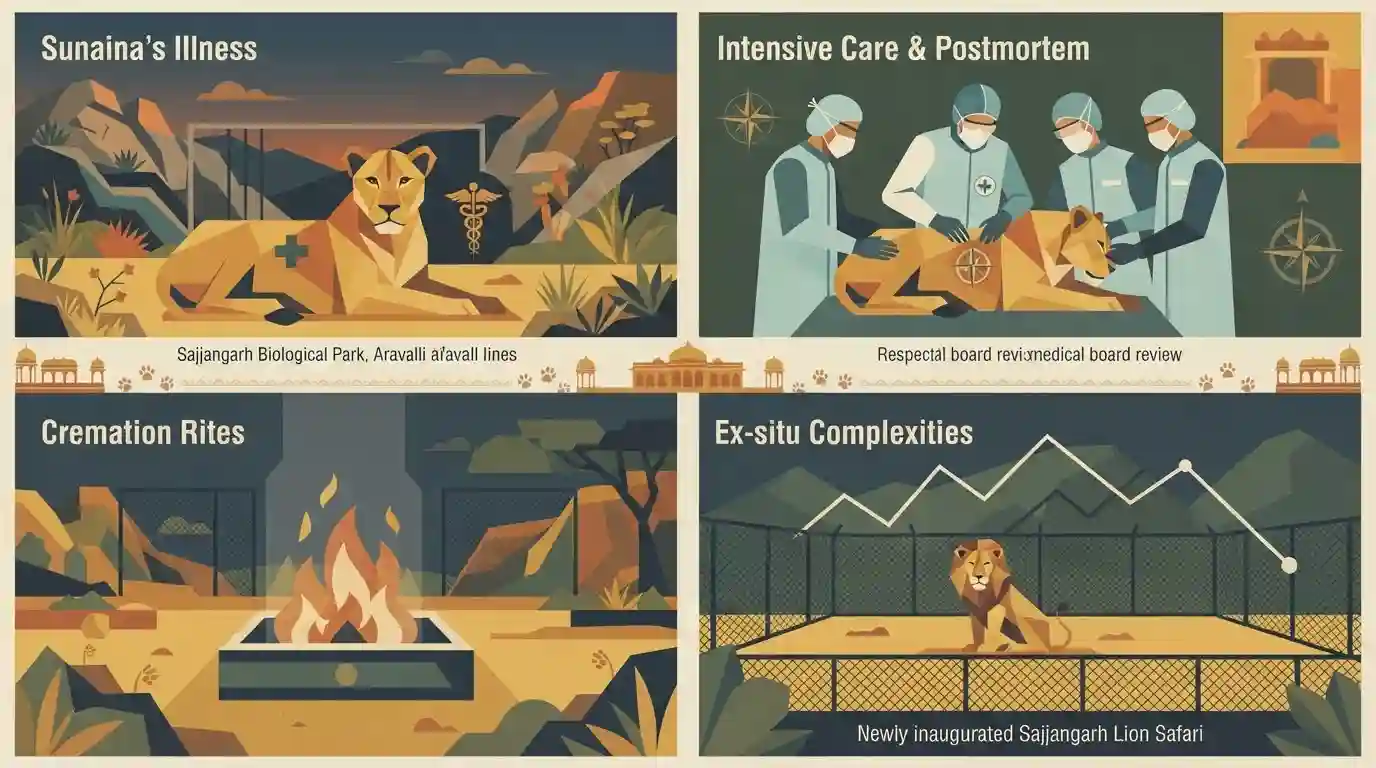
Why It Matters
The management and health of wildlife in biological parks are key aspects of Rajasthan's environmental conservation efforts and eco-tourism. Instances like this draw attention to the infrastructure, veterinary capabilities, and conservation strategies for endangered species like the Asiatic lion within the state's protected enclosures.
Summary
A five-and-a-half-year-old Asiatic lioness named Sunaina passed away from illness at the Sajjangarh Biological Park in Udaipur, Rajasthan. She had been under intensive veterinary care for three months. Following a postmortem by a three-member medical board, she was cremated within the park premises. Her death leaves the recently inaugurated Sajjangarh Lion Safari with only one surviving male lion, Samrat, underscoring the complexities involved in the ex-situ conservation of endangered wildlife species.
Key Points
- Sunaina, a 5.5-year-old Asiatic lioness, died at the Sajjangarh Lion Safari in Udaipur after a prolonged illness.
- Despite intensive veterinary treatment over three months and a brief period of improvement, her condition suddenly deteriorated.
- The Sajjangarh Lion Safari, recently inaugurated, is now left with a single male lion named Samrat.
- The death highlights ongoing challenges in the ex-situ conservation and veterinary care of endangered Asiatic lions in state biological parks.
Important Terms
Sajjangarh Biological Park

A zoological park in Udaipur housing a variety of species, situated near the Sajjangarh Monsoon Palace. Inaugurated in 2015, it acts as an ex-situ conservation facility for the state of Rajasthan.
UPSC context
Important for RPSC Prelims and Geography topics as a key biodiversity hub and tourism landmark in Rajasthan.
Sajjangarh Lion Safari
A 20-hectare safari developed within Sajjangarh Sanctuary. Set to open soon, it aims to boost local tourism and serve as a home for translocated Asiatic lions.
UPSC context
Tests awareness of recent wildlife infrastructure and state initiatives in RPSC Current Affairs and Economy (tourism).
Ex-situ Conservation
Conservation of endangered species outside their natural habitats, such as in zoos, botanical gardens, and seed banks, to ensure their survival and maintain genetic diversity.
UPSC context
Core RPSC Environment/Biology concept. Contrasts with in-situ conservation (National Parks/Sanctuaries).
Asiatic lion
A lion subspecies whose wild population is now restricted entirely to India's Gujarat state. Globally assessed as Vulnerable on the IUCN Red List.
UPSC context
Vital for Environment and Ecology questions detailing keystone species, habitats, and IUCN classification updates.
Prelims Trap
"Sajjangarh Biological Park in Udaipur is home to Rajasthan's first Lion Safari."
Sajjangarh actually hosts the SECOND Lion Safari in Rajasthan. The state's first Lion Safari was established at Nahargarh Biological Park in Jaipur.
Static Concepts Connected
What distinguishes Ex-situ from In-situ wildlife conservation?
- In-situ Conservation: Protecting and breeding endangered species in their natural, native habitats (e.g., Ranthambore National Park, Desert National Park).
- Ex-situ Conservation: Protecting species outside their natural habitats in controlled environments (e.g., Sajjangarh Biological Park, zoos, botanical gardens, and seed banks).
What are the four primary Biological Parks in Rajasthan?
- Nahargarh Biological Park: Located in Jaipur; hosts the state's first lion safari.
- Sajjangarh Biological Park: Located at the foothills of Bansdara hills in Udaipur; hosts the state's second lion safari.
- Machiya Biological Park: Located near Kaylana lake in Jodhpur, focusing on desert flora and fauna.
- Abheda Biological Park: Located in Kota; it is the newest major addition to the state's biological park network.
Cross-Topic Patterns
Wildlife Tourism & Aravalli Geography
Sajjangarh's placement at the Bansdara hills connects ex-situ conservation projects with the broader ecological and topographical study of the Aravalli range in RPSC geography.
Inter-state Wildlife Relocations
The transfer of lions from Sakkarbaug Zoo (Gujarat) to Rajasthan mirrors tiger relocation schemes, testing awareness of inter-state genetic pool management and ex-situ breeding programs.

Match-the-following questions pairing Rajasthan's biological parks (Nahargarh, Sajjangarh, Machiya, Abheda) with their districts are highly likely.
Linked PYQs · 3
Linked PYQs · 3
- 2024RPSC_PRELIMSGS1
Select the most correct statement regarding the Rajasthan State Biological Park (Phase-II): A. It covers 9 districts and is an initiative of the Rajasthan State Biodiversity Authority (RSBA). B. Achada, Merta and Machala Biological Park have been included in phase-II. C. In phase-II, Bio-Diversity Council, Water Conservation has also been incorporated in its list.
- 2025RPSC_PRELIMSGS1
Choose the incorrect statement with respect to the Rajasthan Forestry and Biodiversity Project (Phase-2).
- 2023RPSC_PRELIMSGS1
The National Tiger Conservation Authority has conferred the status of the fifth tiger sanctuary in Rajasthan, to which of the following sanctuaries?
