Strategic Stalemate in Russia Ukraine Conflict
Source:The Hindu ↗
Why It Matters
This article highlights the shifting nature of modern warfare (the prominence of drone/UAV-based infrastructure targeting) and the ongoing geopolitical gridlock between Russia and NATO-backed Ukraine. Understanding these dynamics is essential for UPSC GS-2 (International Relations, global security balance) and GS-3 (Security, technology in warfare, and economic impacts on energy security).
Summary
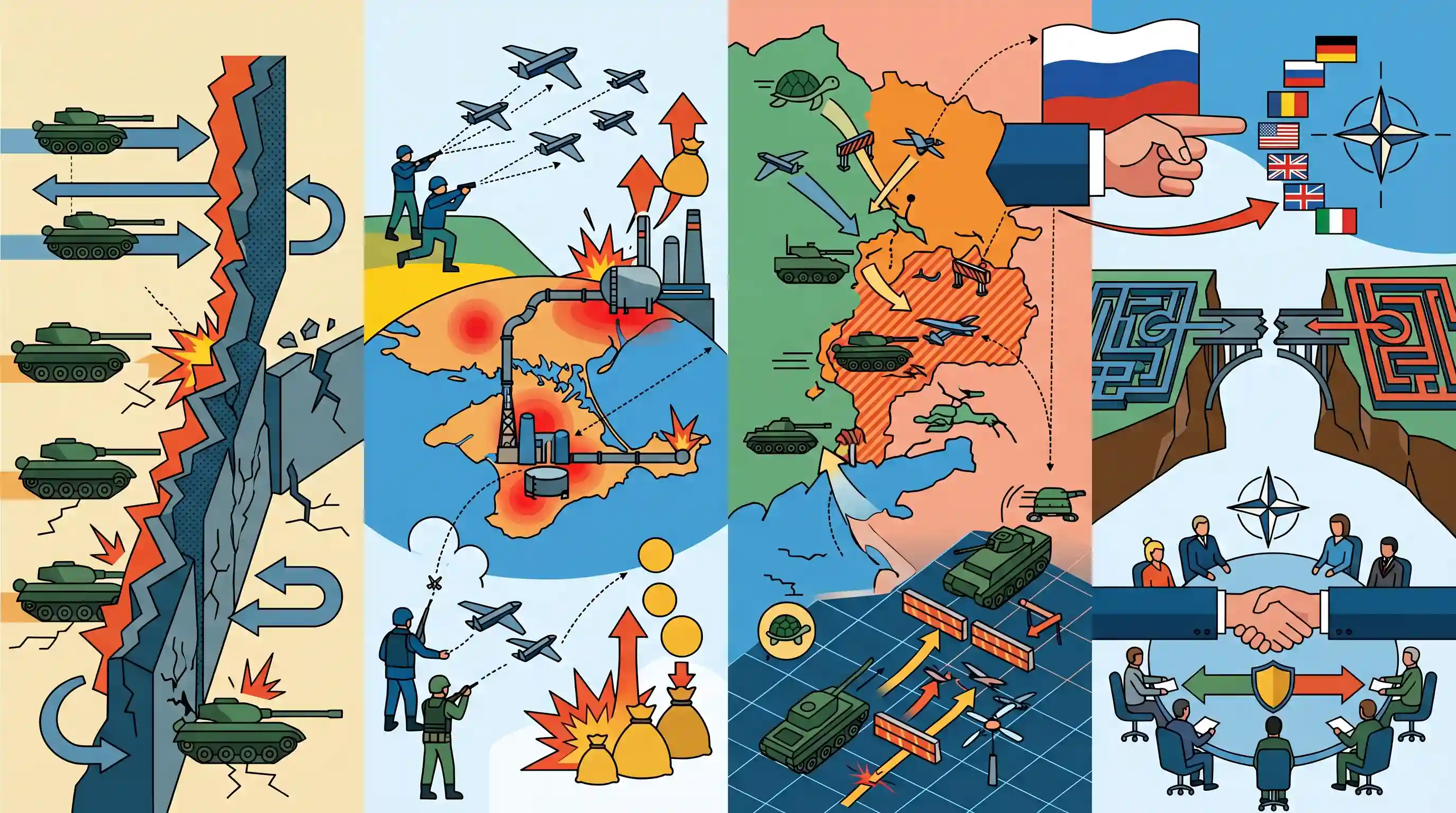
The editorial analyzes the persistent stalemate in the Russia-Ukraine conflict more than four years after Russia's February 2022 invasion. Ukraine has successfully raised the cost of the war for Moscow by utilizing daily drone strikes to target Russian refining capacity and critical energy logistics in Crimea. However, these asymmetric tactics have only slowed, rather than halted, Russian ground advances in eastern Ukraine (such as Kostiantynivka and Lyman). With Russia accusing NATO of enabling deep strikes and neither side having a clear military path to achieve its objectives, the editorial emphasizes the necessity of an immediate ceasefire, mutual concessions, and diplomatic negotiations concerning regional security and the future of NATO.
Key Points
- The Russia-Ukraine conflict has dragged on for over four years since February 2022, resulting in significant casualties, economic dependencies, and an apparent military stalemate.
- Ukraine has shifted tactics towards high-frequency drone warfare, targeting Russian oil refineries ('long-range sanctions') and critical energy/fuel infrastructure, especially in annexed Crimea.
- Despite infrastructure disruptions, Russia continues to make incremental battlefield progress, recently capturing Kostiantynivka and closing in on Lyman, bringing its total territorial control to over 20% of Ukraine (since 2014).
- Russia accuses NATO countries of enabling deep-strike capabilities inside its borders, creating escalatory pressure on President Putin to widen the conflict.
- The editorial argues that neither side has a viable military path to victory and calls for mutual concessions, an immediate ceasefire, and diplomatic dialogue concerning security concerns and NATO’s future expansion.
Important Terms
NATO

An intergovernmental military alliance established in 1949 by the Washington Treaty, focused on collective defense (Article 5) where an attack on one member is considered an attack on all.
UPSC context
GS Paper II (International Relations). Tests knowledge of global security alliances, regional stability, geopolitical conflicts, and India's foreign policy.
Asymmetric Warfare
A conflict where opposing belligerents have significantly unequal military capabilities, forcing the weaker side to employ unconventional tactics like guerrilla operations, cyberattacks, or targeted drone strikes.
UPSC context
GS Paper III (Internal Security). Tests understanding of modern conflict doctrines, non-state threats, and tactical adaptations in unconventional battlefields.
Drone Warfare
The strategic deployment of unmanned aerial vehicles (UAVs) for surveillance, intelligence, and precision strikes, which dramatically lowers combat costs and increases tactical flexibility.
UPSC context
GS Paper III (S&T/Security). Tests understanding of disruptive military technology, border security threats, and indigenous counter-UAV initiatives.
Russian Defence Ministry
The state administrative and executive command body of Russia's military, responsible for managing national defense policy, armed forces procurement, and overseeing major external security operations.
UPSC context
GS Paper II (International Relations). Tests knowledge of state-level defense architectures and official military command structures during regional security crises.
Prelims Trap
Both Finland and Sweden, who joined NATO recently, share direct land borders with Russia.
While Finland shares a 1,340 km land border with Russia, Sweden does not share any land border with Russia (it is separated by Finland and the Gulf of Bothnia).
Static Concepts Connected
What geographical features and littoral states define the Sea of Azov and its connectivity?
- Littoral States: It is bounded by Ukraine to the north/west and Russia to the south/east, making it a highly contested semi-enclosed sea.
- Key Passage: It connects to the larger Black Sea via the Kerch Strait, a narrow channel crucial for regional shipping and military transit.
- Physical Feature: It is widely recognized as the shallowest sea in the world, with a maximum depth of only about 14 meters.
What are the core operational principles of NATO's collective defense under Article 5?
- Collective Defense: Article 5 states that an armed attack against one member state shall be considered an attack against all members.
- Single Invocation: Historically, Article 5 has only been invoked once, following the September 11, 2001 terrorist attacks on the United States.
- Consensus Rule: All NATO decisions, including invoking Article 5 or admitting new members, require the unanimous consensus of all member nations.
Cross-Topic Patterns
Asymmetric warfare & Border defense
Cheap FPV and fiber-optic drones in Ukraine redefine India's tactical doctrine along the Line of Actual Control (LAC) to counter low-cost aerial threats.
Energy supply chains & Strategic autonomy
Attacks on Russian refining capacity force global oil reallocation, testing India’s balancing act of importing discounted crude while maintaining Western ties.

Black Sea-Sea of Azov maritime chokepoints and NATO's Arctic-Baltic expansion are prime targets for multi-statement geography questions in 2026.
Linked PYQs · 3
Linked PYQs · 3
- 2023PrelimsGS1
Consider the following countries: 1. Bulgaria 2. Czech Republic 3. Hungary 4. Latvia 5. Lithuania 6. Romania How many of the above-mentioned countries share a land border with Ukraine?
- 2023MainsGS3
The use of unmanned aerial vehicles (UAVs) by our adversaries across the borders to ferry arms/ammunitions, drugs, etc., is a serious threat to the internal security. Comment on the measures being taken to tackle this threat.
- 2023MainsGS2
‘Virus of Conflict is affecting the functioning of the SCO’ In the light of the above statement point out the role of India in mitigating the problems.
