India-Canada Relations and G-7 Outreach Implications
Source:The Hindu ↗
Why It Matters
The article illustrates the impact of domestic political challenges, such as extremist movements (Khalistan issue), on international diplomacy and bilateral relations. It emphasizes the importance of diaspora and trade (FTA) as stabilizing factors, and the role of dialogue in resolving diplomatic standoffs.
Summary
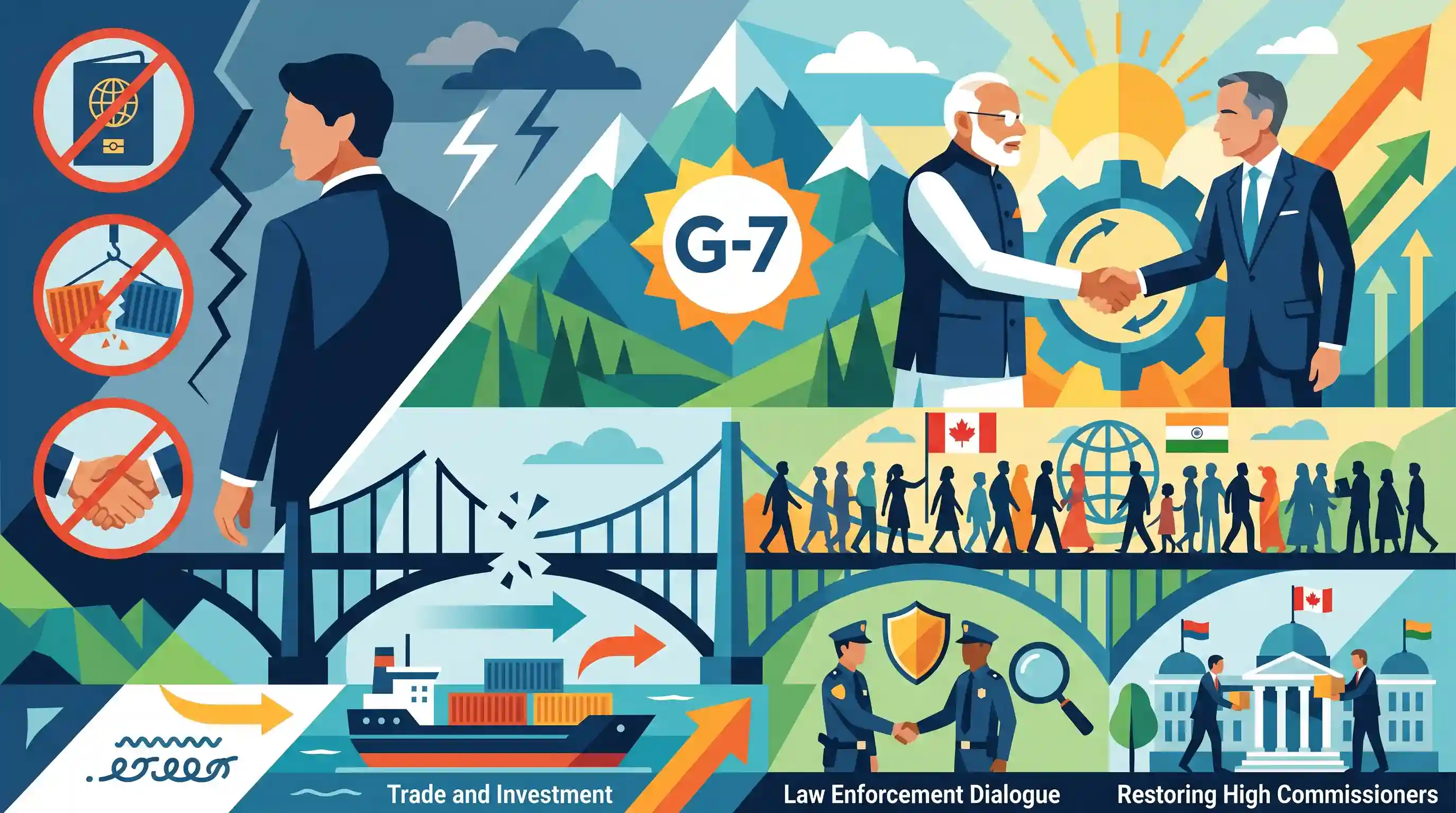
The editorial highlights the potential for a reset in India-Canada relations with Prime Minister Narendra Modi's visit to Kananaskis, Alberta, for the G-7 summit outreach at the invitation of Canada's new Prime Minister, Mark Carney. Bilateral ties had deteriorated significantly under former PM Justin Trudeau due to allegations regarding India's role in the assassination of Khalistani activist Hardeep Singh Nijjar, leading to suspended visa services, reduced diplomatic missions, and halted Free Trade Agreement (FTA) talks. Despite historical friction over the Khalistan issue, the two nations remain deeply connected through trade, investment, and a 1.86-million-strong Indian diaspora. The anticipated "law enforcement dialogue" and efforts to restore high commissioners and trade negotiations signal a pragmatic approach to mending ties and addressing mutual security concerns.
Key Points
- Prime Minister Narendra Modi has been invited by Canada's new Prime Minister, Mark Carney, to attend the G-7 summit outreach in Kananaskis, Alberta.
- Bilateral relations previously nosedived following former Canadian PM Justin Trudeau's allegations of Indian involvement in the assassination of Khalistani activist Hardeep Singh Nijjar.
- The diplomatic spat led to the suspension of visas, reduction of diplomatic missions, and halting of Free Trade Agreement (FTA) negotiations.
- Despite the political friction, the countries share robust ties through trade, investment, and an Indian diaspora comprising 1.86 million people.
- A new "law enforcement dialogue" is expected to address security concerns and the Nijjar case, paving the way for restoring high commissioners and resuming trade talks.
Important Terms
G7 (Group of Seven)

An informal forum of seven advanced economies (US, UK, France, Germany, Italy, Japan, Canada) that coordinates global economic, security, and energy policies.
UPSC context
GS II: Global Groupings; tests India's role as a recurring 'Outreach Country' and its engagement with Western powers.
Free Trade Agreement (FTA)
A treaty between two or more countries to reduce or eliminate trade barriers, such as tariffs and quotas, to facilitate the cross-border flow of goods and services.
UPSC context
GS II & III: Bilateral Agreements & Economy; fundamental for understanding trade diplomacy and market access strategies.
Comprehensive Economic Partnership Agreement (CEPA)
A comprehensive trade pact covering not just goods and services, but also investment, intellectual property, and broad economic cooperation.
UPSC context
GS II & III: Bilateral Relations & Economy; represents the highest level of economic integration between India and its partners.
Indian Diaspora
The global community of persons of Indian origin, playing a significant role in soft power, remittances, and influencing host-country foreign policy.
UPSC context
GS II: Diaspora; tests the political and economic influence of overseas Indians on bilateral ties.
Khalistan Movement
A separatist movement seeking an independent Sikh state, which remains a primary security concern and a recurring friction point in India's foreign relations.
UPSC context
GS II & III: International Relations & Internal Security; explores the intersection of domestic extremism and diplomatic strain.
Early Progress Trade Agreement (EPTA)
An interim or transitional trade deal designed to provide immediate market access in specific sectors while larger, comprehensive negotiations continue.
UPSC context
GS II: Bilateral Agreements; highlights tactical, incremental steps in complex international trade negotiations.
Prelims Trap
The Vienna Convention mandates exact numerical equality (diplomatic parity) in staff between two hosting nations.
The VCDR doesn't mandate exact equality. Article 11.1 actually allows the host state to unilaterally limit a foreign mission's size to what it deems reasonable and normal.
Static Concepts Connected
What are key provisions of the 1961 Vienna Convention regarding diplomatic staff?
- Article 11 (Size): The host state may require that the size of a foreign mission be kept within limits it considers reasonable and normal (used by India for parity).
- Article 9 (PNG): The receiving state can declare any member of the diplomatic staff unacceptable (persona non grata) at any time without providing reasons.
How do Early Progress Trade Agreements (EPTA) differ from CEPA?
- EPTA / EHS: "Early harvest" deals are interim confidence-building steps used to lower tariffs on select goods before finalizing a comprehensive pact.
- CEPA: A comprehensive economic partnership (CEPA) covers a much wider ambit, including trade in services, investments, intellectual property, and government procurement.
Cross-Topic Patterns
Diaspora vote banks vs. Sovereign Security
The influence of the 1.86-million strong Indian diaspora in Canadian domestic elections repeatedly clashes with India's zero-tolerance policy on cross-border extremism and sovereign security.
Canadian Pension Funds insulating FDI
Despite severe diplomatic strain, Canadian pension funds (like CPPIB) maintain deep, insulated investments in India's NIIF, real estate, and renewable energy sectors due to structural yield requirements.

Expect 2026 Prelims questions on Vienna Convention's 'diplomatic parity' clause and the legal distinction between Extradition and MLATs.
Linked PYQs · 4
Linked PYQs · 4
- 2023MainsGS2
Indian diaspora has scaled new heights in the West. Describe its economic and political benefits for India.
- 2020MainsGS2
Indian diaspora has a decisive role to play in the politics and economy of America and European Countries'. Comment with examples.
- 2023PrelimsGS1
Consider the following statements about G-20: 1. The G-20 group was originally established as a platform for the Finance Ministers and Central Bank Governors to discuss the international economic and financial issues. 2. Digital public infrastructure is one of India's G-20 priorities. Which of the statements given above is/are correct?
- 2011MainsGS2
Compared to the South Asian Free Trade Area (SAFTA), the Bay of Bengal Initiative for Multisectoral Technical and Economic Cooperation Free Trade Area (BIMSTEC FTA) seems to be more promising." Critically evaluate.
