Constitutional Criteria for Determining OBC Status
Source:The Hindu ↗
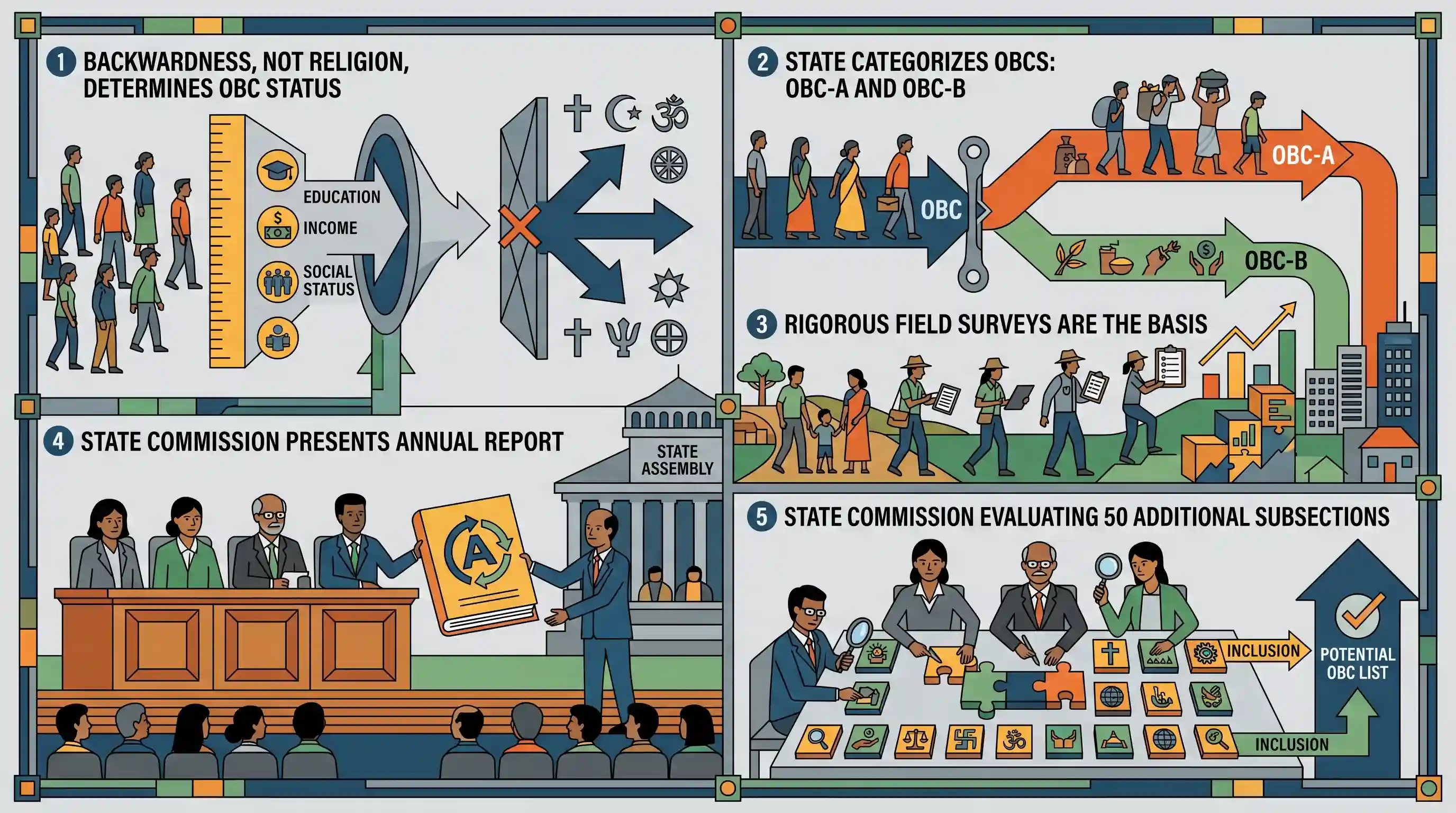
Why It Matters
The criteria for identifying backward classes are a recurring constitutional issue and fundamental to social justice policies in India. This development highlights the debate over religion versus social/educational backwardness in reservation policies and the role of State Commissions for Backward Classes in identifying SEBCs.
Summary
West Bengal Chief Minister Mamata Banerjee declared in the State Assembly that backwardness is the sole benchmark for deciding Other Backward Class (OBC) status, asserting that religion plays no role in inclusion. Presenting the annual report of the West Bengal Commission for Backward Classes, she detailed that the state categorizes its OBCs into OBC-A (more backward) and OBC-B (less backward) based on rigorous field surveys. Furthermore, a state commission is currently evaluating 50 additional subsections to assess their backwardness for potential inclusion.
Key Points
- West Bengal uses backwardness, rather than religion, as the primary criterion for determining OBC status.
- The state maintains two categories based on the degree of backwardness: OBC-A (49 subsections) and OBC-B (91 subsections).
- The state government has tasked a commission to survey 50 new subsections for potential inclusion in the OBC categories.
- Inclusions into the OBC lists are made following extensive field surveys and recommendations by the West Bengal Commission for Backward Classes.
Important Terms
West Bengal Commission for Backward Classes

A statutory body established under the 1993 State Act to identify backward classes and advise the government on inclusion and sub-categorization in reservation lists.
UPSC context
GS Paper II: Statutory/Regulatory bodies and their role in promoting social justice for backward sections.
Socially and Educationally Backward Classes (SEBCs)
The formal constitutional term for groups eligible for OBC reservations, identified based on criteria of social and educational deprivation rather than religion alone.
UPSC context
GS Paper II: Indian Constitution (Articles 15, 16, and 342A) and mechanisms for affirmative action.
Indra Sawhney Case (1992)
A landmark 1992 Supreme Court judgment that upheld 27% OBC reservation, mandated the exclusion of the 'creamy layer,' and capped total reservations at 50%.
UPSC context
GS Paper II: Landmark judicial pronouncements impacting the basic structure and reservation policies.
OBC-A and OBC-B Categorization
West Bengal's sub-classification of OBCs into 'More Backward' (Category A) and 'Backward' (Category B) to ensure equitable reservation benefits across varying levels of deprivation.
UPSC context
GS Paper II: Governance and social justice issues regarding the sub-categorization of OBCs for targeted benefits.
Article 340
Constitutional provision empowering the President to appoint a commission to investigate and recommend measures for the advancement of socially and educationally backward classes.
UPSC context
GS Paper II: Constitutional provisions for the protection and development of vulnerable sections.
Creamy Layer
A socio-economic threshold used to exclude more affluent and advanced members of an OBC community from receiving reservation benefits to prioritize the truly needy.
UPSC context
GS Paper II: Issues relating to the management of social sector/services relating to education and human resources.
Prelims Trap
States must consult the National Commission for Backward Classes to identify and notify their own OBC lists.
The 105th Amendment exempted State governments from consulting the NCBC (under Article 338B) when identifying and maintaining their own State-level SEBC lists.
Static Concepts Connected
What is the constitutional framework for identifying and sub-categorizing OBCs in India?
- 105th CAA: Restored the power of State governments to prepare and maintain their own SEBC lists independent of the Central List.
- Article 340: Empowers the President to appoint a commission to investigate SEBC conditions (e.g., Justice Rohini Commission for Central List sub-categorization).
- Indra Sawhney Judgement: Upheld the validity of sub-categorizing OBCs into 'backward' and 'more backward' classes to ensure equitable distribution of reservation benefits.
Can religion be a criterion for reservation under the Indian Constitution?
- Articles 15 & 16: The Constitution prohibits the State from discriminating against citizens on grounds *only* of religion, race, caste, sex, or place of birth.
- Socio-Educational Benchmark: Reservation must be based on socio-educational backwardness. While a group within a religious minority can be classified as an SEBC, religion alone cannot be the sole benchmark.
Cross-Topic Patterns
Sub-categorization of reserved classes
West Bengal's OBC-A/B split conceptually mirrors the recent Supreme Court constitution bench ruling that affirmed states' power to sub-categorize Scheduled Castes to aid the most marginalized.
Federalism vs. Social Justice lists
The friction over who defines "backwardness" frequently tests Indian federalism, culminating in the 105th Constitutional Amendment to protect State legislative competence over their own affirmative action lists.

Expect a multi-statement question on the 105th CAA, State powers to maintain SEBC lists without NCBC consultation, and Indra Sawhney limits.
Linked PYQs · 3
Linked PYQs · 3
- 2022MainsGS2
Discuss the role of the National Commission for Backward Classes in the wake of its transformation from a statutory body to a constitutional body.
- 2023PrelimsGS1
Consider the following organizations/bodies in India: 1. The National Commission for Backward Classes 2. The National Human Rights Commission 3. The National Law Commission 4. The National Consumer Disputes Redressal Commission How many of the above are constitutional bodies?
- 2023MainsGS2
“Development and welfare schemes for the vulnerable, by its nature, are discriminatory in approach.” Do you agree? Give reasons for your answer.
