Bilateral Engagement and Counter Terrorism Cooperation with Malaysia
Source:The Hindu ↗
Why It Matters
This reflects the pragmatic evolution of India's foreign policy—managing contentious issues (like Zakir Naik and statements on domestic terror attacks) while advancing strategic and economic cooperation. It touches on multiple GS2 themes: bilateral ties in Southeast Asia, ASEAN trade dynamics (AITIGA), counter-terrorism diplomacy (FATF), and the expansion of multilateral forums like BRICS.
Summary
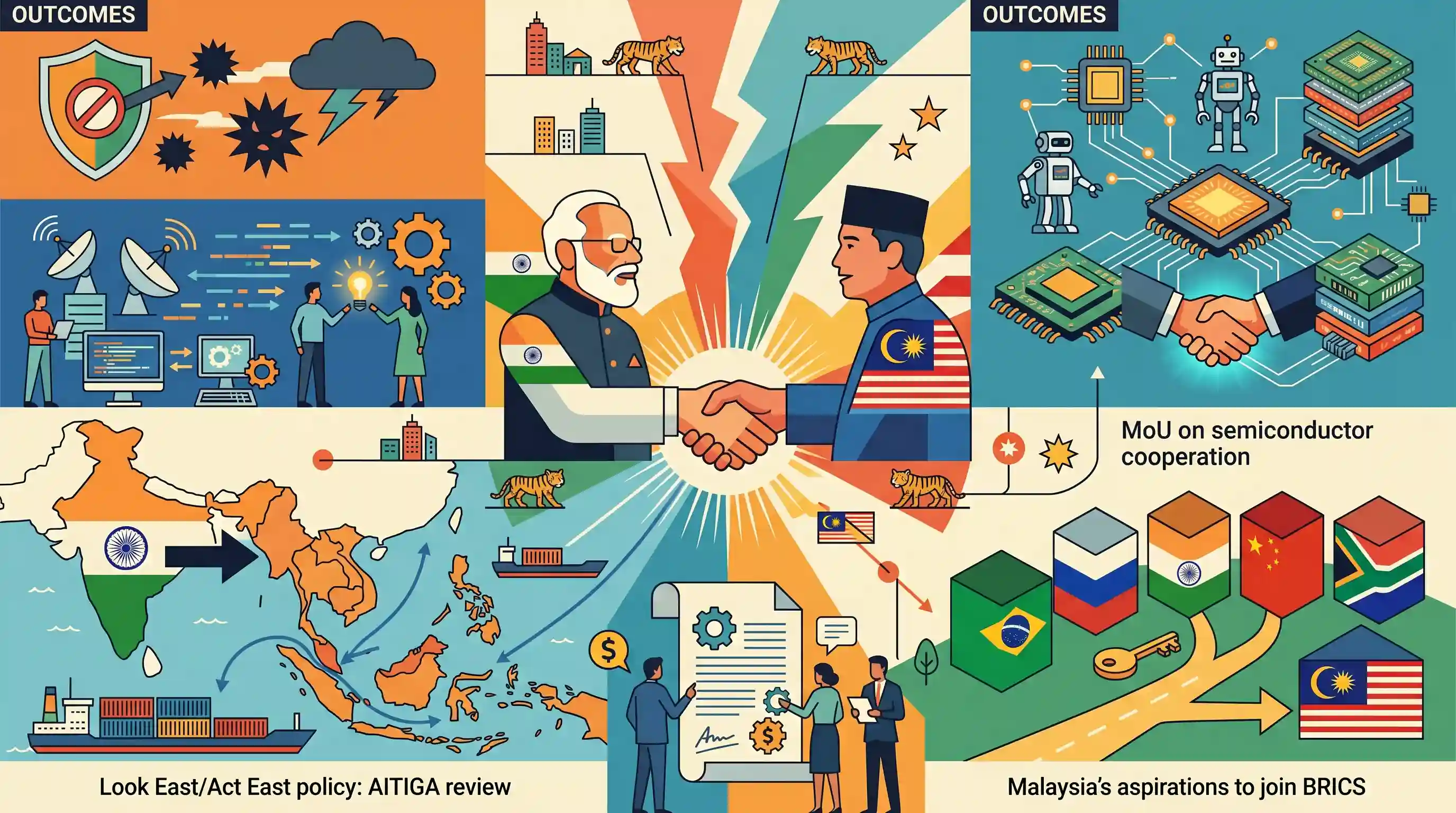
Prime Minister Narendra Modi's visit to Malaysia signifies a strategic push to mend bilateral relations that were strained over recent geopolitical remarks by the Malaysian leadership. The trip yielded concrete outcomes, including an unequivocal joint condemnation of cross-border terrorism, enhanced intelligence-sharing mechanisms, and an MoU on semiconductor cooperation. Furthermore, discussions touched upon Malaysia's aspirations to join BRICS and the critical need for India to actively engage in the review of the ASEAN-India Trade in Goods Agreement (AITIGA) to bolster its Look East / Act East policy.
Key Points
- Prime Minister Narendra Modi visited Malaysia as his first foreign trip in 2026 to repair strained bilateral ties.
- Relations had soured after Malaysian PM Anwar Ibrahim sought a "thorough enquiry" into the 2025 Pahalgam terror attacks and later hosted Pakistan's PM.
- A joint statement was issued unequivocally condemning terrorism and emphasizing intelligence sharing and coordination at FATF and the UN.
- An MoU on semiconductors was signed between IIT Madras Global and the Advanced Semiconductor Academy of Malaysia.
- India needs to reconsider its stance on the ASEAN-India Trade in Goods Agreement (AITIGA) review to strengthen regional trade integration.
- Malaysia expressed its aspiration to become a BRICS member, a bloc India will chair later this year.
Important Terms
ASEAN-India Trade in Goods Agreement (AITIGA)

A trade pact between India and the 10 ASEAN member states, effective since 2010, focused on reducing tariffs on tangible goods. It is currently under review to address India's widening trade deficit.
UPSC context
GS Paper II (International Relations) and GS Paper III (Economy). Relevant for understanding trade imbalances, FTAs, and India's economic integration with Southeast Asia.
ASEAN
A 10-member regional intergovernmental organization in Southeast Asia that promotes economic growth and regional stability. India maintains a Comprehensive Strategic Partnership with the bloc.
UPSC context
GS Paper II (Bilateral/Regional Groupings). Central to India's 'Act East Policy' and Indo-Pacific strategy. Tests knowledge of regional security and economic cooperation.
BRICS
An intergovernmental organization comprising major emerging economies (originally Brazil, Russia, India, China, South Africa). Malaysia is currently a 'Partner Country' and seeks full membership to diversify its geopolitical ties.
UPSC context
GS Paper II (International Groupings). Important for studying global governance reforms and India's role in the Global South.
Act East Policy
India's diplomatic initiative launched in 2014 to strengthen economic, strategic, and cultural ties with the Asia-Pacific region, evolving from the earlier 'Look East Policy' with a greater focus on security.
UPSC context
GS Paper II (India and its neighborhood). A pillar of Indian foreign policy tested via regional connectivity projects and maritime security cooperation.
IIT Madras Global
The international arm of the Indian Institute of Technology Madras, established to export Indian technical education and research excellence through offshore campuses and global academic partnerships.
UPSC context
GS Paper II (Issues relating to Education/Soft Power). Reflects India's 'Knowledge Diplomacy' and the internationalization of higher education.
Advanced Semiconductor Academy of Malaysia (ASEM)
A Malaysian institution dedicated to closing the talent gap in the semiconductor industry. It signed a landmark MoU with IIT Madras for skilling in chip design and computer architecture.
UPSC context
GS Paper III (Science & Technology/Economy). Significant for studying global supply chain resilience and bilateral high-tech cooperation.
Prelims Trap
"AITIGA is a comprehensive Free Trade Agreement covering goods, services, and investments between India and the ASEAN bloc."
AITIGA specifically governs only Trade in Goods (signed 2009). India and ASEAN negotiated and signed separate agreements for Services and Investments much later, in 2014.
Static Concepts Connected
What is the structure of the ASEAN-India Free Trade Area (AIFTA)?
- Trade in Goods: Governed by AITIGA (signed 2009, effective 2010), which is currently undergoing a crucial review to address India's growing trade deficit with the bloc.
- Services & Investments: Governed by separate agreements signed in 2014, upgrading the relationship to a more comprehensive economic partnership.
- Rules of Origin: A major friction point in AITIGA; India demands stricter value-addition norms to prevent third-party goods (like Chinese electronics) from entering duty-free.
What are the key stages in the global semiconductor value chain?
- Design: Involves creating the electronic circuits. This is highly skill-intensive and is India's primary strength globally, with a massive specialized engineering workforce.
- Fabrication (Fab): The actual manufacturing of chips in "foundries." It is extremely capital-intensive and historically dominated by Taiwan, South Korea, and the US.
- ATP / OSAT: The final stage of assembling, testing, and packaging chips. India and Malaysia are heavily focusing on building capacity in this exact segment.
Cross-Topic Patterns
Act East meets Critical Tech
India's Act East policy is evolving from traditional trade and connectivity to integrating critical technology supply chains, evidenced by the new semiconductor MoU between IIT Madras and Malaysia.
AITIGA review + China dumping bypass
The AITIGA review links directly to India's domestic manufacturing concerns. Lax "Rules of Origin" in the original pact have historically allowed Chinese goods to enter India duty-free via ASEAN.
BRICS Expansion & Middle Powers
Malaysia's BRICS aspiration reflects a broader trend of ASEAN middle powers seeking multipolar economic alignments to hedge against Western financial dominance and dollar dependency.

Expect a 2026 Prelims question linking ASEAN trade pacts (AITIGA vs Services) with India's evolving supply chain and tech strategies.
Linked PYQs · 4
Linked PYQs · 4
- 2011MainsGS2
Compared to the South Asian Free Trade Area (SAFTA), the Bay of Bengal Initiative for Multisectoral Technical and Economic Cooperation Free Trade Area (BIMSTEC FTA) seems to be more promising." Critically evaluate.
- 2012MainsGS2
Compare the significance of IBSA and BRICS in the context of India's multilateral diplomacy.
- 2022MainsGS3
Discuss the types of organised crimes. Describe the linkages between terrorists and organised crime that exist at the national and transnational levels.
- 2021MainsGS3
Analyse the complexity and intensity of terrorism, its causes, linkages and obnoxious nexus. Also suggest measures required to be taken to eradicate the menace of terrorism.
