Artificial Intelligence Application for Child Education
Source:Indian Express ↗
Why It Matters
The article highlights the expansion of Generative AI into early education and consumer markets. It touches upon crucial UPSC themes including the regulation of emerging technologies, the need for robust child safety frameworks in the digital age, and the ethical implications of algorithmic biases.
Summary
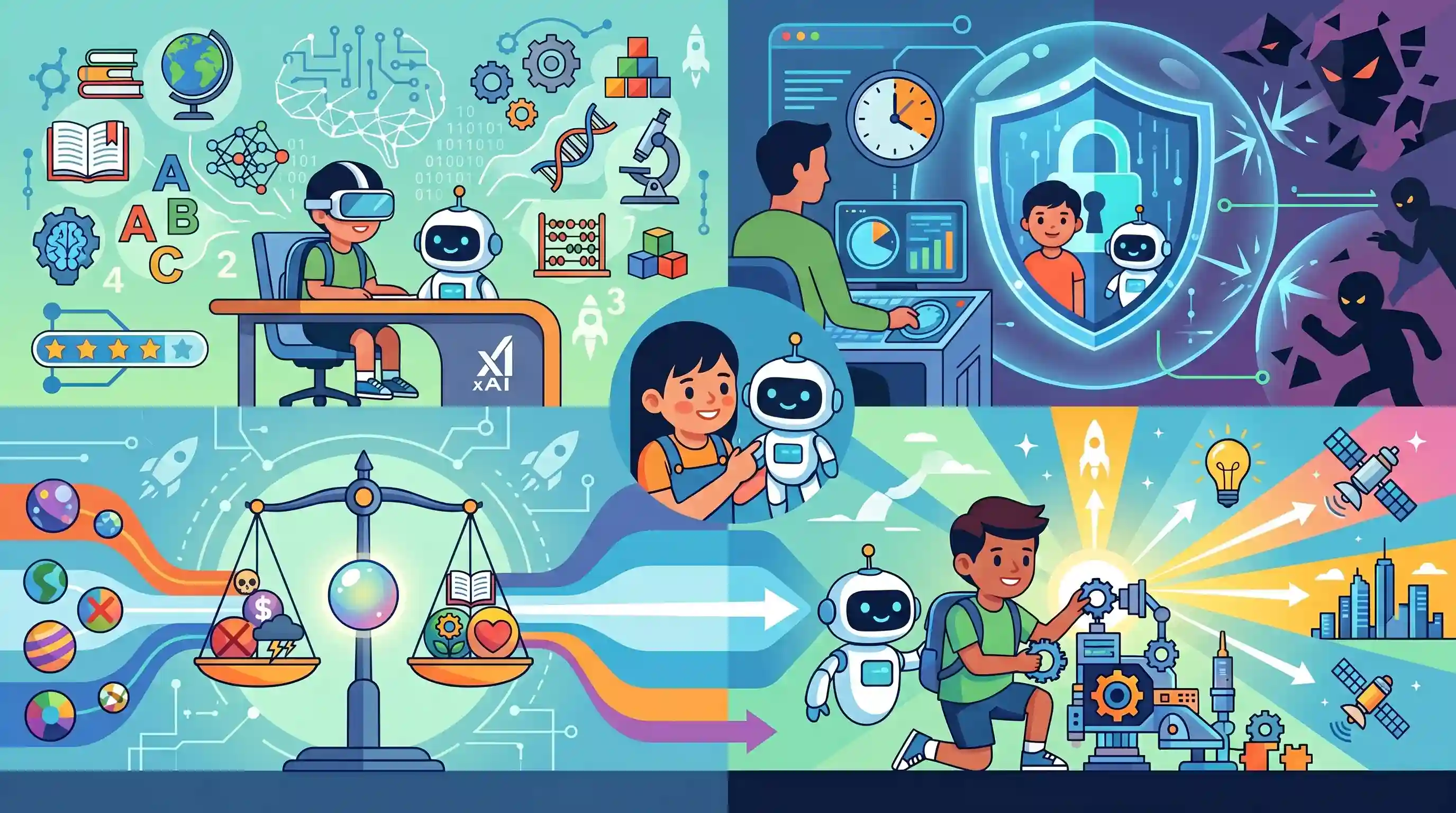
Elon Musk's xAI has announced "Baby Grok," a kid-friendly AI chatbot tailored to provide safe, educational, and interactive content for children. Positioned as a neutral alternative to existing models like ChatGPT and Gemini—which Musk criticizes for alleged ideological biases—the app features gamified learning and robust parental controls. It addresses critical contemporary issues regarding children's digital safety, screen time management, and the increasing reliance on AI as a tool for cognitive development and early education.
Key Points
- Elon Musk's xAI has introduced 'Baby Grok', a child-friendly version of its AI chatbot designed to serve as an educational tutor and companion.
- The platform emphasizes strict parental controls to manage screen time and filter out inappropriate material, directly responding to growing concerns about children's safety in the digital era.
- Musk positions Baby Grok as a neutral alternative to competitors like OpenAI's ChatGPT and Google's Gemini, which he accuses of having ideological or 'woke' biases.
- This development reflects the broader integration of Generative AI into personalized education, while simultaneously raising debates regarding algorithmic bias, tech dependence, and cognitive development in minors.
Important Terms
xAI

An AI startup founded by Elon Musk in 2023, focused on developing 'Grok.' It aims to create 'truth-seeking' AI models that challenge perceived ideological biases in mainstream technology.
UPSC context
GS Paper 3: Science & Tech; tests knowledge of private-sector roles in AI development and ethical debates on algorithmic neutrality.
OpenAI
The AI research organization behind ChatGPT. It catalyzed the global generative AI race, prompting international discussions on safety, regulatory frameworks, and the socio-economic impacts of automation.
UPSC context
GS Paper 3: IT & Computers; Paper 4: Ethics; focuses on technological breakthroughs and the ethics of artificial general intelligence.
Generative AI
A subset of AI that produces original content—such as text, images, or code—by learning patterns from massive datasets using large language models (LLMs).
UPSC context
GS Paper 3: Science & Technology; a core topic for applications, effects on everyday life, and potential for misinformation.
Baby Grok
A specialized, 'kid-friendly' AI chatbot announced by xAI designed for safe, educational, and gamified learning, featuring robust parental controls and moderated content filters.
UPSC context
GS Paper 2: Social Justice (Children's issues); GS Paper 3: Education/Technology; tests understanding of AI's role in cognitive development.
Child Online Safety
The regulatory and ethical framework focused on protecting minors from digital harms, including data profiling, age-inappropriate content, and AI-driven psychological manipulation.
UPSC context
GS Paper 3: Cyber Security; GS Paper 2: Governance; relevant for Digital India Act and NITI Aayog’s AI strategy.
Google (Alphabet)
The tech giant that developed Gemini, a multimodal AI model. Google represents the shift toward integrating generative AI into global search, education, and digital productivity tools.
UPSC context
GS Paper 3: IT & Computers; involves the role of multinational corporations in digital infrastructure and data privacy.
Prelims Trap
Under the DPDP Act 2023, educational AI apps are automatically exempt from obtaining verifiable parental consent for processing minors' data.
The DPDP Act 2023 strictly mandates verifiable parental consent for processing personal data of children (under 18) and bans behavioral monitoring, with no blanket exemptions for educational platforms.
Static Concepts Connected
How does the DPDP Act 2023 protect children's data?
- Parental Consent: Mandates verifiable parental consent before processing any personal data of a child (defined as an individual under 18 years).
- Negative List: Prohibits tracking, behavioral monitoring, targeted advertising, and any data processing likely to cause detrimental effect on a child's well-being.
- Government Exemptions: The government can lower the age of consent or exempt specific platforms if they are provably safe and verifiable.
What is 'Algorithmic Bias' in Artificial Intelligence?
- Definition: Systematic errors in AI systems creating unfair or skewed outcomes, usually stemming from prejudiced, incomplete, or unrepresentative underlying training data.
- Manifestation in LLMs: In Large Language Models, bias can manifest as generating culturally skewed content, reinforcing stereotypes, or exhibiting distinct ideological leanings.
- Mitigation Strategies: Mitigated through diverse training datasets, rigorous algorithmic auditing, and continuous reinforcement learning from human feedback (RLHF).
Cross-Topic Patterns
Generative AI and NEP 2020 objectives
AI tutors align with NEP 2020’s goal of personalized learning, but raise ethical concerns regarding cognitive tech-dependence and the erosion of organic socio-emotional development in minors.
Digital Child Rights and the DPDP Act
The deployment of child-facing AI tools directly intersects with the DPDP Act's strict ban on behavioral monitoring of minors, a regulatory area overseen by bodies like the NCPCR.

Algorithmic bias and the DPDP Act's mandates on verifiable parental consent are ripe for a multi-statement Prelims question in 2026.
Linked PYQs · 3
Linked PYQs · 3
- 2025MainsGS2
The National Commission for Protection of Child Rights has to address the challenges faced by children in the digital era. Examine the existing policies and suggest measures the Commission can initiate to tackle the issue.
- 2020PrelimsGS1
With the present state of development, Artificial Intelligence can effectively do which of the following? 1. Bring down electricity consumption in industrial units 2. Create meaningful short stories and songs 3. Disease diagnosis 4. Text-to-Speech Conversion 5. Wireless transmission of electrical energy Select the correct answer using the code given below:
- 2023MainsGS3
Introduce the concept of Artificial Intelligence (AI). How does Al help clinical diagnosis? Do you perceive any threat to privacy of the individual in the use of Al in healthcare?
