Ayush Ministry plans new Ayurveda institutes to boost integrative care
Source:The Hindu ↗
Why It Matters
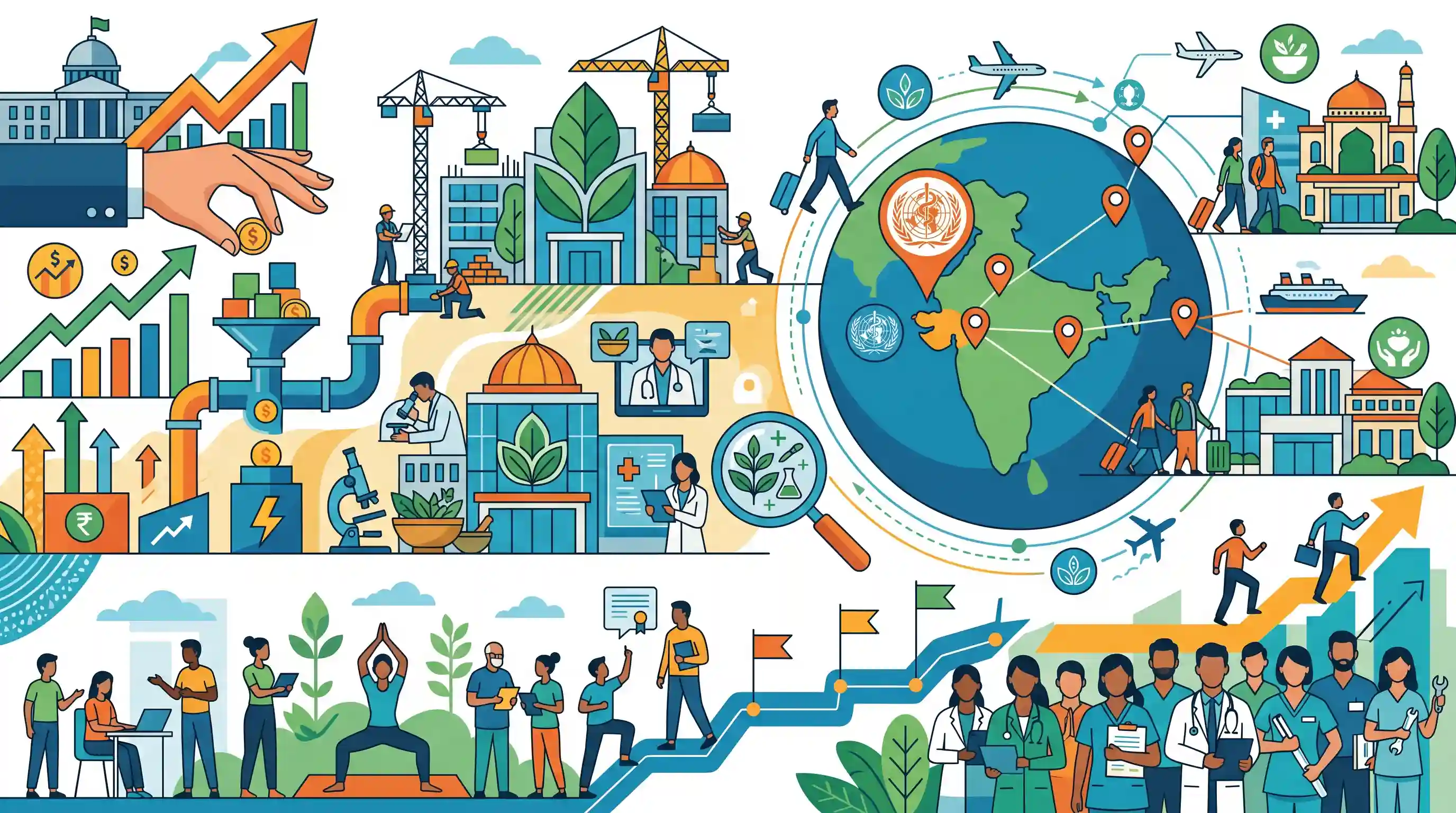
The mainstreaming of traditional medicine reflects a critical policy shift towards 'integrative healthcare'. By linking AYUSH to the National Skills Qualifications Framework (NSQF) and Medical Value Tourism, the government is simultaneously addressing public health infrastructure gaps, standardizing the unregulated wellness industry, and generating localized employment.
Summary
The Ministry of Ayush is seeking proposals to establish three new All India Institutes of Ayurveda (AIIAs) to promote evidence-based integrative healthcare. The initiative follows a 10% hike in the Ministry's budget to ₹4,408.93 crore in the 2026-27 Union Budget. Key focus areas include upgrading the WHO Global Traditional Medicine Centre in Jamnagar and incorporating AYUSH centres into five new Regional Medical Value Tourism Hubs that combine traditional therapies with advanced medical treatments. Additionally, to generate employment and professionalize the sector, yoga and wellness competencies are being aligned with the National Skills Qualifications Framework (NSQF) to train up to 1.5 lakh caregivers.
Key Points
- The Ministry of Ayush plans to set up three new All India Institutes of Ayurveda (AIIAs) following a 10% budget increase for the sector (₹4,408.93 crore) in the 2026-27 Union Budget.
- The WHO Global Traditional Medicine Centre in Jamnagar is slated for a major upgrade to bolster research, training, and global collaboration in traditional medicine.
- AYUSH centres will be integrated into five proposed Regional Medical Value Tourism Hubs, offering a blend of modern advanced medical treatment and traditional therapies.
- Yoga and wellness competencies will be included within the National Skills Qualifications Framework (NSQF) to standardize training for 1.5 lakh caregivers, formalizing employment in the wellness sector.
Important Terms
All India Institute of Ayurveda (AIIA)

Apex autonomous institutes under the Ministry of Ayush, established to provide tertiary-level healthcare, advanced research, and clinical education in Ayurveda, modeled after the All India Institute of Medical Sciences (AIIMS).
UPSC context
GS Paper 2: Issues relating to Health and Government policies; relevant for prelims (institutional setup) and mains (healthcare infrastructure).
Ministry of Ayush
A central ministry responsible for developing education, research, and the propagation of traditional Indian medicine systems: Ayurveda, Yoga & Naturopathy, Unani, Siddha, Sowa Rigpa, and Homeopathy.
UPSC context
GS Paper 2: Governance and Health; tests understanding of pluralistic healthcare and government interventions in social sectors.
WHO Global Traditional Medicine Centre (WHO GCTM)
The first and only global outposted knowledge centre for traditional medicine, established in Jamnagar, Gujarat, to build evidence-based standards, data analytics, and policies for traditional therapies worldwide.
UPSC context
GS Paper 2: International Relations and Health; highlights India’s global leadership in traditional medicine and collaboration with WHO.
Medical Value Tourism (MVT)
The practice of traveling across international borders to seek medical treatments or wellness therapies. India leverages its traditional AYUSH systems and cost-effective clinical care to become a global hub.
UPSC context
GS Paper 3: Economy (Services Sector) and GS Paper 2 (Health); tests potential for economic growth through health services.
National Skills Qualifications Framework (NSQF)
A competency-based framework that organizes qualifications into levels of knowledge, skills, and aptitude. It facilitates horizontal and vertical mobility between vocational training and formal academic education.
UPSC context
GS Paper 2: Education and Human Resources; GS Paper 3: Employment and Skilling; tests policies for professionalizing the workforce.
Prelims Trap
"The WHO Global Traditional Medicine Centre is a network of facilities distributed across Southeast Asia."
Aspirants often assume WHO centers are a distributed network. GCTM is uniquely the first and ONLY global outposted centre for traditional medicine.
Static Concepts Connected
What are the core features of the National Skills Qualifications Framework (NSQF)?
- Competency-based: Organizes qualifications into 10 levels based on progressive learning outcomes, mapping knowledge, skills, and aptitude.
- Mobility: Facilitates multiple entry and exit pathways between vocational education, skills training, and general academic education.
- Institutional backing: Notified in 2013, it supersedes earlier frameworks and is anchored by the National Council for Vocational Education and Training (NCVET).
How does India structurally promote Medical Value Tourism (MVT)?
- Heal in India: A unified digital repository to standardize treatment costs, quality, and integrate AYUSH therapies alongside allopathy for international patients.
- Medical Visas: Introduction of specialized e-Medical and e-Medical Attendant visas for citizens from over 150 countries to ease border friction.
- Ayush Integration: A specific visa category (Ayush Visa) and quality certification (Ayush Mark) specifically introduced for foreigners seeking traditional therapies.
Cross-Topic Patterns
Skilling meets Geriatric Health
Aligning AYUSH competencies with NSQF connects formal skilling (GS3) directly to the demographic shift and the rising demand for geriatric and non-communicable disease management (GS2).
Soft Power Institutionalization
India is moving beyond cultural diplomacy by embedding its civilizational heritage (Ayush) into concrete multilateral frameworks (WHO Jamnagar) and global trade services (Medical Value Tourism).

Expect a Prelims question combining the WHO Jamnagar Centre, 'Heal in India', and NSQF accreditation for AYUSH practitioners in 2026.
Linked PYQs · 4
Linked PYQs · 4
- 2017PrelimsGS1
With reference to 'National Skills Qualification Framework (NSQF)', which of the statements given below is/are correct? 1. Under NSQF, a learner can acquire the certification for competency only through formal learning. 2. An outcome expected from the implementation of NSQF is the mobility between vocational and general education. Select the correct answer using the code given below:
- 2018PrelimsGS1
With reference to Pradhan Mantri Kaushal Vikas Yojana, consider the following statements: 1. It is the flagship scheme of the Ministry of Labour and Employment. 2. It, among other things, will also impart training in soft skills, entrepreneurship, financial and digital literacy. 3. It aims to align the competencies of the unregulated workforce of the country to the National Skill Qualification Framework. Which of the statements given above is/are correct?
- 2024MainsGS2
In a crucial domain like the public healthcare system the Indian State should play a vital role to contain the adverse impact of marketisation of the system. Suggest some measures through which the State can enhance the reach of public healthcare at the grassroots level.
- 2022MainsGS3
The increase in life expectancy in the country has led to newer health challenges in the community. What are those challenges and what steps need to be taken to meet them?
