Ayodhya Ram Temple Donation Staff Resignations and Audit
Source:thefederal ↗
Why It Matters
This incident highlights issues regarding accountability, administrative security, and transparency in managing high-volume religious trust finances in major cultural and tourism centers like Ayodhya. In the UPPSC exam, this connects with governance, state schemes supporting religious tourism (like Swami Vivekanand Etihasik Paryatan Yatra Yojna), and urban development programs (like HRIDAY).
Summary
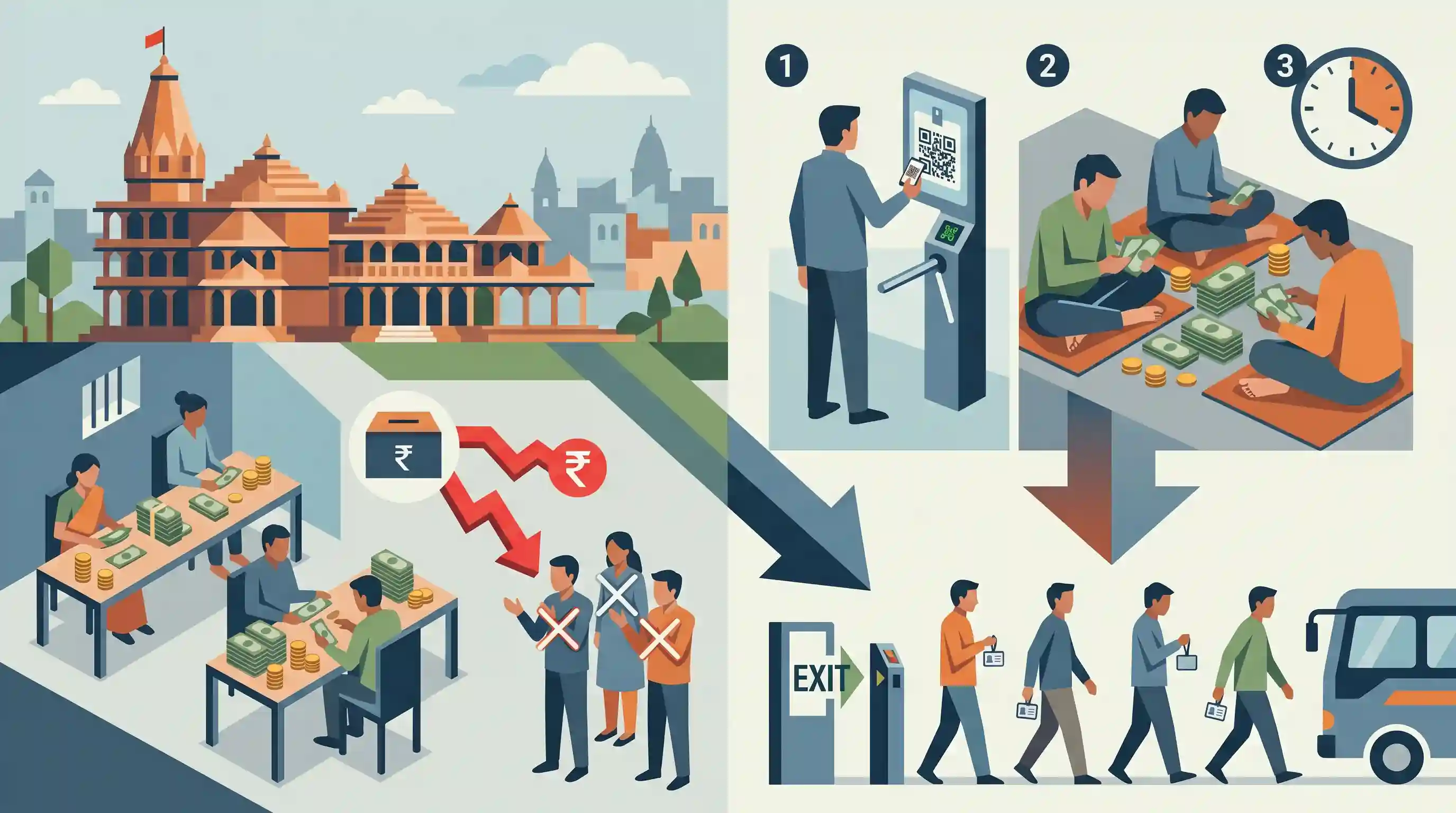
Nearly 20 donation-counting staff at the Ayodhya Ram Temple resigned after an embezzlement probe exposed the siphoning off of cash offerings before they reached bank deposits. The Shri Ram Janmabhoomi Teerth Kshetra Trust has implemented stringent security measures (including digital entry tracking, barefoot counting, and QR-coded security IDs), which, coupled with fear and longer single shifts, triggered the mass exit of counting personnel.
Key Points
- Over half of the donation-counting staff (nearly 20 out of 40) at the Ayodhya Ram Temple have resigned following an investigation into the embezzlement of offerings.
- The embezzlement probe centers on the alleged siphoning of devotees' offerings before they were deposited into bank accounts. Eight individuals involved in the handling and counting of donations have been arrested.
- To curb financial leakage, the Shri Ram Janmabhoomi Teerth Kshetra Trust has tightened protocols, reducing counting to a single 9-10 hour shift performed barefoot on the floor.
- New security measures include QR-coded ID cards with digital security features, multi-layered frisking, bans on mobile phones and personal belongings, uniform policies for outsourced staff, and a digital entry-exit tracking system.
- The resignations were driven by increased workload, long hours without salary increments, and fear associated with the police investigation.
Important Terms
Shri Ram Janmabhoomi Teerth Kshetra Trust

An autonomous 15-member trust set up by the Indian Government in 2020 following a Supreme Court verdict to construct, manage, and administer the Ram Mandir complex in Ayodhya.
UPSC context
GS Paper II (Executive Bodies, Dispute Resolution); tests understanding of landmark judicial rulings, executive schemes, and the governance of public-religious trusts.
Heritage City Development and Augmentation Yojana (HRIDAY)
A central sector scheme launched in 2015 by the Ministry of Housing and Urban Affairs to preserve, revitalize, and integrate India's rich heritage character with urban infrastructure and economic planning.
UPSC context
GS Paper I (Heritage & Culture) and GS Paper II (Government Schemes); tests concepts of holistic urban rejuvenation and heritage conservation.
Uttar Pradesh Swami Vivekanand Etihasik Paryatan Yatra Yojna 2021
A state government scheme providing ₹12,000 financial assistance to registered laborers in the unorganized sector for undertaking historical and religious pilgrimages to cultural sites across Uttar Pradesh.
UPSC context
GS Paper II (Welfare Schemes); tests knowledge of state-level social security initiatives, worker welfare, and the promotion of religious tourism.
Uttar Pradesh Labour Welfare Board
A statutory body established under the UP Labour Welfare Fund Act, 1965, responsible for administering welfare funds to implement social security, educational, and recreational schemes for state workers.
UPSC context
GS Paper II (Statutory Bodies, Welfare Schemes); tests comprehension of labor welfare mechanisms and state-level institutional frameworks for unorganized labor.
Prelims Trap
Ayodhya was one of the core heritage cities selected and revitalized under the HRIDAY scheme.
Ayodhya was never part of HRIDAY (2015-2019); only Mathura and Varanasi from UP were included. HRIDAY concluded before the Ayodhya temple development began.
Static Concepts Connected
What defines a 'public authority' under Section 2(h) of the RTI Act, 2005?
- Constitutional/Statutory origin: Bodies established by the Constitution, parliamentary/state laws, or notifications issued by the appropriate government.
- Government control: Institutions owned, controlled, or substantially financed directly or indirectly by government funds.
- Substantial funding: Non-government organizations (NGOs) that receive significant government funding also fall under the RTI Act's ambit.
How do statutory temple boards differ from private/non-statutory religious trusts in India?
- Legislative creation: Statutory boards (like Tirupati or Vaishno Devi) are created by dedicated state laws, enabling direct government administrative supervision.
- Trust governance: Non-statutory trusts operate under general trust deeds, where government nominees often lack voting rights and vacancies are filled internally.
Cross-Topic Patterns
State patronage vs Secularism
Examines the limits of state regulatory intervention in secular matters (like finances) of religious institutions under Articles 25 and 26 of the Constitution.
Labor welfare through spiritual tourism
Linking industrial labor welfare schemes (like Swami Vivekanand Yatra Yojna) to boost local service economies in major cultural hubs.

RTI applicability to public-private religious trusts and HRIDAY target cities will likely feature in a 2026 GS-2 or Prelims paper.
Linked PYQs · 2
Linked PYQs · 2
- 2020UPPSC_PRELIMSGS1
Which of the following cities of Uttar Pradesh is/are covered under the 'Heritage City Development and Augmentation Yojana (HRIDAY)' ? 1. Varanasi 2. Mathura 3. Prayagraj 4. Ayodhya Select the correct answer from the codes given below.
- 2021UPPSC_PRELIMSGS1
'Uttar Pradesh Swami Vivekanand Etihasik Paryatan Yatra Yojna 2021' was introduced by the U.P. Government for which of the following people for religious travel ?
