SIT Submits Preliminary Report on Ayodhya Ram Temple Donations
Source:The Hindu ↗
Why It Matters
This case touches upon state administrative actions, the legal accountability of publicly and government-mandated trusts (established under the 2019 Supreme Court verdict), and broader issues of governance, financial transparency, and administrative reforms in Uttar Pradesh. Such developments often form the core of current-affairs based polity and administrative questions in the UPPSC PCS Prelims.
Summary
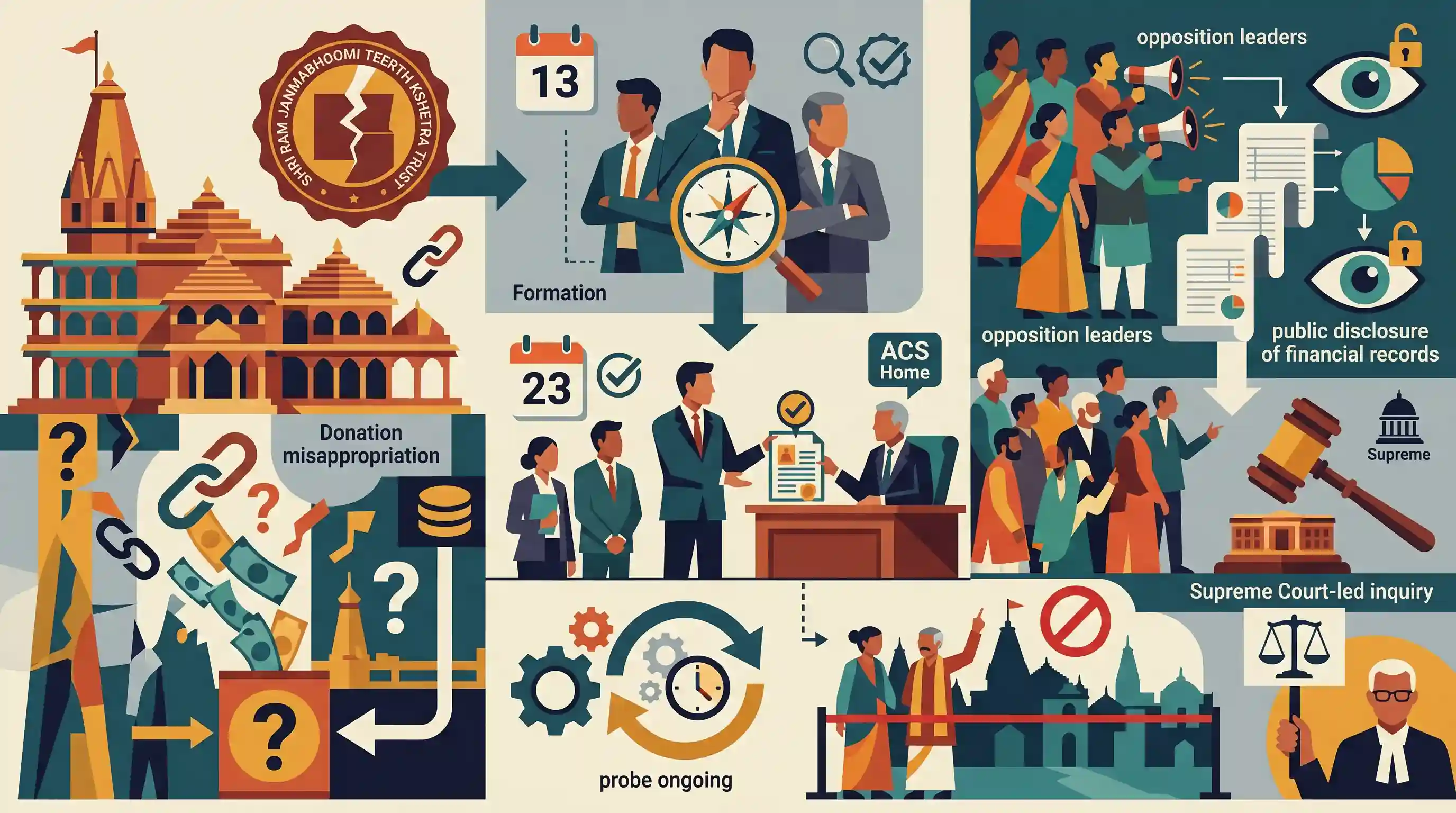
The Special Investigation Team (SIT) led by Lucknow Division Commissioner Vijay Vishwas Pant submitted its preliminary report on June 23, 2026, to Sanjay Prasad, the Additional Chief Secretary (Home) of Uttar Pradesh. The SIT was established on June 13, 2026, by the state government following allegations of donation misappropriation at the Ayodhya Ram Temple. The probe remains ongoing, with temple functionaries instructed to remain in Ayodhya, while opposition leaders demand a public disclosure of financial records and a Supreme Court-led inquiry.
Key Points
- The Special Investigation Team (SIT) probing irregularities in donations at the Ayodhya Ram Temple submitted its preliminary report to the Uttar Pradesh government on June 23, 2026.
- The SIT was constituted on June 13, 2026, by the U.P. government following a formal request by the temple trust amidst allegations of financial misappropriation.
- The investigation team, led by Lucknow Division Commissioner Vijay Vishwas Pant, submitted the document directly to the Additional Chief Secretary (Home), Sanjay Prasad.
- SIT officials have instructed trust and temple functionaries not to leave Ayodhya while the investigation continues and additional facts are gathered.
- Opposition parties, specifically senior Congress leader Ajay Kumar Lallu, have demanded that the report, bank statements, and CCTV footage of monetary transactions be made public, and called for a Supreme Court judge-led inquiry.
Important Terms
Shri Ram Janmabhoomi Teerth Kshetra Trust

A 15-member trust established by the Government of India in 2020 to supervise and manage the construction of the Ram Mandir in Ayodhya, following the Supreme Court's 2019 verdict.
UPSC context
GS Paper II (Governance) & GS Paper I (Culture); tests knowledge of temple administration, public trusts, and executive implementation of judicial orders.
Special Investigation Team (SIT)
A specialized, temporary team of law enforcement officers appointed ad hoc by courts or governments in India to conduct impartial, focused investigations into highly complex or sensitive cases.
UPSC context
GS Paper II (Criminal Justice & Governance); tests mechanisms of police administration, executive accountability, and judicial oversight over specialized probes.
Public Trust
A legal entity created for charitable or religious purposes to benefit the general public, regulated under the Indian Trusts Act, 1882, the Charitable and Religious Trusts Act, 1920, or state-specific legislations.
UPSC context
GS Paper II (Governance & Transparency); tests mechanisms of non-governmental organizations, statutory regulations of religious/charitable assets, and administrative accountability.
Uttar Pradesh Government
The executive authority of the Indian state of Uttar Pradesh, empowered to maintain law and order, police administration, and oversee the regulation of local public trusts under the Seventh Schedule.
UPSC context
GS Paper II (Federalism & State Legislature); tests state-level executive powers, federal relations, and governance of regional religious or charitable institutions.
Prelims Trap
A trust holding an FCRA license can receive foreign contributions directly into any designated account in any scheduled commercial bank branch.
Under the amended FCRA (Section 17), all primary foreign contributions must be received exclusively in the designated SBI Main Branch, New Delhi, not directly into any other local branch or bank.
Static Concepts Connected
What is the legal status and powers of a Special Investigation Team (SIT) in India?
- Legal Basis: An SIT is an ad-hoc body with no dedicated statutory Act, created via executive power or judicial orders.
- Investigative Powers: Investigating officers exercise the statutory powers of a police officer-in-charge under the BNSS, 2023 (formerly CrPC).
- Accountability: It must submit its final report to the directing court or the concerned executive authority.
What are the key features of the Gurjara-Chaulukya (Solanki) sub-style of Nagara architecture?
- Material Usage: Avoids the use of iron or steel, utilizing stone-to-stone interlocking and traditional joinery.
- Ornamentation: Features highly ornate, elevated plinths (jagati) and intricately carved exterior walls.
- Structural Layout: Incorporates multi-tiered pillared halls (mandapas) with distinctive stepped, octagonal ceilings.
Cross-Topic Patterns
FCRA compliance in Public Trusts
Strict regulatory monitoring of foreign funding in religious and charitable trusts highlights the intersection of public administration, national security, and civil society governance.
Epigraphical records and post-Mauryan legitimacy
Linking epigraphical evidence like the Dhanadeva inscription to the Shunga dynasty's revival of Vedic orthodox rituals to secure political legitimacy post-Maurya.

Expect UPSC to test the specific post-Mauryan Dhanadeva inscription alongside Nagara architectural sub-styles in 2026.
Linked PYQs · 3
Linked PYQs · 3
- 1997UPPSC_PRELIMSGS1
The temples of Bhuvaneshwar and Puri were built in:
- 2018UPPSC_PRELIMSGS1
Which of the following inscriptions gives the information about two Ashvamedha Yajna performed by the King Pushyamitra Shunga?
- 2019UPPSC_PRELIMSGS1
Mazdoor Kisan Shakti Sangathan (MKSS), a Social Movement has been associated with which of the following in India?
