Ayodhya Temple Trust Donation Embezzlement and Police Raids
Source:The Hindu ↗
Why It Matters
This news highlights the administrative and financial governance of major religious institutions such as the Shri Ram Janmabhoomi Teerth Kshetra Trust. For UPPSC Prelims, understanding the background of the trust, the geographical significance of Ayodhya (Sarayu River), and legal/administrative concepts like judicial vs. police custody are highly relevant.
Summary
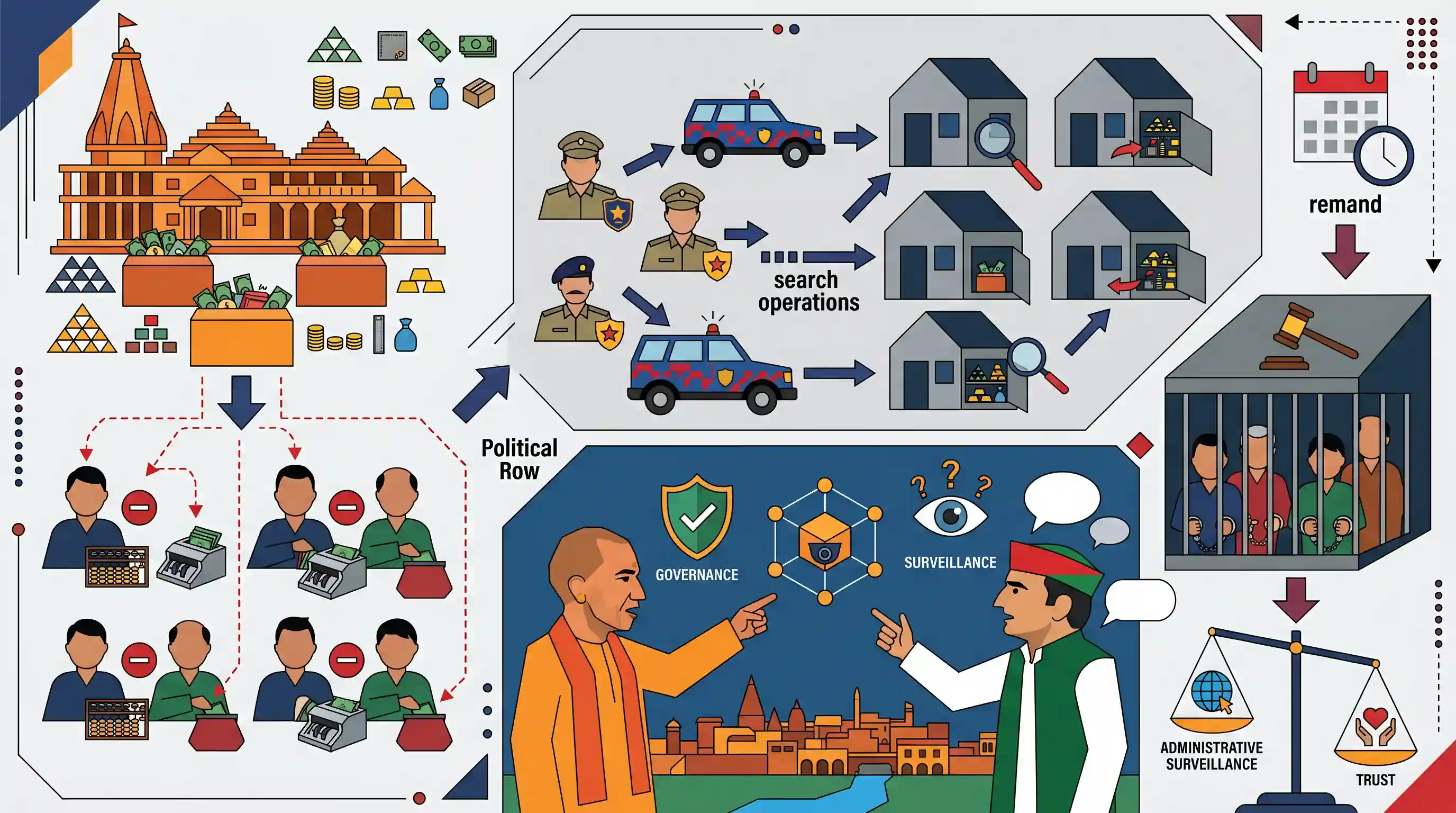
The article reports on the search operations conducted by the Ayodhya Police at the residences of eight accused in the alleged embezzlement of donations at the Ram Temple. The accused, who were responsible for counting temple cash and valuables, have been remanded to judicial custody. The case has also sparked a political row between UP Chief Minister Yogi Adityanath and Samajwadi Party leader Akhilesh Yadav over administrative surveillance and governance in Ayodhya.
Key Points
- The Ayodhya Police conducted searches at the residences of eight accused in connection with the alleged embezzlement of donations received at the Ram Temple in Ayodhya.
- One of the accused is Ramashankar Yadav, a close aide of Champat Rai, the General Secretary of the Shri Ram Janmabhoomi Teerth Kshetra Trust.
- The eight accused were associated with counting cash and valuables at the temple and have been remanded to judicial custody.
- The police have recovered ₹79.85 lakh from the possession of the accused so far.
- The development has led to an intense political confrontation between Chief Minister Yogi Adityanath and Samajwadi Party president Akhilesh Yadav regarding the governance, security, and integrity of religious developments in Ayodhya.
Important Terms
Shri Ram Janmabhoomi Teerth Kshetra Trust

A 15-member trust established by the Government of India in 2020 following the Supreme Court's Ayodhya verdict, responsible for managing the construction and administration of the Ram Mandir in Ayodhya.
UPSC context
GS Paper II: Polity and Governance, testing statutory/non-statutory bodies, trusts, and administrative transparency of public charitable institutions.
Bharatiya Nagarik Suraksha Sanhita (BNSS)
The primary procedural law in India governing criminal investigations, arrests, and trials, which replaced the Code of Criminal Procedure (CrPC), 1973, in July 2024 to modernize criminal justice delivery.
UPSC context
GS Paper II: Polity and Governance, testing criminal justice reforms, judicial procedures, police accountability, and fundamental rights of undertrials.
Supreme Court Ayodhya Verdict (2019)
A landmark unanimous judgment by a five-judge Constitution Bench of the Supreme Court of India that resolved the long-standing Ayodhya land dispute, awarding the land to a trust and invoking Article 142.
UPSC context
GS Paper II: Indian Constitution and Judiciary, focusing on secularism, basic structure, judicial review, and the scope of Article 142.
Samajwadi Party
A recognized regional political party in India, active primarily in Uttar Pradesh, registered under the Representation of the People Act, 1951, and recognized by the Election Commission of India.
UPSC context
GS Paper II: Indian Polity, testing electoral systems, political parties, criteria for state-party recognition, and Representative of the People Act provisions.
Bharatiya Janata Party
One of India's major recognized national political parties, registered under the Representation of the People Act, 1951, and recognized by the Election Commission based on its multi-state electoral performance.
UPSC context
GS Paper II: Indian Polity, testing the multi-party system, criteria for national party recognition, and the dynamics of electoral politics.
Prelims Trap
Because the Ram Mandir Trust was established under a Supreme Court directive, it is legally classified as a public authority under the RTI Act.
The trust is an independent, autonomous body that is neither owned, controlled, nor substantially financed by any government, exempting it from Section 2(h) of the RTI Act.
Static Concepts Connected
What is the legal status of a consecrated Hindu deity regarding property ownership?
- Juristic Person: A consecrated deity is recognized as a legal/juristic entity capable of holding property, suing, and being sued in a court of law.
- Perpetual Minor: The law treats the deity as a perpetual minor, meaning its properties are managed by a shebait (manager) acting as a legal fiduciary.
- Sacred Trust Property: Donations made to the deity belong to the deity itself, not the private administrators or trustees who manage the estate.
Can the CAG automatically audit autonomous religious trusts?
- Funding Nexus: The CAG (Articles 148–151) lacks automatic jurisdiction over autonomous trusts that do not receive substantial government funding or grants.
- Enabling Conditions: An audit of such trusts requires explicit state legislation or a direct order from the Supreme Court using its Article 142 powers.
Cross-Topic Patterns
Legal Personhood: Deities vs. Rivers
Contrasts the established jurisprudence of deities as juristic persons with the contested legal personhood of natural entities like the Ganga and Yamuna rivers.
RTI Scope and Court Mandates
Explores why court-ordered bodies (like BCCI or the Ram Mandir Trust) remain outside the RTI Act unless they meet the financial dependency test of Section 2(h).

Distinctions between public authorities and court-mandated private trusts under RTI and CAG will likely feature in a 2026 GS-2 paper.
Linked PYQs · 2
Linked PYQs · 2
- 2020UPPSC_PRELIMSGS1
Which of the following is not a correct match?
- 2023UPPSC_PRELIMSGS1
Which of the following statement is correct? (1) Ram Ganga river joins the Ganga at Kannauj. (2) River Betwa joins the Yamuna near Prayagraj. Select the correct answer using the code given below –
