Political legacy and regional strategy of Iran leadership
Source:The Hindu ↗
Why It Matters
Iran is a pivotal player in Middle Eastern geopolitics. Its political stability, foreign policy, and proxy networks under Khamenei directly influence global energy markets, regional security dynamics, and India's strategic interests, including investments like the Chabahar Port and the International North-South Transport Corridor (INSTC).
Summary
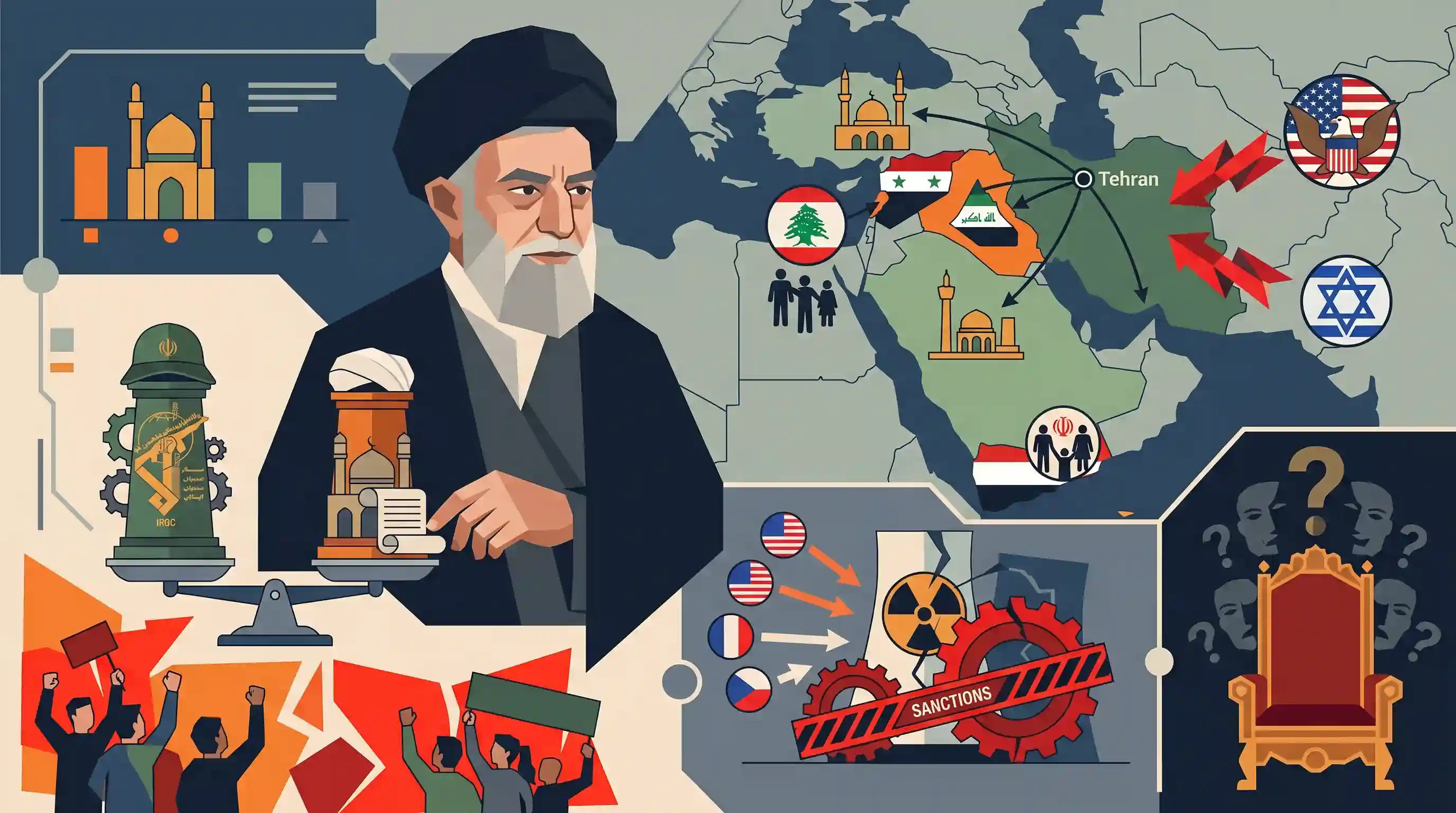
The article analyzes the legacy and leadership of Ayatollah Ali Khamenei, the Supreme Leader of Iran, detailing how he reshaped the Islamic Republic's domestic and foreign policies. It highlights his role in expanding Iran's regional influence through the 'Axis of Resistance' to counter the United States and Israel, and his complex maneuvering amidst severe Western sanctions and the JCPOA nuclear negotiations. Domestically, it examines his strategy of balancing the IRGC with clerical institutions to maintain control, despite facing significant internal unrest and protests over socio-economic issues. The piece concludes by touching upon the critical succession debate and its potential impact on Middle Eastern stability.
Key Points
- Ayatollah Ali Khamenei consolidated the Islamic Republic's power by balancing clerical authority with the rising influence of the Islamic Revolutionary Guard Corps (IRGC).
- He established and expanded the 'Axis of Resistance', a network of proxy forces across the Middle East, to counter US and Israeli influence and project Iranian power.
- Khamenei's leadership has been marked by navigating severe Western sanctions over Iran's nuclear ambitions, while occasionally allowing pragmatic negotiations like the JCPOA.
- His tenure faces significant domestic challenges, including widespread protests driven by economic hardship and demands for social freedoms, highlighting a growing disconnect with younger generations.
- The impending question of succession poses major implications for the future stability of Iran and the broader Middle Eastern geopolitical landscape.
Important Terms
Joint Comprehensive Plan of Action (JCPOA)

A landmark 2015 agreement between Iran and the P5+1 (US, UK, France, Russia, China, and Germany) to limit Iran's nuclear program in exchange for lifting economic sanctions.
UPSC context
GS Paper II: Important for International Relations, nuclear non-proliferation, and India’s energy security and strategic interests in West Asia.
Islamic Revolutionary Guard Corps (IRGC)
An elite multi-service branch of the Iranian Armed Forces established in 1979 to protect the Islamic system from internal and external threats. It wields significant economic and regional power.
UPSC context
GS Paper II & III: Relevant to West Asian geopolitics, regional security, and the impact of foreign entities on India's interests.
Axis of Resistance
A loose informal alliance of state and non-state actors (e.g., Hezbollah, Hamas, Syrian government) led by Iran, aimed at countering Western and Israeli influence in the Middle East.
UPSC context
GS Paper II: Critical for understanding regional power dynamics, proxy warfare, and India's diplomatic balancing act in West Asia.
Supreme Leader (Rahbar)
The highest political and religious authority in Iran, serving as the Head of State and Commander-in-Chief. The leader has final authority over all domestic and foreign policies.
UPSC context
GS Paper II: Relevant for comparing political systems and understanding the centralized decision-making structure of a key regional partner.
Assembly of Experts
An 88-member deliberative body of clerics tasked with electing, overseeing, and potentially dismissing the Supreme Leader. It plays a pivotal role in the leadership succession process.
UPSC context
GS Paper II: Important for understanding Iran's constitutional framework and the institutional mechanisms governing political stability and succession.
Prelims Trap
"The JCPOA is a bilateral nuclear treaty signed between the USA and Iran."
Aspirants often forget the JCPOA was a multilateral agreement involving the P5+1 (US, UK, France, Russia, China, Germany) and the EU, not just a US-Iran deal.
Static Concepts Connected
What is the Joint Comprehensive Plan of Action (JCPOA)?
- Multilateral Agreement: Signed in 2015 between Iran and the P5+1 (China, France, Russia, UK, US, Germany) plus the European Union.
- Core Objective: Aimed to severely limit Iran's civilian nuclear program and increase UN IAEA monitoring in exchange for relief from international economic sanctions.
- Current Status: The agreement was effectively disrupted after the United States unilaterally withdrew in 2018 under the Trump administration, prompting Iran to breach uranium enrichment limits.
How does Iran fit into India's INSTC strategy?
- INSTC Overview: A 7,200-km multi-mode route (ship, rail, road) connecting India to Russia and Europe via Iran and Azerbaijan, bypassing the congested Suez Canal.
- Transit Hub: Iran provides the critical maritime-to-land transit bridge. India's investments in Iran's Chabahar port are meant to link with the INSTC to access Central Asian markets.
- Sanction Hurdles: US sanctions on Iran have historically delayed infrastructure funding and complicated the logistics of fully operationalizing the Iranian leg of the corridor.
Cross-Topic Patterns
Middle East proxies vs. India's connectivity
The rising instability from Iran's 'Axis of Resistance' directly complicates India's geoeconomic investments in Chabahar Port and the INSTC, severely testing New Delhi's delicate balancing act in West Asia.
Sanctions and Rupee-Rial trade mechanisms
Western sanctions on Iran previously forced India to explore a Rupee-Rial payment mechanism, connecting this geopolitical issue directly to UPSC's macro-economic focus on Vostro accounts and de-dollarization.

Mapping Middle East proxies (Houthis, Hezbollah) alongside India's connectivity nodes (Chabahar, INSTC) is highly likely in 2026 Prelims.
Linked PYQs · 3
Linked PYQs · 3
- 2025MainsGS2
"Energy security constitutes the dominant kingpin of India's foreign policy, and is linked with India's overarching influence in Middle Eastern countries.” How would you integrate energy security with India's foreign policy trajectories in the coming years?
- 2018MainsGS2
“India’s relations with Israel have, of late, acquired a depth and diversity, which cannot be rolled back.” Discuss.
- 2023PrelimsGS1
Consider the following pairs: Area of conflict mentioned in news Country where it is located 1. Donbas : Syria 2. Kachin : Ethiopia 3. Tigray : North Yemen How many of the above pairs are correctly matched?
