Indian Astronaut Mission to International Space Station
Source:The Hindu ↗
Why It Matters
This marks a major milestone in India's space endeavors, serving as a critical precursor to the indigenous Gaganyaan mission. The microgravity experiments conducted will enhance India's capabilities in space biology and human survival in space environments.
Summary
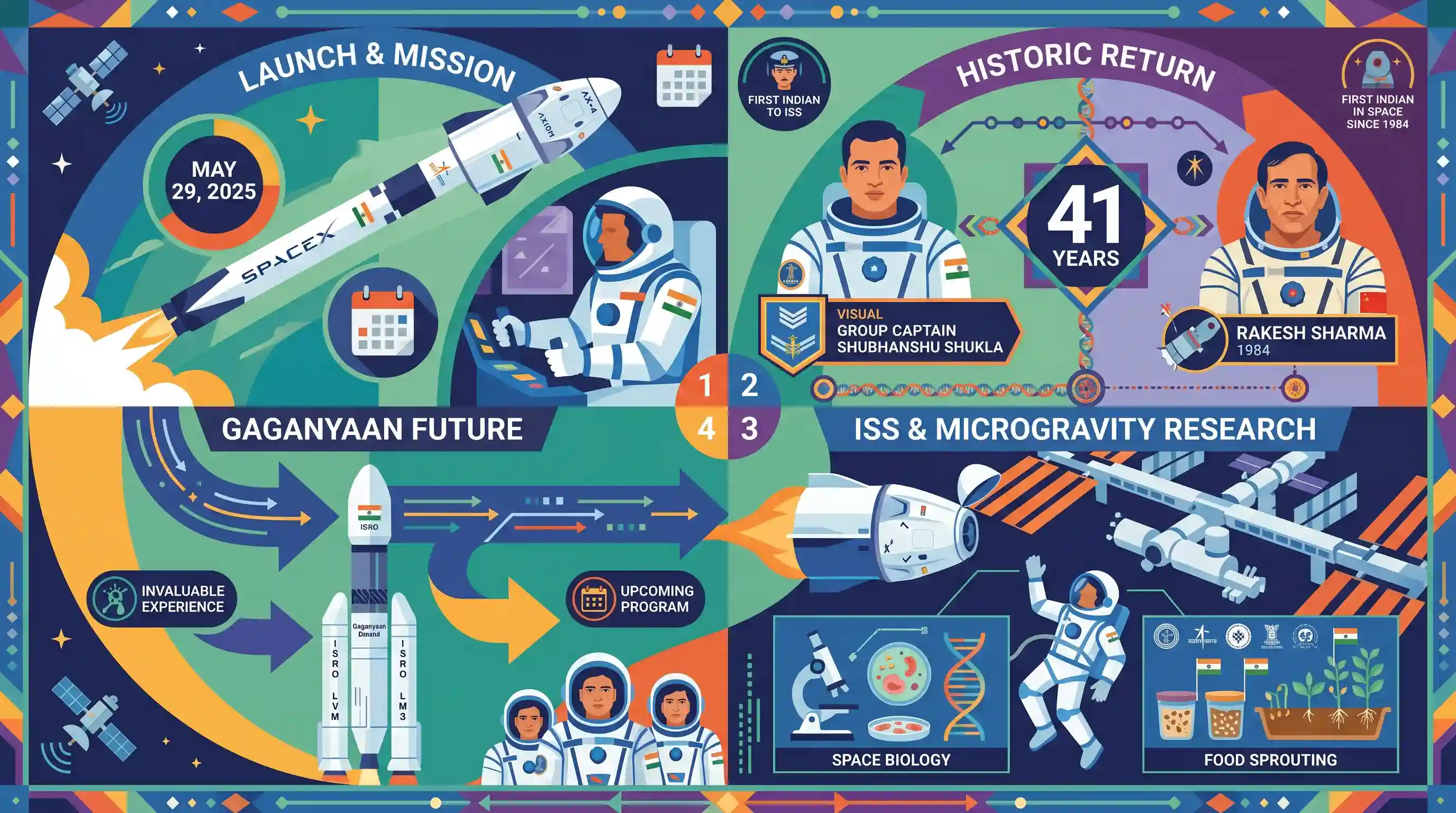
Indian astronaut-designate Group Captain Shubhanshu Shukla will embark on a historic journey to the International Space Station (ISS) aboard the commercial Axiom-4 (Ax-4) mission on May 29, 2025. Launching via a SpaceX Dragon spacecraft, he will become the first Indian to visit the ISS and the first Indian in space since Rakesh Sharma in 1984. Serving as a mission specialist, Shukla will conduct various microgravity experiments proposed by Indian researchers, including studies on space biology and food sprouting. This mission is expected to provide invaluable experience for ISRO's upcoming Gaganyaan human spaceflight program.
Key Points
- Group Captain Shubhanshu Shukla is set to fly to the International Space Station (ISS) on May 29, 2025, as part of the commercial Axiom-4 (Ax-4) mission.
- He will be the first Indian astronaut to visit the ISS and the first Indian to travel to space in 40 years, following Rakesh Sharma's historic flight in 1984.
- Shukla, an astronaut-designate for ISRO's Gaganyaan mission, will gain crucial spaceflight experience that will benefit India's upcoming indigenous human spaceflight program.
- The mission will launch from NASA's Kennedy Space Center in Florida using a SpaceX Falcon 9 rocket and a Dragon spacecraft.
- During his time on the ISS, Shukla will conduct several microgravity experiments proposed by Indian scientists, focusing on muscle regeneration, cyanobacteria, tardigrades, and India-centric food sprouting (green gram and fenugreek).
Important Terms
Axiom-4 (Ax-4) mission

A commercial human spaceflight mission to the ISS in 2025, notable for carrying Indian astronaut Shubhanshu Shukla as pilot, facilitating international scientific research and technology demonstrations.
UPSC context
GS Paper 3 (Space Technology); tests international space diplomacy and India’s growing role in commercial human spaceflight.
Gaganyaan mission
India's first indigenous human spaceflight program by ISRO, aimed at demonstrating human spaceflight capability by sending a three-member crew to Low Earth Orbit for a three-day mission.
UPSC context
GS Paper 3 (Indigenization of Technology); crucial for topics on national prestige, technological self-reliance, and space exploration.
ISRO (Indian Space Research Organisation)
The premier Indian space agency responsible for space research, satellite communication, and planetary exploration, currently spearheading the Gaganyaan program and international collaborative missions.
UPSC context
GS Paper 3 (S&T Institutions); fundamental for understanding India’s space infrastructure and major technological milestones.
Axiom Space
A private American space infrastructure company that organizes commercial astronaut missions to the ISS and is developing the first commercial space station.
UPSC context
GS Paper 3 (Space Technology); relevant for understanding the global trend of space commercialization and private-public partnerships.
SpaceX
A private US aerospace company that provides the Falcon 9 rocket and Dragon spacecraft used for the Axiom-4 mission and NASA’s crewed flights.
UPSC context
GS Paper 3 (Space Technology); significant for developments in reusable launch vehicle technology and private-sector roles in exploration.
International Space Station (ISS)
A collaborative modular research facility in Low Earth Orbit, serving as a laboratory for experiments in biology, physics, and materials science under microgravity.
UPSC context
GS Paper 3 (Science & Tech); key for international cooperation and the environment for cutting-edge space research.
Microgravity Research
Scientific experiments conducted in near-zero gravity to study biological and physical processes that behave differently than they do under Earth's dominant gravitational force.
UPSC context
GS Paper 3 (Science & Technology); focuses on the application of space science in medicine, agriculture, and material engineering.
Prelims Trap
Rakesh Sharma was the first Indian astronaut to visit the International Space Station (ISS) in 1984.
Rakesh Sharma travelled aboard a Soviet Soyuz mission to the Salyut-7 space station, not the ISS. The ISS was not launched until 1998.
Static Concepts Connected
What are the key objectives and orbit details of ISRO's Gaganyaan mission?
- Core Objective: To demonstrate indigenous capability to undertake human spaceflight to Low Earth Orbit (LEO).
- Orbit & Duration: A 3-member crew will be launched to a 400 km LEO for a 3-day mission.
- Re-entry: Safe return to Earth by landing in Indian sea waters.
- Launch Vehicle: LVM3 (Launch Vehicle Mark-3), reconfigured with a Human Rated Crew Escape System.
Why are biological experiments conducted in microgravity environments like the ISS?
- Gene Expression: Microgravity induces physiological changes, revealing unique genetic and molecular responses not observable on Earth.
- Extremophile Studies: Organisms like tardigrades are studied to understand survival mechanisms (cryptobiosis) against cosmic radiation and vacuum.
- Life Support Systems: Algae and cyanobacteria are tested for future deep-space agriculture and closed-loop oxygen generation.
Cross-Topic Patterns
Commercial Space & Indo-US Space Ties
Ax-4 is a private mission (Axiom/SpaceX) facilitated by NASA-ISRO agreements, highlighting the shift from state-led spaceflight to commercial partnerships, aligning with India's signing of the Artemis Accords.
Extremophiles & Astrobiology
Testing tardigrades and cyanobacteria links space technology with fundamental biology, echoing past UPSC questions on extremophiles, cryptobiosis, and potential life-support systems.

Expect questions contrasting Gaganyaan's LEO parameters with the commercial Ax-4 ISS mission and Rakesh Sharma's 1984 Salyut-7 flight.
Linked PYQs · 2
Linked PYQs · 2
- 2025PrelimsGS1
Consider the following space missions : I. Axiom-4 II. SpaDeX III. Gaganyaan How many of the space missions given above encourage and support micro-gravity research?
- 2017MainsGS3
India has achieved remarkable successes in unmanned space missions including the Chandrayaan and Mars Orbitter Mission, but has not ventured into manned space missions. What are the main obstacles to launching a manned space mission, both in terms of technology and logistics? Examine critically.
