Axiom 4 Mission and Indian Astronaut International Space Station Visit
Source:The Hindu ↗
Why It Matters
This mission is a major milestone for India's space program, as it marks the first Indian presence on the ISS and provides crucial operational experience for a Gaganyaan astronaut. It also highlights the growing importance of commercial space partnerships (ISRO-Axiom) and advances Indian scientific research in microgravity environments.
Summary
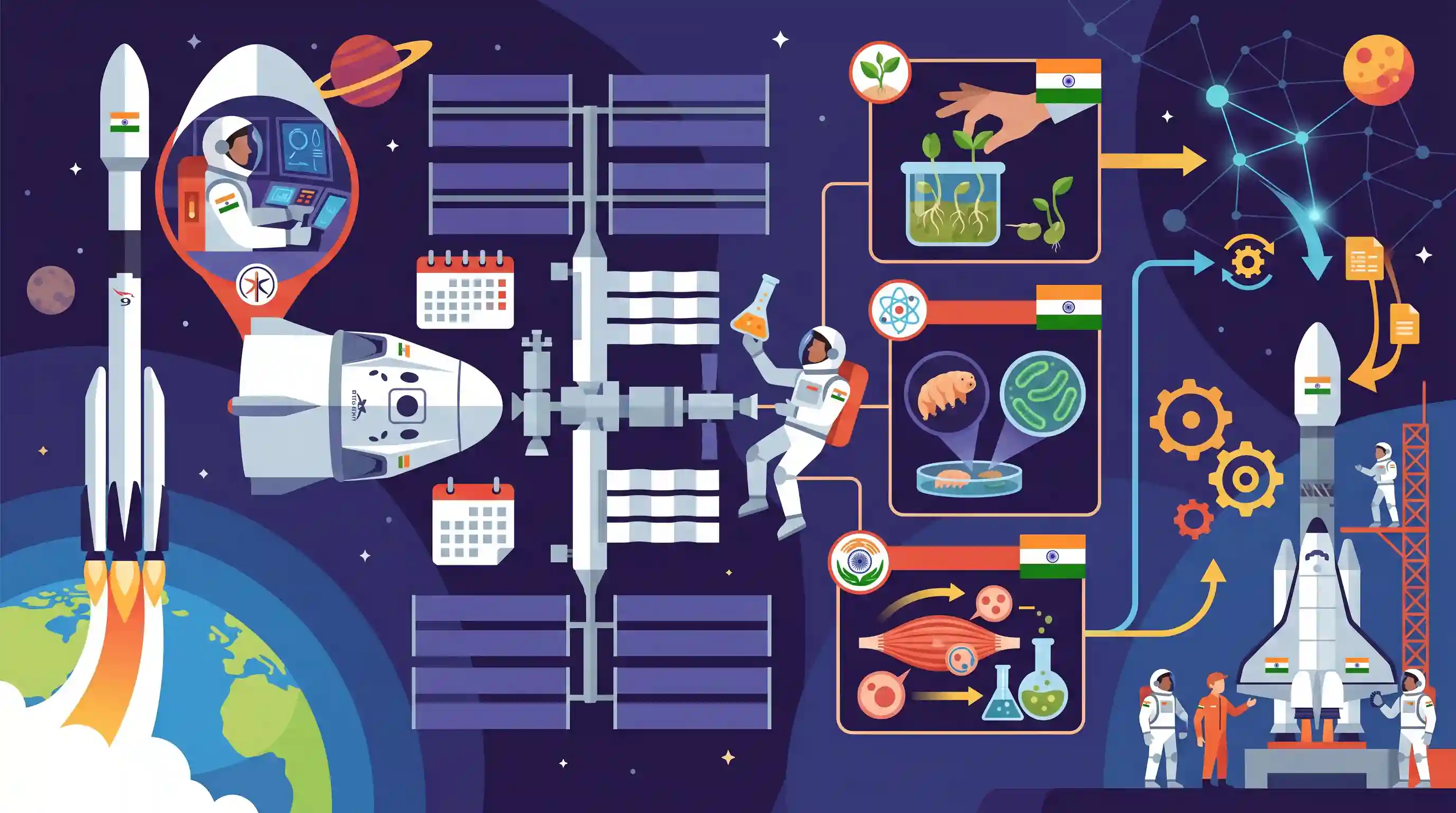
Group Captain Shubhanshu Shukla, an astronaut-designate for ISRO's Gaganyaan program, is set to become the first Indian to visit the International Space Station (ISS) as the pilot of the commercial Axiom-4 (Ax-4) mission. Launching aboard a SpaceX Dragon spacecraft on May 29, the 14-day mission will feature 60 scientific studies. Crucially, the mission includes seven microgravity experiments designed by Indian researchers, focusing on muscle regeneration, astrobiology (cyanobacteria, tardigrades), and the sprouting of seeds like green gram to explore India-centric food sources in space. This collaborative mission provides vital real-world spaceflight experience ahead of India's indigenous Gaganyaan manned mission.
Key Points
- Group Captain Shubhanshu Shukla, an Indian astronaut-designate for the Gaganyaan mission, will fly to the International Space Station (ISS) on May 29 as the pilot of the Axiom-4 (Ax-4) mission.
- The Ax-4 mission is a commercial spaceflight operated by Axiom Space using a SpaceX Dragon spacecraft. The crew will be commanded by former NASA astronaut Peggy Whitson.
- Shukla will become the first Indian astronaut to board the ISS and the first Indian to travel to space in over 40 years.
- During the 14-day mission, the crew will conduct 60 scientific studies. ISRO has shortlisted seven microgravity research experiments proposed by Indian principal investigators.
- The Indian microgravity experiments will focus on muscle regeneration, cyanobacteria, tardigrade resilience, and the sprouting of green gram and fenugreek to study 'India-centric food in space'.
Important Terms
Gaganyaan Mission

ISRO's flagship human spaceflight program aiming to send a three-member crew to Low Earth Orbit (400 km) for three days and return them safely.
UPSC context
GS Paper 3 (Science & Tech); tests knowledge of indigenous space capabilities and 'Atmanirbhar Bharat' in high-technology sectors.
Axiom-4 (Ax-4) Mission
The fourth commercial mission to the ISS, facilitating private and government-sponsored astronauts (like India's Shubhanshu Shukla) to gain operational spaceflight experience.
UPSC context
GS Paper 3 (Space); relevant for international collaboration and the role of commercial entities in national space goals.
Microgravity Research
Scientific studies conducted in near-weightlessness to observe physical and biological processes unaffected by Earth's gravity, such as muscle regeneration or seed germination.
UPSC context
GS Paper 3 (Science); examines the application of space environments to solve challenges in medicine, agriculture, and materials.
Axiom Space
A private American company providing commercial spaceflight services and currently developing the 'Axiom Station' to serve as a commercial successor to the ISS.
UPSC context
GS Paper 3 (Space); highlights the global trend of 'New Space' or private sector participation in orbital missions.
ISRO (Indian Space Research Organisation)
India’s primary space agency responsible for space exploration and satellite technology; currently leading the indigenous development of the Gaganyaan program.
UPSC context
GS Paper 3 (Institutions); fundamental for all questions regarding India's scientific progress and institutional framework in space.
International Space Station (ISS)
A collaborative research laboratory in Low Earth Orbit where international astronauts conduct long-term scientific experiments in a microgravity environment.
UPSC context
GS Paper 3 (Space); signifies the primary platform for global scientific cooperation and human presence in space.
Prelims Trap
Shubhanshu Shukla is the first Indian in space, flying aboard an ISRO-NASA joint mission to the ISS.
Rakesh Sharma was the first Indian in space (1984). Also, Ax-4 is a private commercial mission by Axiom Space, not a state-led ISRO-NASA joint mission.
Static Concepts Connected
What is microgravity and how does it impact human physiology during spaceflight?
- Continuous free-fall: Microgravity is not the absence of gravity, but a state of weightlessness achieved when a spacecraft orbits Earth in a state of continuous free-fall.
- Muscle and bone: The lack of structural load causes astronauts to suffer severe muscle atrophy and progressive loss of bone density (osteopenia) without rigorous exercise.
- Fluid shifts: Bodily fluids migrate towards the upper body and head, causing vision impairment (SANS), facial puffiness, and overall immune system suppression.
What are the core technical components of ISRO's Gaganyaan mission?
- Human-Rated LVM3: Uses a modified, human-rated Launch Vehicle Mark-3 (HLVM3) with enhanced solid, liquid, and cryogenic stages to ensure absolute crew safety.
- Orbital Module: Comprises a pressurized Crew Module (CM) for astronauts and a Service Module (SM), targeting a 400 km Low Earth Orbit (LEO) for three days.
- Crew Escape System: A specialized emergency abort system designed to rapidly pull the Crew Module away from the launch vehicle in case of any pad or ascent anomalies.
Cross-Topic Patterns
Extremophiles in space biology
Sending tardigrades and cyanobacteria links space technology with core environmental biology. UPSC frequently tests extremophiles, their resilience, and bio-indicators in the Prelims science section.
Privatization of Low Earth Orbit
Axiom-4 highlights the global shift from state-run space stations to private commercial spaceflights, conceptually mirroring India's own domestic space privatization push via IN-SPACe and NSIL.

Microgravity biology (tardigrades/cyanobacteria) combined with Gaganyaan's LEO parameters is a high-probability 2026 Prelims question.
Linked PYQs · 2
Linked PYQs · 2
- 2025PrelimsGS1
Consider the following space missions : I. Axiom-4 II. SpaDeX III. Gaganyaan How many of the space missions given above encourage and support micro-gravity research?
- 2017MainsGS3
India has achieved remarkable successes in unmanned space missions including the Chandrayaan and Mars Orbitter Mission, but has not ventured into manned space missions. What are the main obstacles to launching a manned space mission, both in terms of technology and logistics? Examine critically.
