Axiom Mission Four Delay and International Space Station Issues
Source:The Hindu ↗
Why It Matters
The article is highly relevant for UPSC candidates as it merges India's human spaceflight ambitions (Gaganyaan) with international and private space collaborations (ISRO-NASA-Axiom-SpaceX). It also draws attention to the structural degradation of the ISS, an important topic as the world debates the future of low-Earth orbit stations post-ISS retirement.
Summary
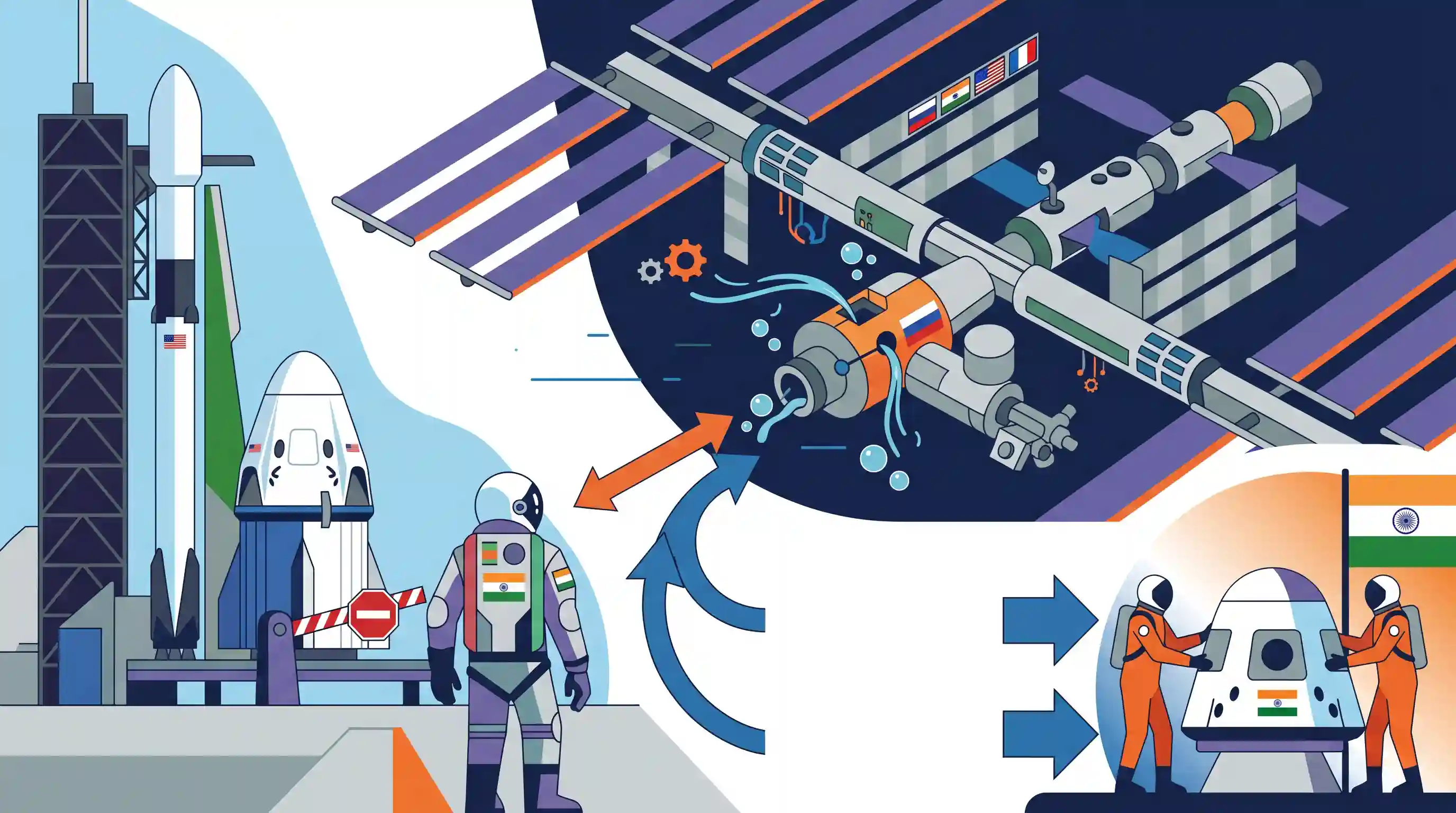
The launch of Axiom Mission 4 (Ax-4) to the International Space Station (ISS), which includes Indian 'Gaganyaatri' Shubhanshu Shukla, has been further postponed. The delay was triggered by a newly detected pressure leak in the Russian Zvezda service module on the ISS. This mission, a commercial venture using SpaceX infrastructure, is critical for ISRO as it provides real-world human spaceflight experience to its astronauts ahead of the indigenous Gaganyaan mission. The incident also underscores the increasing maintenance challenges faced by the aging ISS infrastructure.
Key Points
- The Axiom Mission 4 (Ax-4) has been delayed again due to a technical glitch—a new pressure signature or leak—in the aft segment of the Russian Zvezda service module on the ISS.
- The mission features ISRO astronaut Group Captain Shubhanshu Shukla, who will gain vital spaceflight experience ahead of India's indigenous Gaganyaan mission.
- Ax-4 is a private commercial spaceflight operated by Axiom Space using SpaceX's Falcon 9 rocket and Crew Dragon spacecraft.
- The incident highlights the operational vulnerabilities of the aging International Space Station, particularly within its Russian segment, prompting joint evaluations by NASA and Roscosmos.
Important Terms
Axiom Mission 4 (Ax-4)

A commercial crewed mission to the International Space Station (ISS) involving Indian astronaut Shubhanshu Shukla, providing critical operational experience for India's future human spaceflight endeavors.
UPSC context
GS Paper III (Space); tests awareness of international collaborations and their role in bolstering India's human spaceflight program.
Gaganyaan
ISRO's flagship program to demonstrate indigenous human spaceflight capability by sending a crew to Low Earth Orbit (LEO) and ensuring their safe return to Earth.
UPSC context
GS Paper III (Science & Tech); a priority topic regarding indigenous technology, strategic autonomy, and India's status as a space power.
Zvezda Service Module
A primary Russian component of the ISS providing life support and living quarters; currently facing technical challenges like pressure leaks due to its aging structure.
UPSC context
GS Paper III (Space); illustrates challenges of aging international space infrastructure and its impact on global mission timelines.
Axiom Space
A private U.S. aerospace company that organizes commercial missions to the ISS and is currently training Indian astronauts as part of a bilateral space agreement.
UPSC context
GS Paper III (Space); highlights the shift towards commercialization of space and public-private partnerships in global exploration.
ISRO (Indian Space Research Organisation)
India's premier space agency responsible for the development of space technology and exploration, currently executing the Gaganyaan program and international space collaborations.
UPSC context
GS Paper III (Science & Tech); central to questions on India’s institutional progress and indigenous technological breakthroughs.
SpaceX
A private aerospace manufacturer providing the Falcon 9 rocket and Dragon spacecraft for the Ax-4 mission, representing the growth of commercial space transportation.
UPSC context
GS Paper III (Space); signifies the increasing role of private entities in reducing costs and providing reusable space infrastructure.
Prelims Trap
Axiom Mission 4 is a joint inter-governmental space mission executed directly by ISRO and NASA.
Ax-4 is a private, commercial mission operated by Axiom Space using SpaceX hardware. ISRO purchased a seat for its astronaut via a NASA-facilitated agreement; it is not a joint sovereign mission.
Static Concepts Connected
What are the key modules and structural segments of the International Space Station (ISS)?
- Zvezda (Russian): Provides critical life support systems, propulsion, and serves as the structural and functional center of the Russian Orbital Segment.
- Destiny (US): The primary operating facility for US research payloads, supporting numerous experiments in microgravity.
- Columbus & Kibo: Distinct research laboratories attached to the ISS provided by the European Space Agency (ESA) and JAXA (Japan), respectively.
What are the foundational components of ISRO's indigenous Gaganyaan mission?
- Launch Vehicle: The launch vehicle is the HLVM3, a human-rated reconfigured version of the LVM3 (formerly GSLV Mk III), ensuring high reliability.
- Orbital Module: Consists of a habitable Crew Module (CM) with an earth-like environment and an unpressurized Service Module (SM) providing propulsion and power.
- Crew Escape System: A quick-acting solid motor-based system designed to pull the Crew Module to a safe distance in case of a launch abort emergency.
Cross-Topic Patterns
Commercial spaceflight & space sector privatization
Axiom-4 highlights the global shift towards private space stations. This ties directly to India's space reforms and the creation of IN-SPACe to promote non-governmental entities in space exploration.
ISS retirement & Bharatiya Antariksha Station
The Zvezda module's recurring leaks underscore the ISS's aging infrastructure (retiring ~2030), accelerating the geopolitical race for sovereign stations like China's Tiangong and India's proposed Bharatiya Antariksha Station (BAS).

Expect a 2026 multi-statement question contrasting commercial LEO missions (Axiom) with sovereign space station plans (BAS/Gaganyaan).
Linked PYQs · 3
Linked PYQs · 3
- 2025PrelimsGS1
Consider the following space missions : I. Axiom-4 II. SpaDeX III. Gaganyaan How many of the space missions given above encourage and support micro-gravity research?
- 2016MainsGS3
Discuss India's achievements in the field of Space Science and Technology. How the application of this technology has helped India in its socio-economic development?
- 2017MainsGS3
India has achieved remarkable successes in unmanned space missions including the Chandrayaan and Mars Orbitter Mission, but has not ventured into manned space missions. What are the main obstacles to launching a manned space mission, both in terms of technology and logistics? Examine critically.
