एक्सिओम 4 मिशन की स्पलैशडाउन और मानव अंतरिक्ष उड़ान के निहितार्थ
स्रोत:द हिंदू ↗
क्यों मायने रखता है
Axiom-4 मिशन एक भारतीय अंतरिक्ष यात्री को महत्वपूर्ण कक्षीय (orbital) अनुभव प्रदान करके भारत की मानव अंतरिक्ष उड़ान क्षमताओं को सीधे तौर पर बढ़ाता है, जो ISRO के गगनयान मिशन के लिए एक महत्वपूर्ण मील के पत्थर के रूप में कार्य करता है। यह अंतरिक्ष अन्वेषण के बढ़ते निजीकरण और अंतर्राष्ट्रीयकरण को भी दर्शाता है।
सारांश
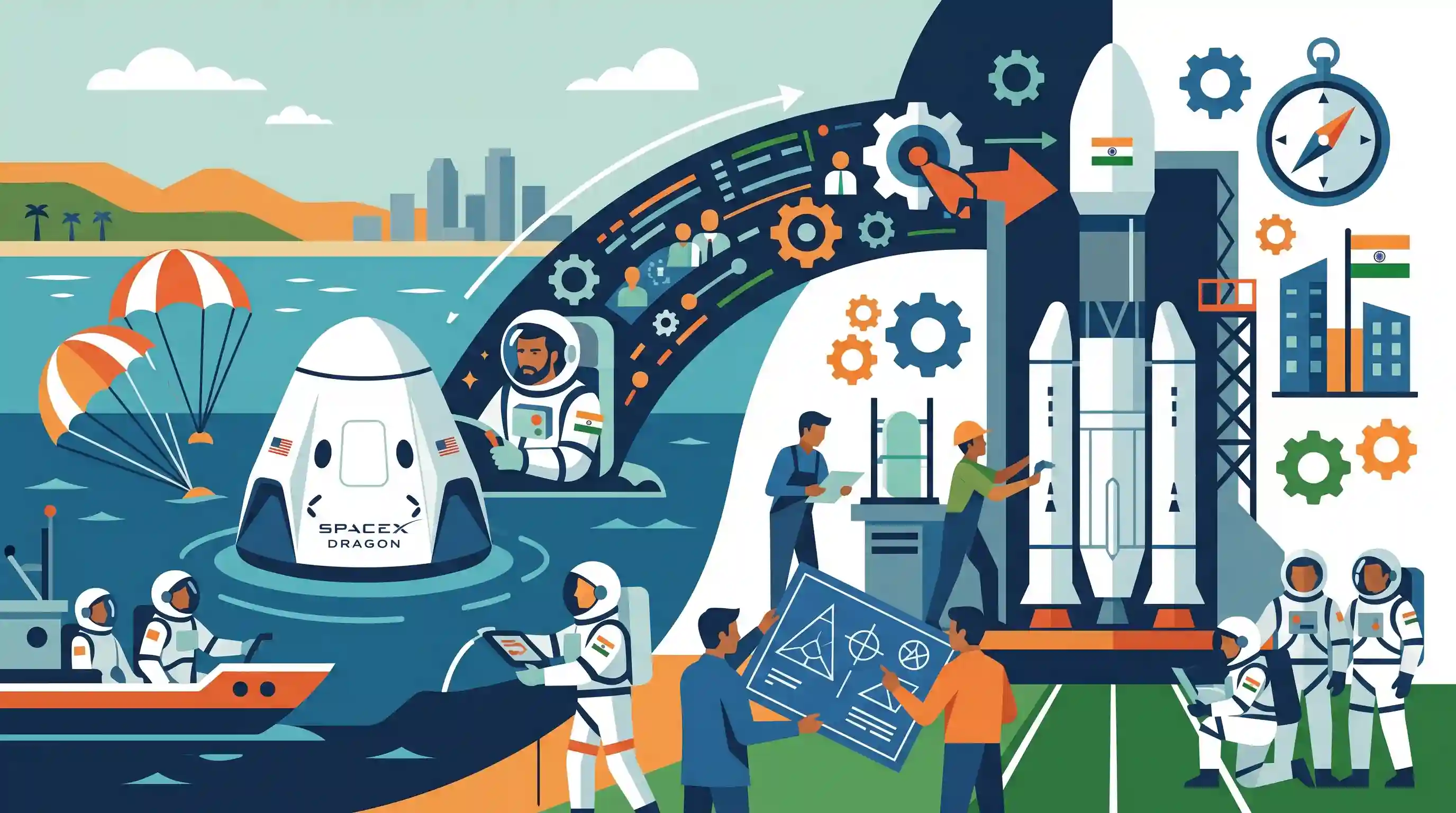
The Axiom-4 (Ax-4) mission has concluded with Indian astronaut Group Captain Shubhanshu Shukla and three other crew members splashing down off the coast of San Diego. Shukla piloted the SpaceX Dragon spaceship during this 18-day commercial space mission to the International Space Station (ISS). This milestone significantly bolsters India's technical and operational readiness for its upcoming maiden human spaceflight mission, the Gaganyaan programme.
मुख्य बिंदु
- Indian astronaut Group Captain Shubhanshu Shukla successfully piloted the SpaceX Dragon spacecraft back from the International Space Station.
- The commercial Axiom-4 (Ax-4) mission, comprising an international crew of four, concluded its 18-day mission with a splashdown off the coast of San Diego on July 15, 2025.
- ISRO views this mission as a vital precursor and training exercise for India's upcoming indigenous human spaceflight mission, Gaganyaan.
- The mission highlights the growing role of private companies like Axiom Space and SpaceX in facilitating human access to low Earth orbit.
महत्वपूर्ण शब्द
Gaganyaan programme

भारत का पहला स्वदेशी मानव अंतरिक्ष उड़ान मिशन, जिसका लक्ष्य 3 सदस्यीय दल को 400 किमी की कक्षा में भेजना और उन्हें सुरक्षित रूप से पृथ्वी पर वापस लाना है।
UPSC context
GS Paper III: Space Technology; tests understanding of indigenous tech, crew safety, and India's human spaceflight capabilities.
Axiom Mission 4 (Ax-4)
A commercial astronaut mission to the International Space Station (ISS) operated by Axiom Space, featuring Indian pilot Shubhanshu Shukla.
UPSC context
GS Paper III: Space; relevant for international space cooperation and India's growing role in global commercial spaceflight.
Axiom Space
A private American space infrastructure developer that organizes commercial missions to the ISS and is building the first commercial space station.
UPSC context
GS Paper III: Privatization of Space; signifies the transition of LEO activities from government to private sectors.
स्पेसएक्स
A private aerospace firm that provided the Falcon 9 rocket and Dragon spaceship for the Ax-4 mission to the ISS.
UPSC context
GS Paper III: Technology; demonstrates the impact of reusable launch vehicles on global space accessibility and cost.
International Space Station (ISS)
निम्न पृथ्वी कक्षा (Low Earth Orbit) में स्थित एक मॉड्यूलर रहने योग्य उपग्रह, जो अंतर्राष्ट्रीय अनुसंधान और प्रौद्योगिकी प्रदर्शनों के लिए एक सूक्ष्मगुरुत्वाकर्षण प्रयोगशाला (microgravity laboratory) के रूप में कार्य करता है।
UPSC context
GS Paper III: Science & Technology; tests awareness of global space infrastructure and collaborative scientific research.
ISRO
India's national space agency responsible for the Gaganyaan mission and coordinating scientific experiments for the Ax-4 flight.
UPSC context
GS Paper III: Indigenization of Technology; central to India's self-reliance in space and indigenous hardware development.
Low Earth Orbit (LEO)
An orbit around Earth with an altitude up to 2,000 km, where most manned missions and the ISS are located.
UPSC context
GS Paper III: Space Technology; fundamental for understanding mission planning, satellite communications, and space debris management.
प्रारंभिक ट्रैप
शुभांशु शुक्ला प्रथम गगनयान मिशन के दौरान अंतरिक्ष में जाने वाले पहले भारतीय नागरिक बने।
Shubhanshu Shukla is the second Indian citizen in space (after Rakesh Sharma in 1984) and flew on the commercial Axiom-4 mission, not the indigenous Gaganyaan.
संबंधित अवधारणाएँ
What characterizes Low Earth Orbit (LEO) used for human spaceflight?
- Altitude range: Typically between 160 km to 1,000 km above Earth. The ISS and India's planned Gaganyaan mission both operate at an altitude of roughly 400 km.
- Orbital velocity: Objects travel at roughly 7.8 km/s, allowing spacecraft like the ISS to complete a full orbit around the Earth in approximately 90 minutes.
- Atmospheric drag: LEO में अंतरिक्ष यान थर्मोस्फीयर और एक्सोस्फीयर से होने वाले ड्रैग (drag) के कारण कक्षीय क्षय (orbital decay) का अनुभव करते हैं, जिसके लिए ऊंचाई बनाए रखने हेतु समय-समय पर री-बूस्टिंग की आवश्यकता होती है।
How does microgravity affect human physiology during spaceflight?
- Musculoskeletal decay: Astronauts experience rapid loss of bone density and severe muscle atrophy due to the absence of normal weight-bearing loads on the body.
- Fluid shift: Blood and bodily fluids shift toward the upper body and head, causing facial puffiness and potential Spaceflight-Associated Neuro-ocular Syndrome (SANS), impairing vision.
अंतर-विषय पैटर्न
Space Privatization & Space Policy 2023
Axiom and SpaceX demonstrate mature commercial spaceflight, mirroring India's structural shift via IN-SPACe and the Space Policy 2023 to empower Non-Governmental Entities (NGEs) in space operations.
ISS to Bharatiya Antariksha Station (BAS)
Microgravity biological experiments (cyanobacteria, food crops) conducted by ISRO on Ax-4 provide foundational data for India's upcoming Bharatiya Antariksha Station (BAS), planned for 2035.

Expect a multi-statement Prelims question in 2026 contrasting Gaganyaan's indigenous LEO parameters with India's Ax-4 ISS experiments.
संबद्ध PYQ · 2
संबद्ध PYQ · 2
- 2025PrelimsGS1
Consider the following space missions : I. Axiom-4 II. SpaDeX III. Gaganyaan How many of the space missions given above encourage and support micro-gravity research?
- 2017MainsGS3
India has achieved remarkable successes in unmanned space missions including the Chandrayaan and Mars Orbitter Mission, but has not ventured into manned space missions. What are the main obstacles to launching a manned space mission, both in terms of technology and logistics? Examine critically.
