Shubhanshu Shukla undergoes training for Axiom 4 space mission
Source:Indian Express ↗
Why It Matters
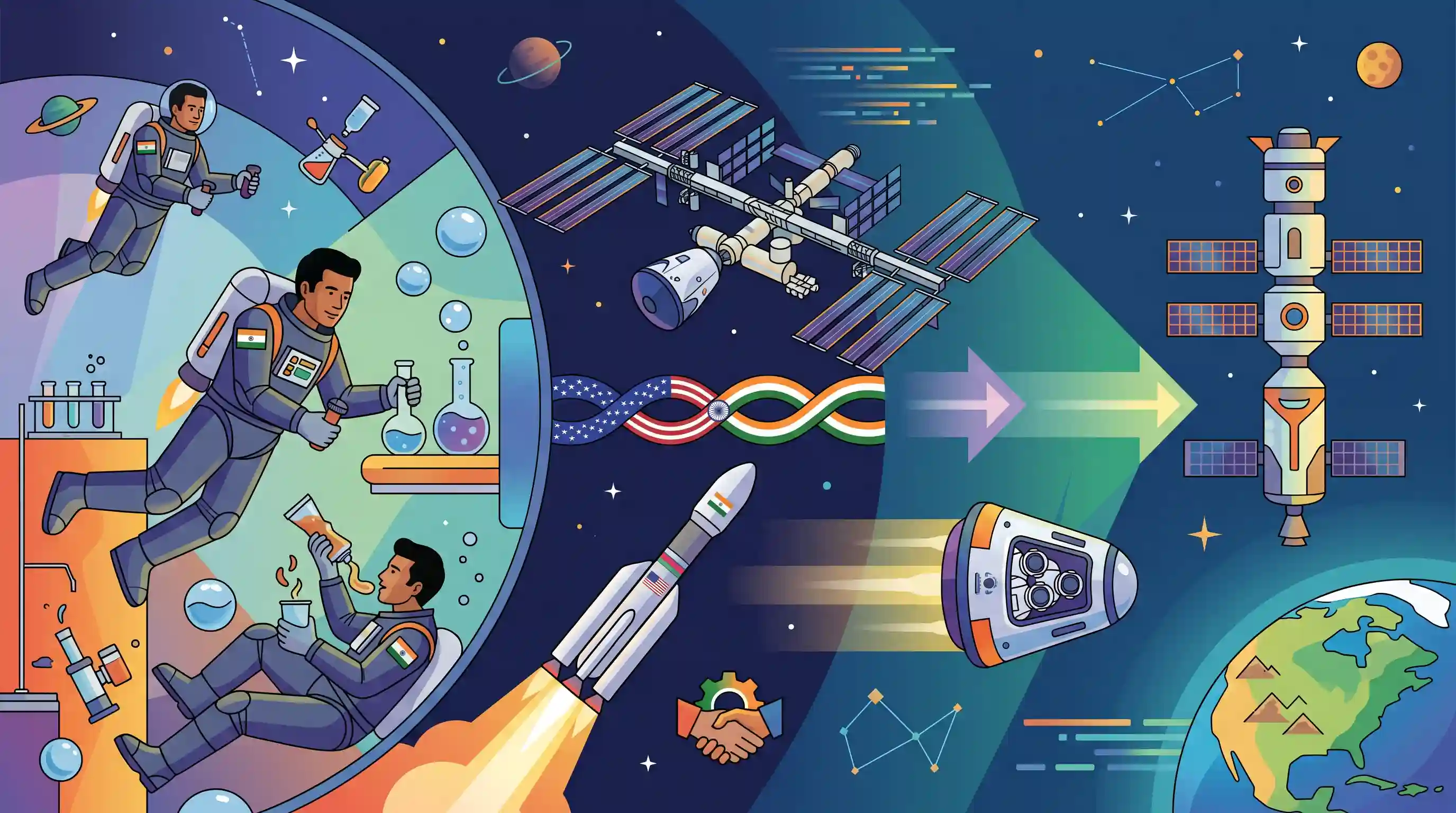
The Axiom-4 mission represents India's strategic return to manned spaceflight, acting as a crucial learning curve in overcoming the technological and logistical challenges for the Gaganyaan mission and the eventual establishment of an Indian space station.
Summary
Group Captain Shubhanshu Shukla has been chosen by ISRO as the primary astronaut for the upcoming Axiom-4 (Ax-4) mission to the International Space Station (ISS), in partnership with NASA and private entity Axiom Space. He is learning everything from maneuvering in microgravity to eating in space. This hands-on experience in space operations will serve as crucial preparation for India's indigenous Gaganyaan manned space mission and future plans to establish the Bharatiya Antariksha Station. The collaborative Indo-US mission also highlights deepening strategic ties in space exploration under the iCET initiative.
Key Points
- Group Captain Shubhanshu Shukla is the prime astronaut for the joint ISRO-NASA Axiom-4 mission to the ISS, with Prasanth Balakrishnan Nair serving as the backup astronaut.
- The astronauts are undergoing rigorous training in the US to adapt to microgravity, learn complex ISS operations, and master basic daily routines like eating and moving in space.
- The Axiom-4 mission facilitates critical micro-gravity research and serves as a preparatory stepping stone for India's indigenous Gaganyaan human spaceflight programme.
- This collaboration reflects strengthening Indo-US strategic ties in space exploration under the framework of the Initiative on Critical and Emerging Technology (iCET).
- The hands-on experience gained from ISS operations will eventually aid ISRO's long-term goals, including the establishment of the Bharatiya Antariksha Station.
Important Terms
Gaganyaan mission

ISRO's flagship program to demonstrate indigenous human spaceflight capability by sending a crew to a 400 km orbit for three days and returning them safely to Earth.
UPSC context
GS-III (Space Tech): Tests knowledge of indigenous technology, crew safety, and India's status among elite spacefaring nations.
Axiom-4 (Ax-4) mission
A collaborative commercial mission to the International Space Station involving ISRO, NASA, and Axiom Space, featuring India's Group Captain Shubhanshu Shukla as mission pilot.
UPSC context
GS-III (Space): Highlights international collaboration and crucial hands-on training for Indian astronauts prior to indigenous missions.
Bharatiya Antariksha Station (BAS)
India's planned modular space station, with the first module (BAS-1) set for 2028 and full operational capability targeted by 2035 for long-duration human presence.
UPSC context
GS-III (Space Tech): Represents the next phase of India's space program for indigenous research and space economy.
iCET (Initiative on Critical and Emerging Technology)
A 2023 bilateral framework between India and the US to deepen strategic cooperation in critical areas like AI, semiconductors, space, and defense.
UPSC context
GS-II (International Relations): Essential for understanding Indo-US strategic ties and technology transfer mechanisms.
Microgravity
A condition of apparent weightlessness where gravity's effects are greatly reduced, enabling unique research in medicine, materials science, and fluid physics in space.
UPSC context
GS-III (Science): Key to understanding the scientific objectives of space-based laboratories and their Earth-bound applications.
International Space Station (ISS)
A habitable modular research laboratory in low Earth orbit, serving as a hub for international scientific cooperation and long-duration spaceflight studies.
UPSC context
GS-III/GS-II: Central to global space diplomacy and current human spaceflight operations.
Prelims Trap
Shubhanshu Shukla is the first Indian to travel to space.
Rakesh Sharma was the first Indian in space (1984, Soviet T-11). Shukla will be the first Indian on the ISS.
Static Concepts Connected
What are the key characteristics of Low Earth Orbit (LEO) used by Space Stations?
- Altitude: Positioned typically between 160 km to 2,000 km above the Earth's surface.
- Orbital Period: Usually 90 to 120 minutes, meaning objects like the ISS orbit the Earth roughly 16 times a day.
- Applications: Ideal for Earth observation, human spaceflight (ISS, Tiangong, upcoming BAS), and microgravity research due to accessibility and lower launch energy requirements.
What is microgravity and why do astronauts experience it in orbit?
- Definition: A condition where gravity seems extremely small, creating a state of weightlessness for objects and people.
- Continuous Free-fall: Astronauts float not because there is zero gravity, but because the spacecraft is in a continuous state of free-fall towards Earth while moving forward.
- Research Value: Critical for developing regenerative life-support systems, studying fluid dynamics, and observing biological phenomena like myogenesis without gravitational interference.
Cross-Topic Patterns
iCET expands beyond semiconductors
The Initiative on Critical and Emerging Technology (iCET) extends beyond AI and semiconductors; this human spaceflight collaboration signals a strategic shift from historical tech-denial regimes to proactive US-India co-development.
Commercialization of Low Earth Orbit (LEO)
Axiom Space’s involvement highlights the global shift towards the commercialization of Low Earth Orbit (LEO), transitioning from government-run stations to private-public space habitats.

Expect a multi-statement question contrasting the Ax-4 ISS mission with indigenous Gaganyaan and BAS (2035) targets.
Linked PYQs · 2
Linked PYQs · 2
- 2025PrelimsGS1
Consider the following space missions : I. Axiom-4 II. SpaDeX III. Gaganyaan How many of the space missions given above encourage and support micro-gravity research?
- 2017MainsGS3
India has achieved remarkable successes in unmanned space missions including the Chandrayaan and Mars Orbitter Mission, but has not ventured into manned space missions. What are the main obstacles to launching a manned space mission, both in terms of technology and logistics? Examine critically.
