Axiom 4 Mission and Microgravity Research on ISS
Source:The Hindu ↗
Why It Matters
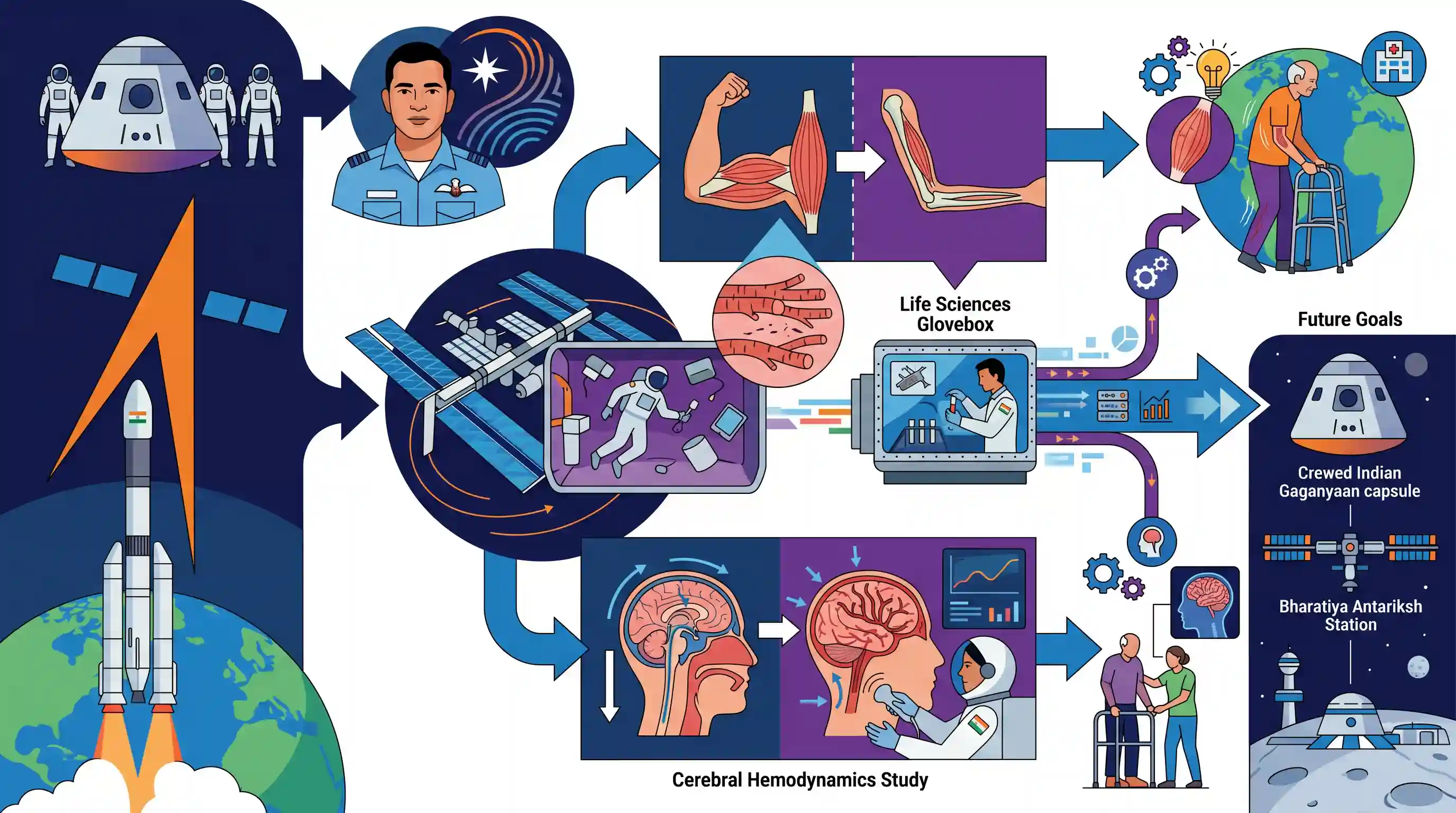
Microgravity research is critical for India's human spaceflight ambitions (Gaganyaan) and the planned Bharatiya Antariksha Station. Furthermore, the experiments demonstrate the tangible socio-economic benefits of space exploration through potential medical breakthroughs for diseases on Earth.
Summary
Group Captain Shubhanshu Shukla has commenced microgravity research on the International Space Station (ISS) as part of the Axiom-4 mission. His work includes the 'Myogenesis' experiment to study skeletal muscle degradation and a 'Cerebral Hemodynamics' study to examine brain blood circulation under microgravity. Selected by ISRO, these experiments aim to nurture India's microgravity research ecosystem ahead of the Gaganyaan mission, while yielding insights applicable to terrestrial medical conditions like muscle degeneration and stroke.
Key Points
- Group Captain Shubhanshu Shukla has begun conducting microgravity research aboard the International Space Station (ISS) during his 14-day stay as part of the Axiom-4 mission.
- He is working on the 'Myogenesis' experiment, proposed by InStem (Bengaluru), which studies the biological pathways behind skeletal muscle degradation in space.
- Insights from the Myogenesis experiment could lead to targeted therapies to protect astronauts and treat muscle-degenerative diseases on Earth.
- He also initiated a 'Cerebral Hemodynamics' study using ultrasound to monitor brain blood circulation in microgravity, potentially informing treatments for stroke and hypertension.
- ISRO shortlisted seven microgravity experiments from Indian researchers to nurture a domestic microgravity research ecosystem, which will aid the upcoming Gaganyaan mission.
- In addition to the Indian experiments, ISRO and NASA are collaborating on five joint science investigations and two in-orbit STEM demonstrations.
Important Terms
Axiom-4 mission

The fourth all-private astronaut mission to the International Space Station (ISS), involving an ISRO-NASA-Axiom collaboration. It serves as a critical operational and scientific precursor for India's upcoming Gaganyaan mission.
UPSC context
GS Paper III (Space Technology); relevant for international space cooperation, private sector participation, and India's human spaceflight milestones.
Shubhanshu Shukla
An Indian Air Force Group Captain and ISRO 'Gaganyatri' selected for the Axiom-4 mission. He is the first Indian to stay on the ISS, conducting microgravity experiments for India’s space program.
UPSC context
GS Paper III (Space Technology); significant as India’s second national astronaut after Rakesh Sharma, representing human spaceflight readiness.
Gaganyaan mission
India's indigenous human spaceflight programme designed to launch a three-member crew into a 400 km orbit for a three-day mission and return them safely to Earth.
UPSC context
GS Paper III (Science & Technology); a flagship project testing indigenous technology, crew safety, and life-support systems.
Myogenesis experiment
The biological process of skeletal muscle formation and regeneration. On the ISS, it is studied to understand muscle atrophy in microgravity and develop treatments for terrestrial muscle-wasting diseases.
UPSC context
GS Paper III (Biotechnology/Health); highlights the application of space research in solving terrestrial medical challenges like aging and muscular dystrophy.
InStem (Institute for Stem Cell Science and Regenerative Medicine)
An autonomous institute under the Department of Biotechnology (DBT), Bengaluru. It specializes in stem cell and regenerative biology, and developed the 'Myogenesis' experiment for the Axiom-4 mission.
UPSC context
GS Paper III (R&D Institutions); tests knowledge of premier Indian research bodies contributing to international space-based life sciences.
Microgravity
A condition of near-weightlessness on the ISS where gravity's effects are minimal. This environment allows scientists to study biological and physical processes impossible to replicate on Earth.
UPSC context
GS Paper III (Science); fundamental concept for understanding space-based research, manufacturing, and the physiological impacts of long-duration space travel.
Prelims Trap
"Axiom-4 is an indigenous ISRO mission serving as the first crewed launch under the Gaganyaan programme."
Axiom-4 is a private commercial spaceflight (operated by Axiom Space/SpaceX) serving as preparatory training. It is not the indigenous Gaganyaan launch itself.
Static Concepts Connected
What are the physiological effects of microgravity on the human body?
- Musculoskeletal atrophy: Lack of mechanical stress causes rapid loss of bone density (osteopenia) and skeletal muscle degradation (myogenesis).
- Fluid shifts: Blood and fluids move upward toward the head, causing 'puffy face' and altering cerebral hemodynamics.
- Sensorimotor changes: The vestibular system struggles to orient the body without gravity, leading to space motion sickness.
What are the primary objectives and architecture of ISRO's Gaganyaan mission?
- Core Objective: Demonstrate indigenous human spaceflight capability to Low Earth Orbit (LEO) for a 3-day mission.
- Launch Vehicle: Utilizes a human-rated LVM3 (HLVM3) equipped with a Crew Escape System (CES) for emergency aborts.
- Orbital Module: Consists of an Earth-like pressurized Crew Module and an unpressurized Service Module for propulsion.
Cross-Topic Patterns
Space tech + Biotech convergence
Microgravity acts as an extreme environment for biological research, yielding targeted terrestrial therapies for muscular dystrophy, osteoporosis, and neuro-vascular diseases.
Space Privatization (Space 2.0)
Axiom-4 exemplifies the shift toward public-private partnerships (ISRO/NASA with Axiom/SpaceX) for human spaceflight, prefiguring upcoming commercial replacements for the ISS.

Expect a multi-statement Prelims question contrasting the commercial Axiom-4 mission with India's indigenous Gaganyaan, testing microgravity effects.
Linked PYQs · 4
Linked PYQs · 4
- 2019MainsGS3
What is India's plan to have its own space station and how will it benefit our space programme?
- 2016MainsGS3
Discuss India's achievements in the field of Space Science and Technology. How the application of this technology has helped India in its socio-economic development?
- 2017MainsGS3
India has achieved remarkable successes in unmanned space missions including the Chandrayaan and Mars Orbitter Mission, but has not ventured into manned space missions. What are the main obstacles to launching a manned space mission, both in terms of technology and logistics? Examine critically.
- 2025PrelimsGS1
Consider the following space missions : I. Axiom-4 II. SpaDeX III. Gaganyaan How many of the space missions given above encourage and support micro-gravity research?
