Axiom 4 mission carrying Shubhanshu Shukla targets June launch
Source:The Hindu ↗
Why It Matters
Provides a contemporary example of India's strategic partnerships in space exploration. Showcases the transitional phase of ISRO leveraging commercial spaceflight (Axiom/SpaceX) to train astronauts and gain operational know-how ahead of launching its own human spaceflight (Gaganyaan) and space station.
Summary
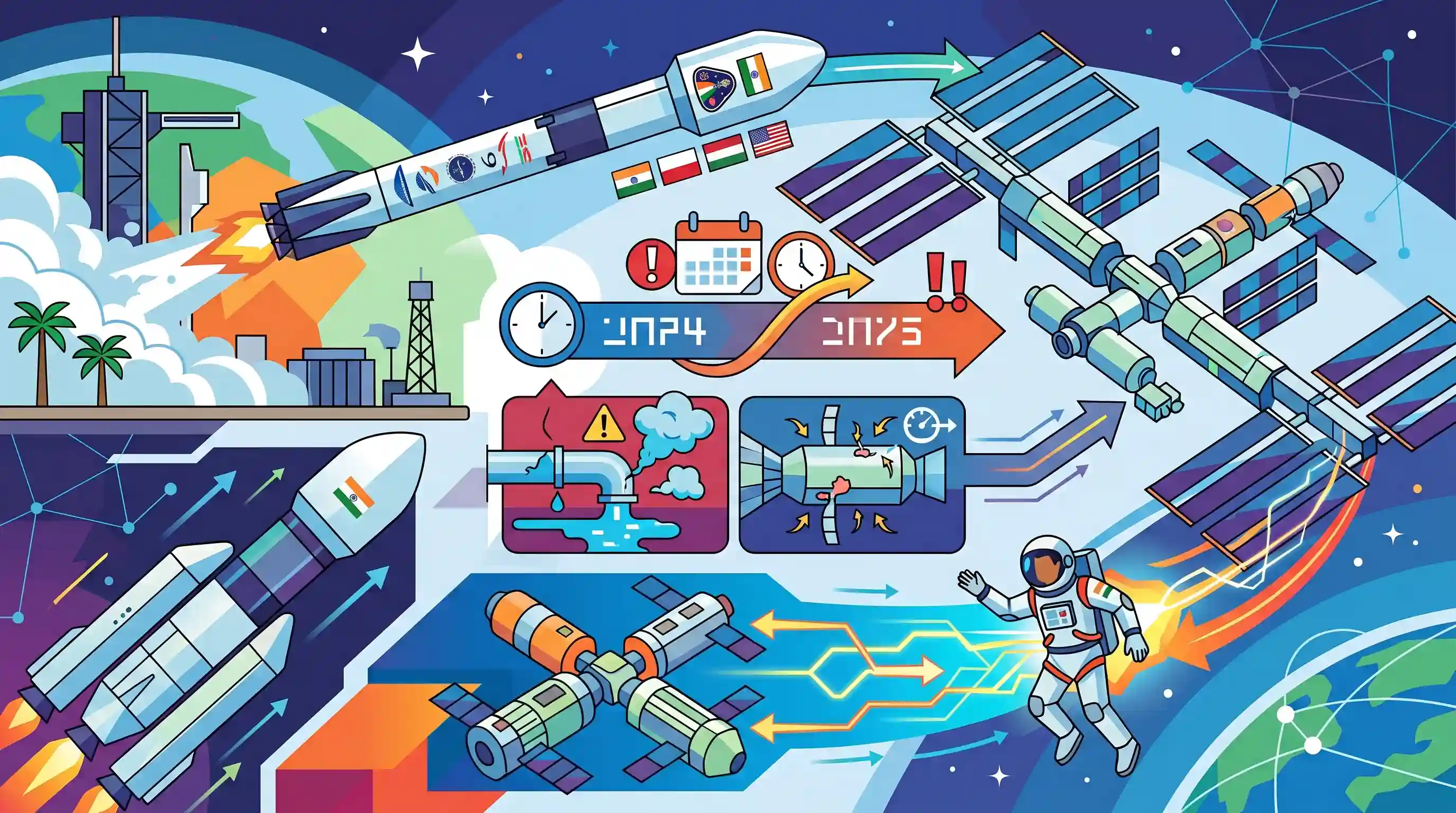
The Axiom-4 (Ax-4) commercial space mission, carrying Indian astronaut Group Captain Shubhanshu Shukla to the International Space Station (ISS), is now scheduled for lift-off on June 19, 2025. Originally slated for late 2024, the SpaceX Falcon 9 launch from the Kennedy Space Centre faced delays due to investigations into a liquid oxygen leak on a previous Falcon 9 flight and ongoing pressure leak anomalies in the Russian 'Zvezda' module of the ISS. The mission, commanded by Peggy Whitson, also includes astronauts from Poland and Hungary. For India, Shukla's participation is a critical precursor to the indigenous Gaganyaan human spaceflight mission and the future Bharatiya Antariksha Station, providing hands-on experience in orbital operations and ISS protocols.
Key Points
- The Axiom-4 commercial mission to the ISS, carrying Indian astronaut Shubhanshu Shukla as a Mission Specialist, is now targeted for a June 19, 2025 launch.
- The mission is commanded by former NASA astronaut Peggy Whitson and includes crew members from Poland and Hungary.
- A SpaceX Falcon 9 rocket and Dragon capsule will ferry the crew from NASA's Kennedy Space Centre.
- Delays to the launch were caused by NASA's investigation into a liquid oxygen leak on a Falcon 9 rocket and pressure anomalies in the Zvezda Service Module (Russian section of the ISS).
- The mission is part of an ISRO-NASA pact, giving an Indian astronaut vital operational experience ahead of India's indigenous Gaganyaan manned mission.
Important Terms
Axiom-4 (Ax-4) Mission

The fourth private astronaut mission to the International Space Station (ISS), organized by Axiom Space. It featured India's Group Captain Shubhanshu Shukla as mission pilot, providing critical operational experience for India's human spaceflight program.
UPSC context
GS-III (Space Technology/International Collaboration). Tests awareness of India's role in the global commercial space market and international partnerships (ISRO-NASA-Axiom).
Gaganyaan
India's flagship human spaceflight mission by ISRO to demonstrate indigenous capability by sending a three-member crew to a 400 km orbit for three days and returning them safely to Earth.
UPSC context
GS-III (Indigenization of Technology). Tests understanding of India's technical self-reliance in life support systems, crew escape, and recovery modules.
Bharatiya Antariksha Station (BAS)
India's planned indigenous space station, with the first module (BAS-1) targeted for 2028 and full operational capacity (five modules) by 2035. It will serve as a hub for microgravity research.
UPSC context
GS-III (Science & Technology). Tests awareness of India’s long-term space vision (Amrit Kaal 2047) and the transition to sustained orbital presence.
Indian Space Research Organisation (ISRO)
The national space agency of India under the Department of Space. It is responsible for the design, development, and execution of India's space program, including lunar, solar, and human missions.
UPSC context
GS-III (Science and Technology Institutions). Fundamental to all questions regarding India's space policy and technological achievements.
Axiom Space
A private American aerospace company that facilitates commercial missions to the ISS. It is currently developing the first commercial space station to eventually replace the International Space Station.
UPSC context
GS-III (Science & Tech). Relevant to the shifting landscape of space exploration toward Public-Private Partnerships (PPP) and commercialization.
Low Earth Orbit (LEO)
An orbit around Earth with an altitude between 160 km and 2,000 km. It is the primary environment for the International Space Station and India's future space missions.
UPSC context
GS-III (Space Awareness). Basic conceptual knowledge required for understanding satellite deployments and human spaceflight trajectories.
Prelims Trap
"Axiom-4 is an ISRO-led indigenous spaceflight mission serving as a testbed for the Gaganyaan programme."
Axiom-4 is a commercial mission operated by Axiom Space using a SpaceX rocket. ISRO is participating via a NASA pact for astronaut experience, but it is neither indigenous nor ISRO-led.
Static Concepts Connected
What defines Low Earth Orbit (LEO) and its significance for space stations?
- Altitude range: Typically ranges from 160 km to 2,000 km above Earth; both the ISS and India's planned Bharatiya Antariksha Station (BAS) operate in this zone.
- Microgravity environment: Offers a prolonged state of weightlessness essential for conducting distinct biological, chemical, and material science experiments.
- Orbital period: Objects travel at high orbital velocities, completing a full revolution around Earth in about 90 to 120 minutes.
What are the foundational technological elements of India's Gaganyaan programme?
- Human-Rated LVM3: The heavy-lift HLVM3 launch vehicle is heavily modified with an integrated Crew Escape System (CES) for abort scenarios.
- Orbital Module: Consists of a pressurized, habitable Crew Module (CM) and an unpressurized Service Module (SM) providing support systems.
- Vyommitra humanoid: A robotic half-humanoid designed to simulate human physiological parameters during uncrewed precursor test flights.
Cross-Topic Patterns
Space Privatization & FDI limits
Axiom-4 showcases the booming commercial Low Earth Orbit (LEO) economy. This links directly to India's recent space sector reforms, allowing up to 100% FDI to empower IN-SPACe and private startups.
Aging ISS & Space Geopolitics
Leaks in the Russian Zvezda module highlight the ISS's end-of-life trajectory. This accelerates new space blocs, contrasting the US Artemis Accords with the Sino-Russian ILRS and India's independent BAS.

Expect a 2026 multi-statement question mixing India's Gaganyaan timeline, Bharatiya Antariksha Station (2035), and commercial pacts like Axiom-4.
Linked PYQs · 2
Linked PYQs · 2
- 2017MainsGS3
India has achieved remarkable successes in unmanned space missions including the Chandrayaan and Mars Orbitter Mission, but has not ventured into manned space missions. What are the main obstacles to launching a manned space mission, both in terms of technology and logistics? Examine critically.
- 2019MainsGS3
What is India's plan to have its own space station and how will it benefit our space programme?
