Commercial Human Spaceflight and Mission Logistics
Source:The Hindu ↗
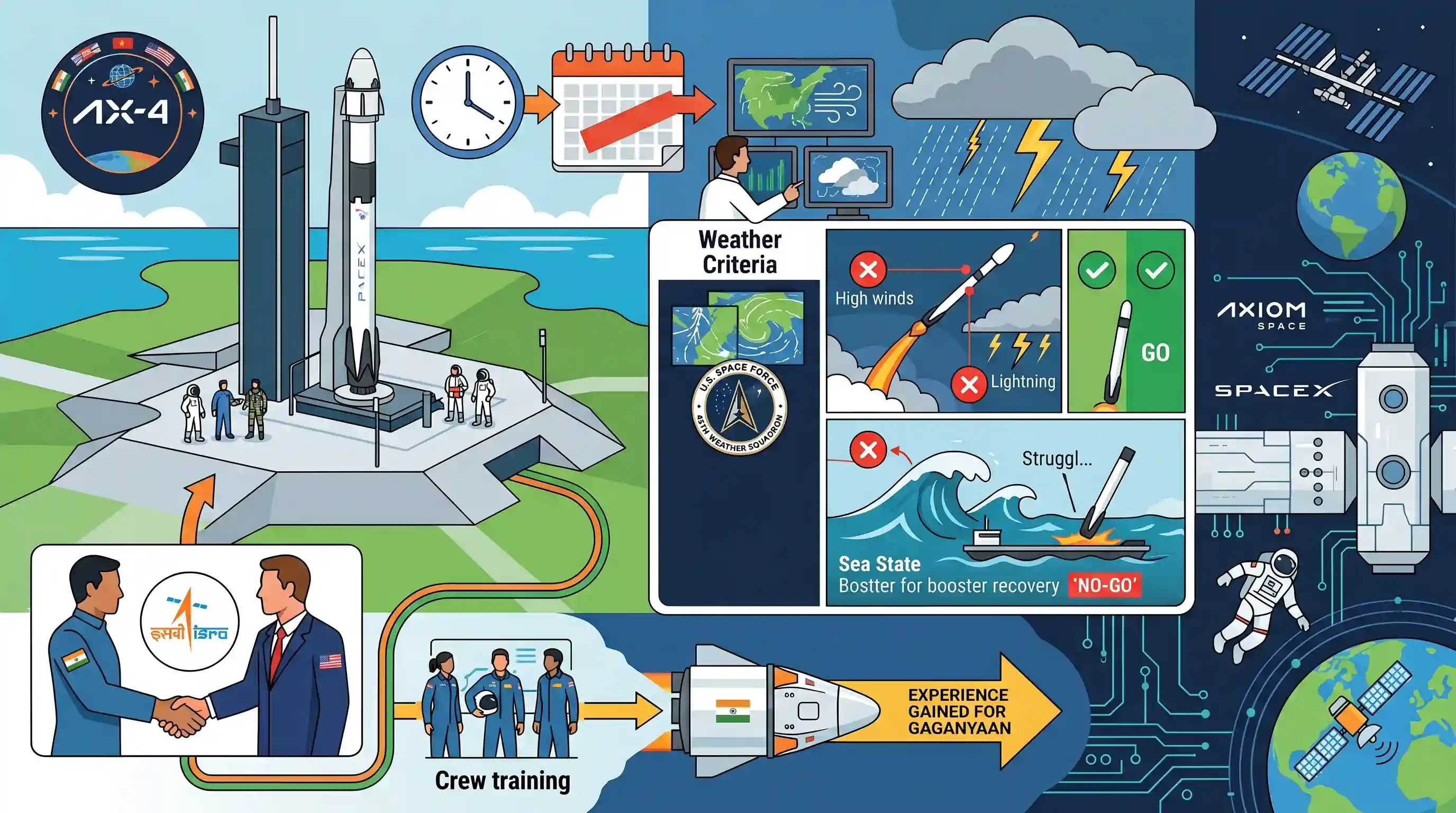
Why It Matters
Manned space missions, particularly involving ISRO astronauts and the Gaganyaan program, are highly relevant for GS3 (Awareness in Space). The article provides practical insights into space logistics, the role of private companies (SpaceX, Axiom), and international space collaboration, which frequently appear in both Prelims and Mains.
Summary
The Axiom-4 (AX-4) mission, an international private astronaut mission to the International Space Station (ISS), has faced launch postponements primarily due to unfavorable weather conditions at NASA's Kennedy Space Center in Florida. The mission, launching atop a SpaceX Falcon 9 rocket, includes ISRO astronaut Group Captain Shubhanshu Shukla. It marks a significant step in ISRO-NASA cooperation and provides critical human spaceflight experience for India's upcoming Gaganyaan program. The article details the stringent weather criteria evaluated by the U.S. Space Force's 45th Weather Squadron, such as ascent corridor conditions and sea state for booster recovery, underscoring the logistical complexities of manned spaceflight.
Key Points
- The Axiom-4 mission to the International Space Station, involving ISRO astronaut Group Captain Shubhanshu Shukla, is targeting a June 11 launch after weather-related delays.
- The launch relies on a SpaceX Falcon 9 rocket and Dragon capsule, highlighting the growing role of private-public partnerships in Low Earth Orbit (LEO) missions.
- Launch Readiness Reviews critically assess weather parameters, including surface high-pressure systems, ascent corridor winds, and sea conditions for the safe recovery of the first-stage booster.
- The mission serves as a vital precursor and training experience for India's indigenous human spaceflight initiative, the Gaganyaan program.
Important Terms
Gaganyaan program

India's indigenous human spaceflight program aiming to send a three-member crew to Low Earth Orbit (LEO) for three days and return them safely to Earth.
UPSC context
GS Paper III (Science & Technology); tests knowledge of indigenous space capabilities and human spaceflight milestones.
Axiom-4 mission (AX-4)
The fourth private astronaut mission to the International Space Station (ISS), featuring Indian astronaut Shubhanshu Shukla, serving as a precursor for India's human spaceflight experience.
UPSC context
GS Paper III (Space Technology); relevant for international collaboration and mission-specific technology demonstrations.
ISRO
India’s national space agency responsible for space research, satellite launches, and flagship missions like Gaganyaan, Chandrayaan, and Mangalyaan.
UPSC context
GS Paper III; core body for all Indian space-related current affairs and technological advancements.
NASA
The United States' federal agency for civilian space programs and aeronautics research, a primary collaborator with ISRO for the AX-4 mission.
UPSC context
GS Paper III (International Relations/Science); significant for understanding bilateral space cooperation (NISAR, iCET).
Axiom Space
A private American space infrastructure developer that manages private astronaut missions to the ISS and is building the world's first commercial space station.
UPSC context
GS Paper III; illustrates the growing role of the private sector and commercialization in space exploration.
45th Weather Squadron
A U.S. Space Force unit responsible for providing weather forecasts and safety assessments for space launches at Kennedy Space Center and Cape Canaveral.
UPSC context
GS Paper III; highlights technical/logistical challenges and safety protocols in manned spaceflight missions.
Prelims Trap
"Axiom-4 is a joint NASA-ISRO governmental mission exploring the lunar surface under the Artemis program."
Axiom-4 is a private astronaut mission to Low Earth Orbit (ISS) operated by Axiom Space. It is not a lunar mission, nor a direct government-to-government venture like NISAR.
Static Concepts Connected
What are the Artemis Accords and India's status?
- Non-binding framework: A US-led multilateral agreement establishing shared principles for peaceful and sustainable civil space exploration.
- India's participation: India signed the Accords in 2023, facilitating advanced ISRO-NASA cooperation, including training Indian astronauts at NASA facilities for ISS missions.
- Lunar & Deep Space: While enabling LEO missions like Axiom-4, the Accords primarily target sustainable exploration of the Moon (Artemis program), Mars, and asteroids.
What defines Low Earth Orbit (LEO) and its current commercial shift?
- Altitude & utility: An Earth-centered orbit with an altitude of 160 km to 2,000 km, home to the ISS and most communication/observation satellites.
- Privatization shift: State agencies like NASA are transitioning LEO infrastructure to private companies (e.g., Axiom Space) to focus government budgets on deep-space exploration.
- Cost reduction: Reusable Launch Vehicles (like Falcon 9) dramatically lower the cost per kilogram to LEO, making commercial space stations and space tourism economically viable.
Cross-Topic Patterns
LEO Privatization & IN-SPACe
Axiom Space's commercial ISS mission reflects the US strategy to privatize LEO. This mirrors India's domestic space sector reforms via IN-SPACe and NSIL to boost private participation in satellite and launch vehicle markets.
Artemis Accords & Tech Diplomacy
India's seat on Axiom-4 is a direct outcome of signing the Artemis Accords in 2023, showcasing how bilateral tech diplomacy (like US-India iCET) is translating into concrete space collaborations.

Expect a 2026 Prelims question mixing Artemis Accords (principles), Axiom-4 (private LEO mission), and Gaganyaan (indigenous) specifics.
Linked PYQs · 4
Linked PYQs · 4
- 2025PrelimsGS1
Consider the following space missions : I. Axiom-4 II. SpaDeX III. Gaganyaan How many of the space missions given above encourage and support micro-gravity research?
- 2017MainsGS3
India has achieved remarkable successes in unmanned space missions including the Chandrayaan and Mars Orbitter Mission, but has not ventured into manned space missions. What are the main obstacles to launching a manned space mission, both in terms of technology and logistics? Examine critically.
- 2018PrelimsGS1
With reference to India's satellite launch vehicles, consider the following statements: 1. PSLVs launch the satellites useful for Earth resources monitoring whereas GSLVs are designed mainly to launch communication satellites. 2. Satellites launched by PSLV appear to remain permanently fixed in the same position in the sky, as viewed from a particular location on Earth. 3. GSLV Mk III is a four-staged launch vehicle with the first and third stages using solid rocket motors; and the second and fourth stages using liquid rocket engines. Which of the statements given above is/are correct?
- 2023MainsGS3
What is the main task of India's third moon mission which could not be achieved in its earlier mission? List the countries that have achieved this task. Introduce the subsystems in the spacecraft launched and explain the role of the Virtual Launch Control Centre' at the Vikram Sarabhai Space Centre which contributed to the successful launch from Sriharikota.
