Axiom 4 Mission: Shubhanshu Shukla Return and Space Cooperation
Source:Indian Express ↗
Why It Matters
The Axiom-4 mission is directly relevant to UPSC's focus on India's space endeavors and international collaborations. It provides ISRO with critical hands-on experience in human spaceflight operations (such as docking, micro-gravity research, and atmospheric re-entry) ahead of the Gaganyaan mission. The topic has been recently tested in Prelims (micro-gravity research in Axiom-4 and Gaganyaan) and frequently appears in Mains (challenges of manned space missions).
Summary
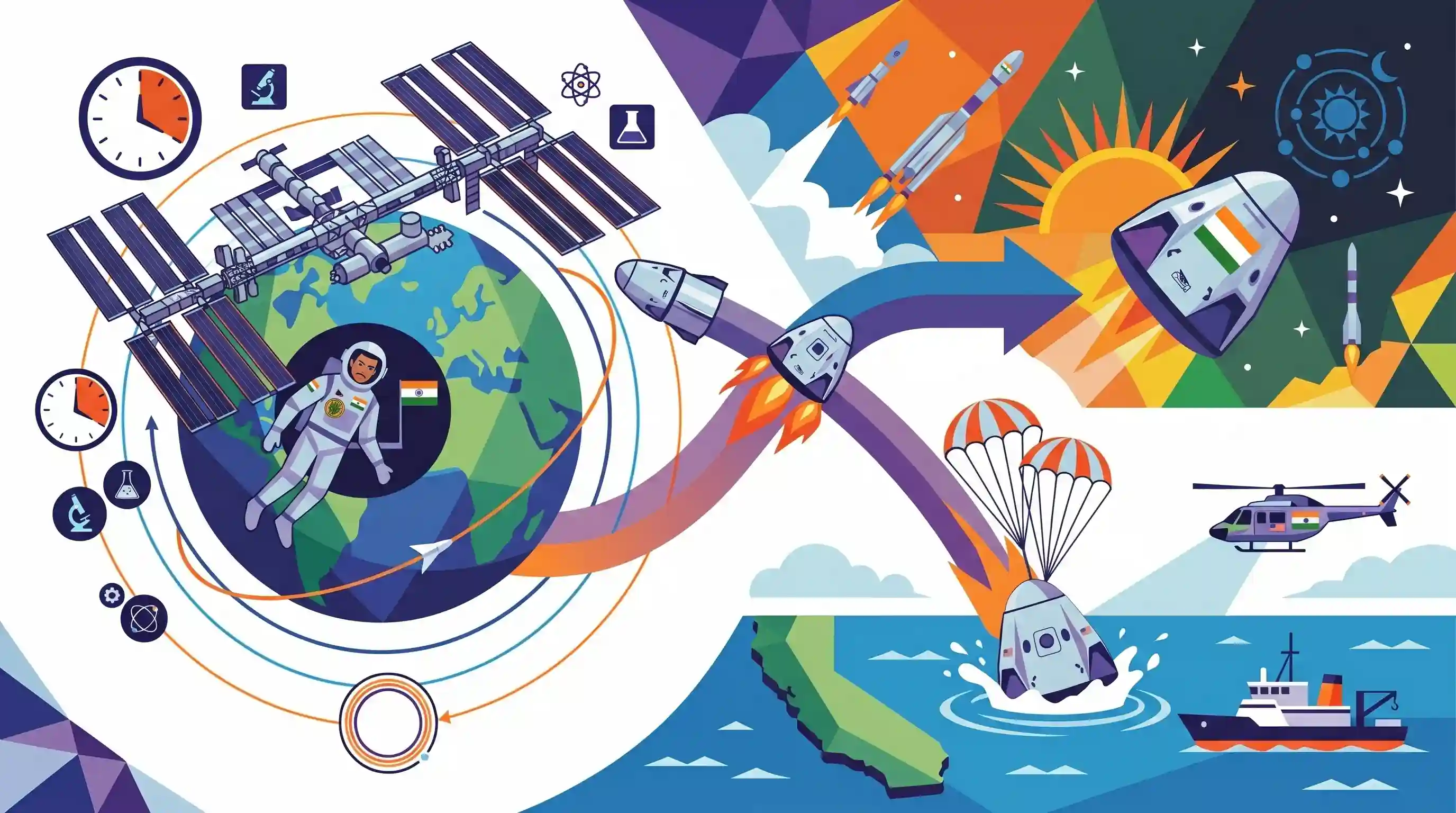
Group Captain Shubhanshu Shukla has safely returned to Earth after completing an 18-day Axiom-4 (Ax-4) mission aboard the International Space Station (ISS). Logging 433 hours in space and orbiting the Earth 288 times, Shukla became India's first astronaut to serve on the ISS. The return journey aboard a SpaceX Dragon spacecraft involved critical orbital maneuvers, culminating in a splashdown in the Pacific Ocean off California. The mission represents a significant milestone in India-US space collaboration and serves as a vital precursor to ISRO's indigenous Gaganyaan human spaceflight program.
Key Points
- Group Captain Shubhanshu Shukla successfully returned to Earth after completing an 18-day Axiom-4 (Ax-4) mission, becoming the first Indian astronaut to serve aboard the International Space Station (ISS).
- The Axiom-4 mission crew spent approximately 433 hours in space, orbiting the Earth 288 times and traversing roughly 12 million kilometers.
- The return journey aboard a SpaceX Dragon spacecraft required complex orbital maneuvers, including departure, phasing, and de-orbit burns, before a parachute-assisted splashdown in the Pacific Ocean.
- This collaborative mission with NASA and Axiom Space provides crucial micro-gravity research opportunities and operational experience for ISRO's upcoming indigenous human spaceflight program, Gaganyaan.
Important Terms
Gaganyaan

India's first indigenous human spaceflight mission designed to send a 3-member crew to a 400 km orbit for three days and return them safely to Earth.
UPSC context
GS-3 (Science & Tech); tests knowledge of indigenization, space safety protocols, and India's standing among global spacefaring nations.
Axiom-4 (Ax-4) Mission
A private crewed mission to the ISS (June-July 2025) involving NASA and ISRO, marking India's first astronaut participation in an International Space Station expedition.
UPSC context
GS-2 (International Relations) and GS-3 (Space Tech); tests India-US space diplomacy and transition to commercial space collaborations.
Axiom Space
An American private space infrastructure company that partners with NASA and international agencies like ISRO to provide commercial access to Low Earth Orbit and the ISS.
UPSC context
GS-3 (Economy/Science & Tech); highlights the growing role of private players and Public-Private Partnerships (PPP) in the global space sector.
Low Earth Orbit (LEO)
The orbital region closest to Earth (altitude 160–2,000 km) used for the ISS, Gaganyaan, and high-resolution Earth observation satellites.
UPSC context
GS-3 (Science & Tech); core conceptual topic regarding types of orbits, satellite communication, and manned spaceflight mission profiles.
International Space Station (ISS)
A modular, habitable space station in low Earth orbit; a multinational collaborative project involving five space agencies, serving as a microgravity research laboratory.
UPSC context
GS-3 (Science & Tech); tests awareness of global cooperation in space and the scientific significance of microgravity environments.
SpaceX Dragon
A reusable spacecraft developed by SpaceX to ferry crew and cargo to the ISS and other LEO destinations, featuring an autonomous docking system.
UPSC context
GS-3 (Space Tech); represents the shift toward reusable launch technology and commercial providers in modern human spaceflight.
Prelims Trap
"Rakesh Sharma was the first Indian astronaut to visit the International Space Station (ISS)."
Rakesh Sharma visited the Soviet Salyut-7 space station in 1984. Shubhanshu Shukla is the first Indian to actually board the International Space Station (ISS).
Static Concepts Connected
What are the key operational characteristics of the International Space Station (ISS)?
- Orbit Type: It operates in Low Earth Orbit (LEO) at an altitude of approximately 400 km.
- Intergovernmental Partnership: It is a multinational collaborative project involving five space agencies: NASA, Roscosmos, JAXA, ESA, and CSA.
- Microgravity Laboratory: It serves as a microgravity and space environment research laboratory for biology, physics, and meteorology.
What are the core technical components of ISRO's Gaganyaan mission?
- Launch Vehicle: Uses the human-rated LVM3 (HLVM3) rocket, previously known as GSLV Mk III.
- Orbital Module: Aims to demonstrate human spaceflight capability by launching a crew of 3 members to a 400 km orbit.
- Re-entry and Recovery: Involves a safe return to Earth via aerobraking and a parachute-assisted splashdown in Indian sea waters.
Cross-Topic Patterns
iCET Space Deliverables
The ISRO-NASA collaboration for this ISS mission is a tangible outcome of the US-India iCET, bridging strategic, technological, and commercial aerospace ties between the two nations.
Commercial Space & IN-SPACe
India's use of commercial entities like Axiom and SpaceX aligns with its own domestic space sector privatization drive (IN-SPACe), showing a shift beyond traditional state-to-state dependencies.

Expect a multi-statement question contrasting ISS, China's Tiangong, and India's planned Bharatiya Antariksha Station (BAS) in 2026.
Linked PYQs · 2
Linked PYQs · 2
- 2025PrelimsGS1
Consider the following space missions : I. Axiom-4 II. SpaDeX III. Gaganyaan How many of the space missions given above encourage and support micro-gravity research?
- 2017MainsGS3
India has achieved remarkable successes in unmanned space missions including the Chandrayaan and Mars Orbitter Mission, but has not ventured into manned space missions. What are the main obstacles to launching a manned space mission, both in terms of technology and logistics? Examine critically.
