AWS Summit 2026: New AI Chips and Digital Infrastructure Focus
Source:The Hindu ↗
Why It Matters
The introduction of advanced 3nm AI chips and frontier agents signals a leap in generative and autonomous AI capabilities, crucial for the GS3 Science & Technology syllabus. Furthermore, the integration of critical national e-governance frameworks (like DigiLocker and GeM) with major global cloud providers raises important questions about digital sovereignty, data security, and the future of India's Digital Public Infrastructure.
Summary
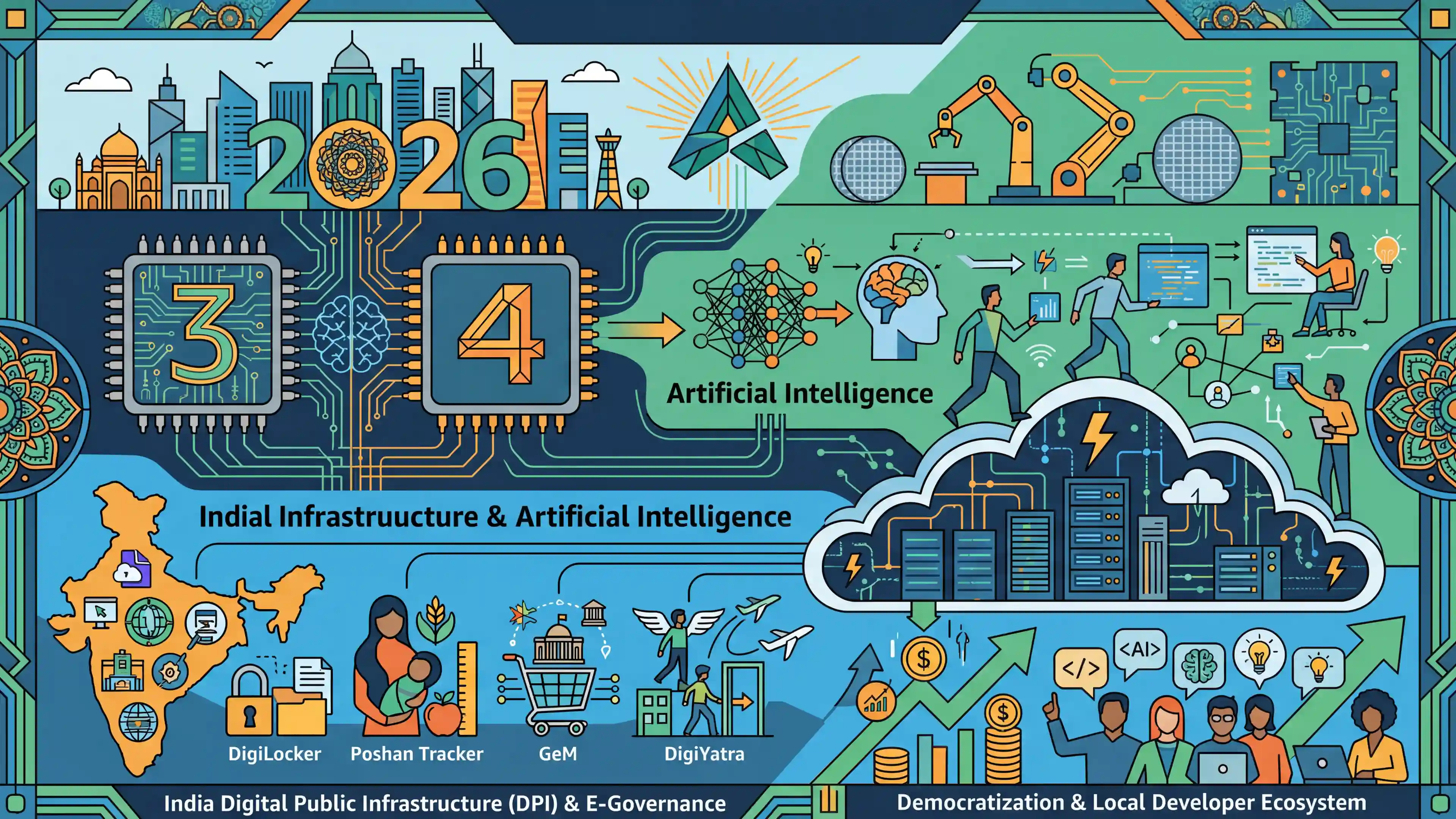
At the AWS Bengaluru Summit 2026, Amazon Web Services launched its advanced Trainium3 AI chips and Graviton4 processors in India, emphasizing custom silicon and the deployment of AI-driven "frontier agents." AWS underscored its strategic focus on India by highlighting its infrastructure support for major Digital Public Infrastructure (DPI) and e-governance platforms, including DigiLocker, Poshan Tracker, GeM, and DigiYatra. The event also reaffirmed Amazon's commitment to massive investments in India to democratize AI access and bolster the local developer ecosystem.
Key Points
- AWS unveiled Trainium3, its first 3nm AI chip designed for next-generation agentic, reasoning, and video generation applications, alongside Graviton4 processors for cloud workloads.
- The summit showcased "frontier agents" such as the agentic coding service Kiro, AWS Security Agent, and AWS DevOps agents, highlighting the shift towards autonomous AI tasks.
- Key Indian digital public infrastructure and governance platforms—including DigiLocker, Poshan Tracker, GeM, and DigiYatra—rely on AWS cloud and infrastructure.
- Amazon reaffirmed its commitment to invest over $35 billion in India by 2030, emphasizing AI democratization and the motto of "building from India, for India and the world."
Important Terms
Digital Public Infrastructure (DPI)

A set of shared, interoperable digital systems (like Aadhaar and UPI) enabling the delivery of public and private services at a societal scale.
UPSC context
GS Paper 3 (Economy/Technology); critical for understanding India's digital leadership and inclusive growth models.
DigiLocker
A flagship Digital India initiative providing a secure cloud-based platform for the storage, sharing, and verification of authentic government-issued documents.
UPSC context
GS Paper 2 (E-governance); tests knowledge of digital empowerment and paperless governance initiatives.
Government e-Marketplace (GeM)
A centralized online procurement portal for government departments and PSUs to purchase common-use goods and services transparently and efficiently.
UPSC context
GS Paper 3 (Indian Economy); focuses on public procurement reforms and MSME empowerment.
Poshan Tracker
An ICT-enabled platform under Mission Poshan 2.0 designed to monitor Anganwadi services and track real-time nutritional outcomes for mothers and children.
UPSC context
GS Paper 2 (Social Justice/Health); relevant for nutrition monitoring and government welfare interventions.
DigiYatra
A facial recognition-based biometric boarding system aimed at providing a seamless, paperless, and contactless travel experience at Indian airports.
UPSC context
GS Paper 3 (Science & Technology); explores application of biometric technology in public infrastructure.
Custom Silicon (AI Chips)
Specialized semiconductor chips (like Trainium3 and Graviton4) designed for high-performance AI training and energy-efficient general-purpose cloud computing.
UPSC context
GS Paper 3 (Science & Tech); highlights global semiconductor trends and hardware for the AI revolution.
Prelims Trap
"Core Indian digital public infrastructures like DigiLocker and Poshan Tracker are hosted exclusively on government-owned cloud infrastructure."
While governed by the state, highly scalable DPIs often utilize private enterprise cloud architectures (like AWS) rather than strictly government-owned NIC servers to manage massive data loads.
Static Concepts Connected
What does a 3nm fabrication process signify in semiconductor technology?
- Transistor density: A smaller nanometer number means smaller transistors, allowing exponentially more to fit on a single silicon chip.
- Energy efficiency: Electrons travel shorter distances, which significantly reduces power consumption and heat generation compared to older 5nm or 7nm nodes.
- Processing speed: Increased transistor density directly enhances computational power and speed, which is crucial for running complex AI and LLM workloads.
How does Agentic AI differ from traditional Generative AI?
- Autonomy: Generative AI requires human prompts to act; Agentic AI can initiate actions autonomously and execute multi-step workflows.
- Reasoning: Agentic AI continuously perceives its environment, reasons, and adapts its logic to achieve a predefined, complex goal.
- Execution capability: It interfaces with external software tools and APIs to complete tasks, rather than just generating text or image outputs.
Cross-Topic Patterns
DPIs on foreign cloud vs Data Sovereignty
The reliance of critical governance tools like Poshan Tracker and DigiLocker on foreign enterprise clouds (AWS) reignites debates over data localization, cloud sovereignty, and the DPDP Act 2023.
AI Chips and India's Semiconductor Mission
As AWS deploys 3nm AI chips in India, it highlights the technology gap India's Semiconductor Mission and PLI schemes aim to bridge, shifting focus from legacy nodes to frontier tech.

Prelims 2026 will likely test the technical distinction between Agentic and Generative AI, or the cloud infrastructure hosting India's DPIs.
Linked PYQs · 3
Linked PYQs · 3
- 2025MainsGS3
India aims to become a semiconductor manufacturing hub. What are the challenges faced by the semiconductor industry in India? Mention the salient features of the India Semiconductor Mission.
- 2023MainsGS3
Introduce the concept of Artificial Intelligence (AI). How does Al help clinical diagnosis? Do you perceive any threat to privacy of the individual in the use of Al in healthcare?
- 2022PrelimsGS1
Consider the following : 1. Aarogya Setu 2. CoWIN 3. DigiLocker 4. DIKSHA Which of the above are built on top of open-source digital platforms?
