Himachal Issues Travel Advisory Amid Severe Monsoon Toll
Source:times-of-india ↗
Why It Matters
Cloudbursts, flash floods, and landslides in Himachal Pradesh are recurrent environmental hazards. The event is a prime case study for the HPAS exam regarding the geographic vulnerability of the Himalayas, the mechanics of monsoon rainfall, and the practical implementation of disaster management frameworks such as early warning systems (IMD alerts) and institutional responses (SEOC, SDRF).
Summary
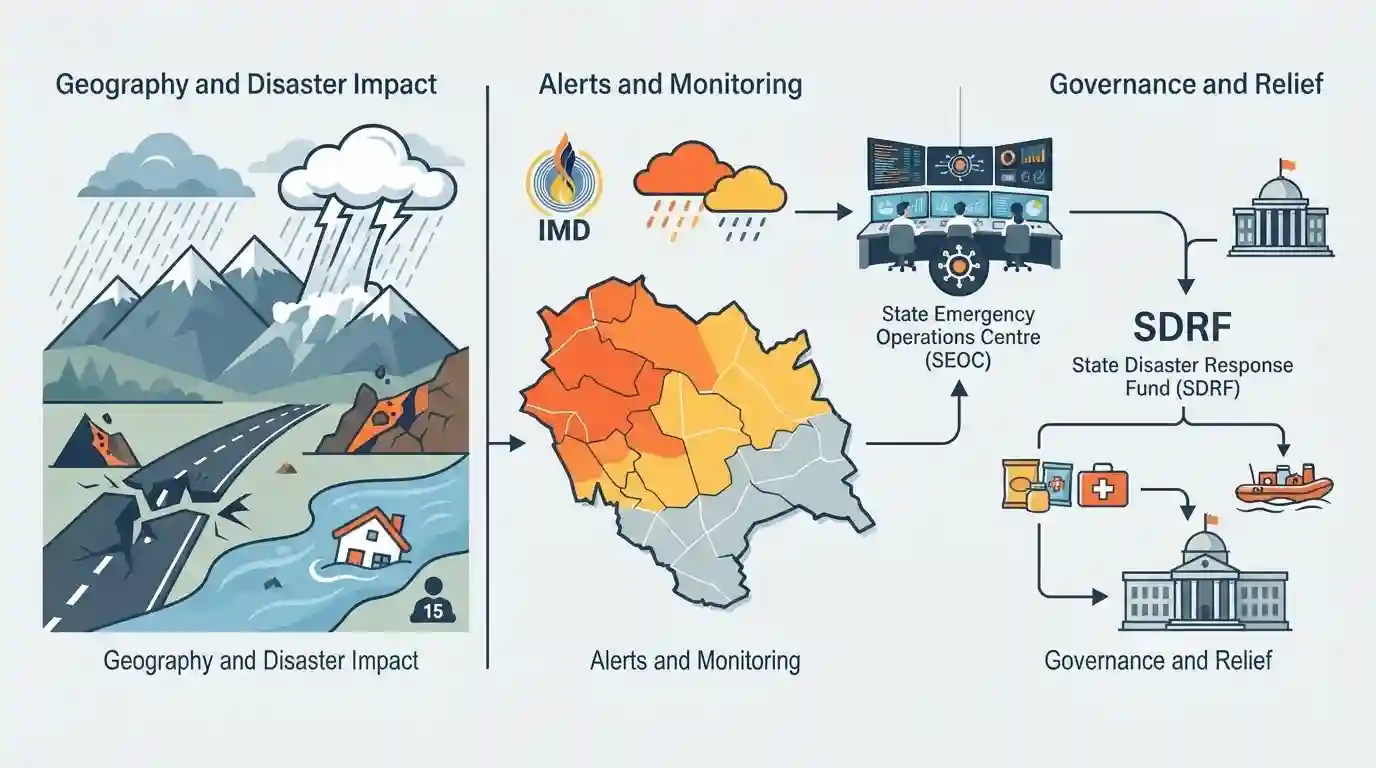
The Himachal Pradesh government has issued warnings advising people to avoid unnecessary travel as heavy monsoon rains continue to batter the state. Cloudbursts, flash floods, and landslides have raised the death toll to 15, with structural and infrastructural damages estimated at nearly Rs 1,000 crore. The Indian Meteorological Department (IMD) has issued 'orange' and 'yellow' alerts across vulnerable districts. Administrative efforts are being coordinated through the State Emergency Operations Centre (SEOC), with funds and relief routed via the State Disaster Response Fund (SDRF).
Key Points
- Heavy rainfall, cloudbursts, flash floods, and landslides in Himachal Pradesh have resulted in 15 deaths and estimated damages of nearly Rs 1,000 crore.
- The Indian Meteorological Department (IMD) has issued 'orange' and 'yellow' alerts for several districts, indicating heavy to moderate rainfall.
- The State Emergency Operations Centre (SEOC) is monitoring the situation, while the State Disaster Response Fund (SDRF) mechanism is active for relief and rehabilitation.
- The recurring nature of these events underscores the geographic vulnerability of the Himalayan region to monsoon-induced disasters and the critical need for effective early warning systems.
Important Terms
State Disaster Response Fund (SDRF)

The primary fund constituted under the Disaster Management Act, 2005, allowing state governments to provide immediate relief during notified natural disasters. It is funded jointly by the Centre and States.
UPSC context
GS Paper 3 (Disaster Management). Tests knowledge of federal financial architecture for disaster relief and mitigation.
Indian Meteorological Department (IMD)
An agency under the Ministry of Earth Sciences responsible for weather forecasting, seismology, and issuing early warnings for severe weather events like cyclones, floods, and cloudbursts across India.
UPSC context
GS Paper 3 (Disaster Management) & GS 1 (Geography). Evaluates understanding of early warning systems and institutional preparedness.
State Emergency Operations Centre (SEOC)
The primary state-level nerve centre functioning under the State Disaster Management Authority (SDMA). It coordinates real-time emergency response, integrating communications and resource deployment between local, state, and central agencies.
UPSC context
GS Paper 3 (Disaster Management). Tests institutional frameworks, inter-agency coordination, and disaster response mechanisms at the state level.
Cloudburst
An extreme weather event defined by the IMD as highly localized, sudden rainfall exceeding 100mm per hour over a 20-30 square kilometre area, frequently causing devastating flash floods in mountainous regions.
UPSC context
GS Paper 1 (Geography) & GS 3 (Disaster Management). Tests knowledge of geophysical phenomena and climate change impacts.
Colour-Coded Weather Alerts
IMD issues universal colour-coded alerts (Green, Yellow, Orange, Red) to indicate weather event severity. 'Yellow' advises awareness, while 'Orange' warns of extremely bad weather requiring preparedness for potential disruptions.
UPSC context
GS Paper 3 (Disaster Management). Crucial for assessing early warning systems, risk communication, and administrative preparedness protocols.
Prelims Trap
A cloudburst is defined as any unexpected, heavy rainfall exceeding 50 mm per hour in a localized hilly region.
IMD strictly defines a cloudburst as rainfall exceeding 100 mm per hour over a small geographical area of approximately 20 to 30 square kilometres. 50 mm/hr does not qualify.
Static Concepts Connected
What do the IMD's colour-coded weather alerts signify?
- Yellow Alert: Signifies 'be updated'. Indicates severely bad weather spanning across several days.
- Orange Alert: Signifies 'be prepared'. Warning of extremely bad weather with potential disruptions in commute and power supply.
- Red Alert: Signifies 'take action'. Indicates extremely bad weather posing an immediate risk to life and causing widespread disruption.
How is the State Disaster Response Fund (SDRF) constituted and funded?
- Statutory Basis: Established under the Disaster Management Act, 2005. It serves as the primary fund available with State Governments for immediate responses to notified disasters.
- Funding Pattern: The Centre contributes 75% for general category states and 90% for North-Eastern and Himalayan states (including Himachal Pradesh).
- Fund Auditing: The accounts of the SDRF are audited annually by the Comptroller and Auditor General (CAG) of India.
Cross-Topic Patterns
Himalayan Carrying Capacity & Infra
Frequent landslides and flash floods in HP are increasingly linked to run-of-the-river hydroelectric projects and unregulated highway widening, bridging physical geography with infrastructure governance.
Climate Change & Micro-Climatic Events
The rising frequency of cloudbursts in the Himalayas reflects a broader pattern of warming-induced moisture loading, connecting global climate models to localized disaster mitigation strategies.

Expect a 2026 multi-statement prelims question testing IMD's strict cloudburst criteria (100mm/hr) alongside SDRF Himalayan funding rules.
Linked PYQs · 3
Linked PYQs · 3
- 2023HPAS_PRELIMSGS1
Consider the following statements : (1) The rainiest district in Himachal Pradesh is Kangra. (2) Rainfall in the Alpine region of Himachal Pradesh varies between 300-600 mm. (3) Winter season in Himachal Pradesh extends from October to March. (4) Mandi is the hottest place in Himachal Pradesh. Choose the correct answer from the options given below :
- 2025HPAS_PRELIMSGS1
Mountain Soil Zone in Himachal Pradesh is found between :
- 2025HPAS_PRELIMSGS1
When was the National Centre for Disaster Management established in India ?
