Solan Avocado Cultivation Boosts Crop Diversification in Himachal
Source:the-news-himachal ↗
Why It Matters
Crop diversification towards high-value exotic fruits like avocados is a critical component of state agricultural policy. It helps increase farmers' incomes, mitigates the risks associated with monoculture or traditional farming, and demonstrates the practical application of centrally sponsored schemes like MIDH at the local level.
Summary
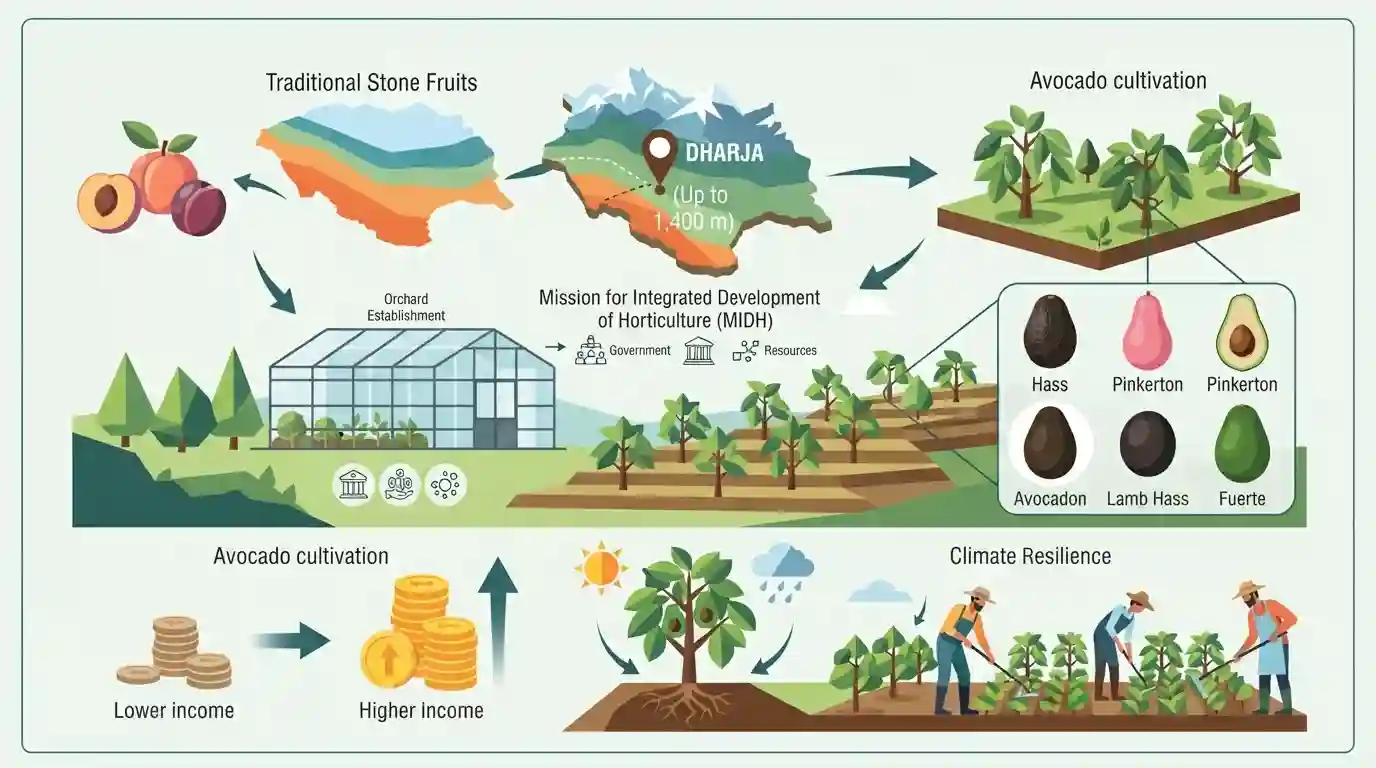
Himachal Pradesh is venturing into high-value exotic fruit cultivation with the establishment of Solan district's first avocado orchard in Dharja. Backed by the Mission for Integrated Development of Horticulture (MIDH), the initiative involves planting premium avocado varieties like Hass, Pinkerton, Lamb Hass, and Fuerte. The successful introduction of these crops at altitudes up to 1,400 meters represents a strategic move towards crop diversification, aiming to enhance farm incomes and build climate resilience by shifting away from traditional stone fruits.
Key Points
- Solan district in Himachal Pradesh witnessed the establishment of its first avocado orchard in Dharja, showcasing a shift towards exotic fruit cultivation.
- The orchard features several high-yielding avocado varieties, including Hass, Pinkerton, Lamb Hass, and Fuerte.
- This crop diversification initiative was financially and technically supported by the Mission for Integrated Development of Horticulture (MIDH).
- Avocado cultivation has shown potential in agro-climatic zones of Himachal Pradesh up to an altitude of 1,400 meters.
Important Terms
Mission for Integrated Development of Horticulture (MIDH)

A Centrally Sponsored Scheme promoting the holistic growth of the horticulture sector. It provides financial and technical assistance for crop diversification, quality planting, infrastructure, and post-harvest management.
UPSC context
Crucial for HPAS GS-3 (Agriculture); tests knowledge of government interventions, funding patterns, and schemes driving rural income enhancement.
Crop Diversification
A strategic agricultural shift from traditional crops, such as conventional stone fruits, to a broader portfolio of high-value or climate-resilient alternatives like exotic avocados.
UPSC context
Core to HPAS GS-3; addresses climate change adaptation, agricultural risk mitigation, and state strategies for boosting horticultural incomes.
Mid-Hill Agro-Climatic Zone
Altitudinal regions in Himachal Pradesh, such as Solan (up to 1,400 meters), featuring a moderate climate perfectly suited for transitioning from traditional farming to sub-tropical exotic fruit cultivation.
UPSC context
Important for HPAS GS-1 and GS-3 (HP Geography & Economy); tests understanding of regional crop suitability and state land-use planning.
Premium Avocado Varieties
High-value, exotic fruit cultivars—specifically Hass, Pinkerton, Lamb Hass, and Fuerte—introduced in Himachal Pradesh's mid-hills to replace traditional crops and build a climate-resilient horticultural economy.
UPSC context
Relevant for HPAS Prelims and GS-3. Tests awareness of specific agricultural innovations, new high-yield crops, and modern farming trends in HP.
Department of Horticulture (Himachal Pradesh)
The primary state agency responsible for executing schemes like MIDH, conducting scientific crop trials, and providing technical training to transition farmers toward profitable exotic fruit cultivation.
UPSC context
Important for HPAS GS-2 (Governance); highlights the role of state administration in agricultural modernization, policy implementation, and farmer welfare.
Prelims Trap
"Hass, Pinkerton, and Fuerte are high-yielding apple varieties newly introduced in Himachal Pradesh."
Aspirants often default to assuming any new high-yielding fruit variety in HP is an apple. These are actually exotic avocado varieties.
Static Concepts Connected
What are the key features of the Mid-Hill Agro-Climatic Zone of HP?
- Altitude: Ranges from 651 to 1,800 meters above mean sea level.
- Coverage: Covers parts of Solan, Sirmour, Mandi, Kangra, and Kullu.
- Crop Suitability: Traditionally suited for stone fruits (peach, plum), kiwi, and increasingly exotic crops like avocados.
What is the funding and scope of MIDH for Himachal Pradesh?
- Scheme Type: Centrally Sponsored Scheme (CSS) launched to promote holistic growth of the horticulture sector.
- Funding Pattern: For Himalayan states like Himachal Pradesh, the Centre and State share funding in a 90:10 ratio.
- Scope: Supports technical advice, planting material, and infrastructure for fruits, vegetables, mushrooms, and spices.
Cross-Topic Patterns
Crop Diversification for Climate Resilience
Shifting from traditional stone fruits to exotic avocados in mid-hills aligns with HP’s Climate Change Action Plan, helping farmers mitigate the impact of fluctuating chill-hour requirements for traditional crops.
Solan's Evolving Horticultural Identity
Solan is expanding its agricultural identity. Already famous as India's Mushroom City and for its tomatoes (Solan Gola), integrating high-value exotics like avocados further boosts its horticultural dominance.

Expect a match-the-following question pairing new exotic varieties (Hass, Fuerte) with their fruit type or HP agro-climatic zone.
Linked PYQs · 3
Linked PYQs · 3
- 2025HPAS_PRELIMSGS1
Mountain Soil Zone in Himachal Pradesh is found between :
- 2025HPAS_PRELIMSGS1
Match List I with List II : | List-I (Scheme) | List-II (Launch Year) | |---|---| | (a) Mukhya Mantri Roshni Yojana | (i) 2015 | | (b) Himachal Pradesh Horticulture Development Project | (ii) 2019 | | (c) Mukhya Mantri Gram Path Yojana | (iii) 2009 | | (d) Swavalamban Yojana | (iv) 2020 | Choose the correct answer from the options given below : Code: (a) (b) (c) (d)
- 2024HPAS_PRELIMSGS1
Arrange the following climatic zones of Himachal Pradesh according to rainfall amount from lowest to highest : (1) Frigid aridic zone (2) Wet temperate zone (3) Humid sub-tropical zone (4) Sub-humid sub-tropical zone Choose the correct answer from the options given below :
