Parliamentary Panel Examines Aviation Safety and Regulation
Source:The Hindu ↗
Why It Matters
Demonstrates the functional utility of Department-related Parliamentary Standing Committees in holding regulatory bodies (like DGCA) accountable and driving structural reforms for institutional independence.
Summary
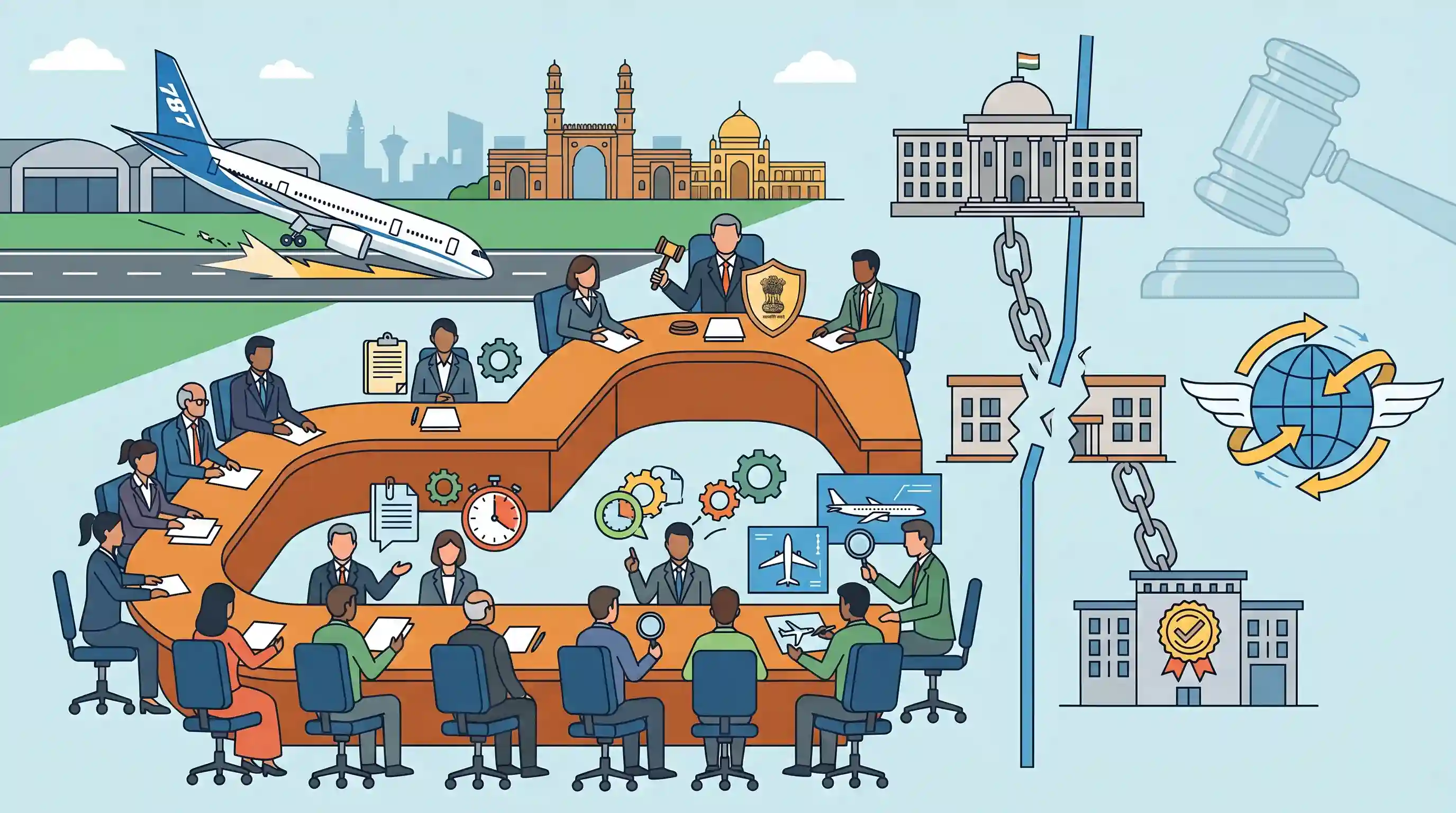
The Parliamentary Standing Committee on Transport, Tourism, and Culture convened to scrutinize aviation safety protocols following an Air India Boeing 787 tail strike in Ahmedabad. Summoning officials from the Directorate General of Civil Aviation (DGCA) and the Aircraft Accident Investigation Bureau (AAIB), the panel raised critical concerns regarding regulatory oversight and delayed enforcement of safety norms. A major structural reform discussed was establishing the AAIB as a completely independent investigative body detached from the Ministry of Civil Aviation, modeled after the U.S. National Transportation Safety Board (NTSB), to ensure impartial crash investigations. The meeting underscores the role of parliamentary oversight in enforcing executive accountability and standardizing India's aviation safety in alignment with ICAO guidelines.
Key Points
- The Parliamentary Standing Committee on Transport, Tourism, and Culture summoned the DGCA and AAIB over aviation safety after a recent Air India Boeing 787 tail strike in Ahmedabad.
- Members stressed the need to make the Aircraft Accident Investigation Bureau (AAIB) fully independent from the Civil Aviation Ministry, similar to the U.S. National Transportation Safety Board (NTSB).
- Concerns were raised about the DGCA's delayed response to safety violations and the efficacy of its auditing processes.
- Industry representatives and committee members urged strict enforcement of International Civil Aviation Organization (ICAO) safety standards.
Important Terms
Directorate General of Civil Aviation (DGCA)

India's apex regulatory body for civil aviation, functioning as an attached office of the Ministry of Civil Aviation. It oversees safety, licensing, airworthiness, and coordinates with international bodies like the ICAO.
UPSC context
GS Paper 2/3: Statutory and Regulatory Bodies. Tests understanding of executive oversight, safety regulations, and infrastructure management.
Aircraft Accident Investigation Bureau (AAIB)
A statutory body under the Ministry of Civil Aviation responsible for investigating civil aircraft accidents and serious incidents in India. It was established in 2012 to ensure investigative independence from the regulator (DGCA).
UPSC context
GS Paper 3: Infrastructure and Disaster Management. Relevant for institutional reforms and the separation of regulatory and investigative functions.
International Civil Aviation Organization (ICAO)
A specialized agency of the United Nations established by the 1944 Chicago Convention. It sets global Standards and Recommended Practices (SARPs) for aviation safety, security, and environmental protection.
UPSC context
GS Paper 2: International Institutions. Evaluates knowledge of global governance frameworks and India's compliance with international treaties.
Parliamentary Standing Committee on Transport, Tourism, and Culture
A permanent panel of Members of Parliament that scrutinizes the policies, annual reports, and Demands for Grants of the Ministry of Civil Aviation and related sectors to ensure executive accountability.
UPSC context
GS Paper 2: Parliament and State Legislatures. Tests the role of committees in legislative oversight and financial scrutiny.
National Transportation Safety Board (NTSB)
An independent U.S. government agency dedicated to investigating transportation accidents. It is often cited as a global model for establishing autonomous, impartial investigative bodies free from regulatory or political influence.
UPSC context
GS Paper 2/3: Governance and Regulatory Reform. Important for comparative analysis of independent investigative mechanisms.
Ministry of Civil Aviation
The nodal administrative authority in India responsible for formulating national policies and programs for the development and regulation of civil aviation, overseeing the DGCA, AAIB, and AAI.
UPSC context
GS Paper 2: Government Policies and Interventions. Focuses on the executive structure and policy-making for the aviation sector.
Prelims Trap
The Aircraft Accident Investigation Bureau (AAIB) is an independent statutory body under the DGCA.
AAIB was separated from DGCA in 2012 to avoid conflict of interest, but it remains under the Ministry of Civil Aviation, currently lacking full statutory independence.
Static Concepts Connected
What is the statutory status and role of the DGCA in India?
- Statutory Status: Upgraded from an attached office to a statutory body under the Aircraft (Amendment) Act, 2020.
- Core Function: Serves as India's primary civil aviation regulator responsible for safety oversight, airworthiness, and licensing.
- Separation of Powers: Accident investigation is deliberately separated from DGCA's regulatory role to prevent conflict of interest.
What is the International Civil Aviation Organization (ICAO)?
- UN Agency: A specialized agency of the United Nations established by the Chicago Convention in 1944.
- Airspace Sovereignty: Affirms that every state has complete and exclusive sovereignty over the airspace above its territory.
- Safety Standards: Sets global aviation safety standards (Annex 13), which originally prompted India's creation of the AAIB.
Cross-Topic Patterns
Executive accountability via DRSCs
DRSCs scrutinizing technical regulators like the DGCA highlights parliamentary oversight bridging complex governance gaps and ensuring continuous executive accountability.
Independent investigators vs. Regulators
The demand to detach AAIB from the Civil Aviation Ministry mirrors regulatory governance themes, emphasizing the separation of policy, regulation, and impartial investigation.

Expect multi-statement Prelims questions mixing the statutory evolution of the DGCA (2020 Act) with the Chicago Convention (ICAO).
Linked PYQs · 3
Linked PYQs · 3
- 2017MainsGS2
Discuss the role of Public Accounts Committee in establishing accountability of the government to the people.
- 2021MainsGS2
Do Department-related Parliamentary Standing Committees keep the administration on its toes and inspire reverence for parliamentary control? Evaluate the working of such committees with suitable examples.
- 2014MainsGS3
International civil aviation laws provide all countries complete and exclusive sovereignty over the airspace above their territory. What do you understand by 'airspace'? What are the implications of these laws on the space above this airspace? Discuss the challenges which this poses and suggest ways to contain the threat.
