Zojila Pass Avalanche and Himalayan Transport Vulnerability
Source:The Hindu ↗
Why It Matters
Avalanches and landslides in the Himalayan region are critical topics for UPSC GS3 Disaster Management and GS1 Geography. Understanding the geographical significance of passes like Zojila (connecting Kashmir to Ladakh) and the need for proactive disaster mitigation, hazard zonation, and infrastructure resilience in ecologically fragile zones is essential for aspirants.
Summary
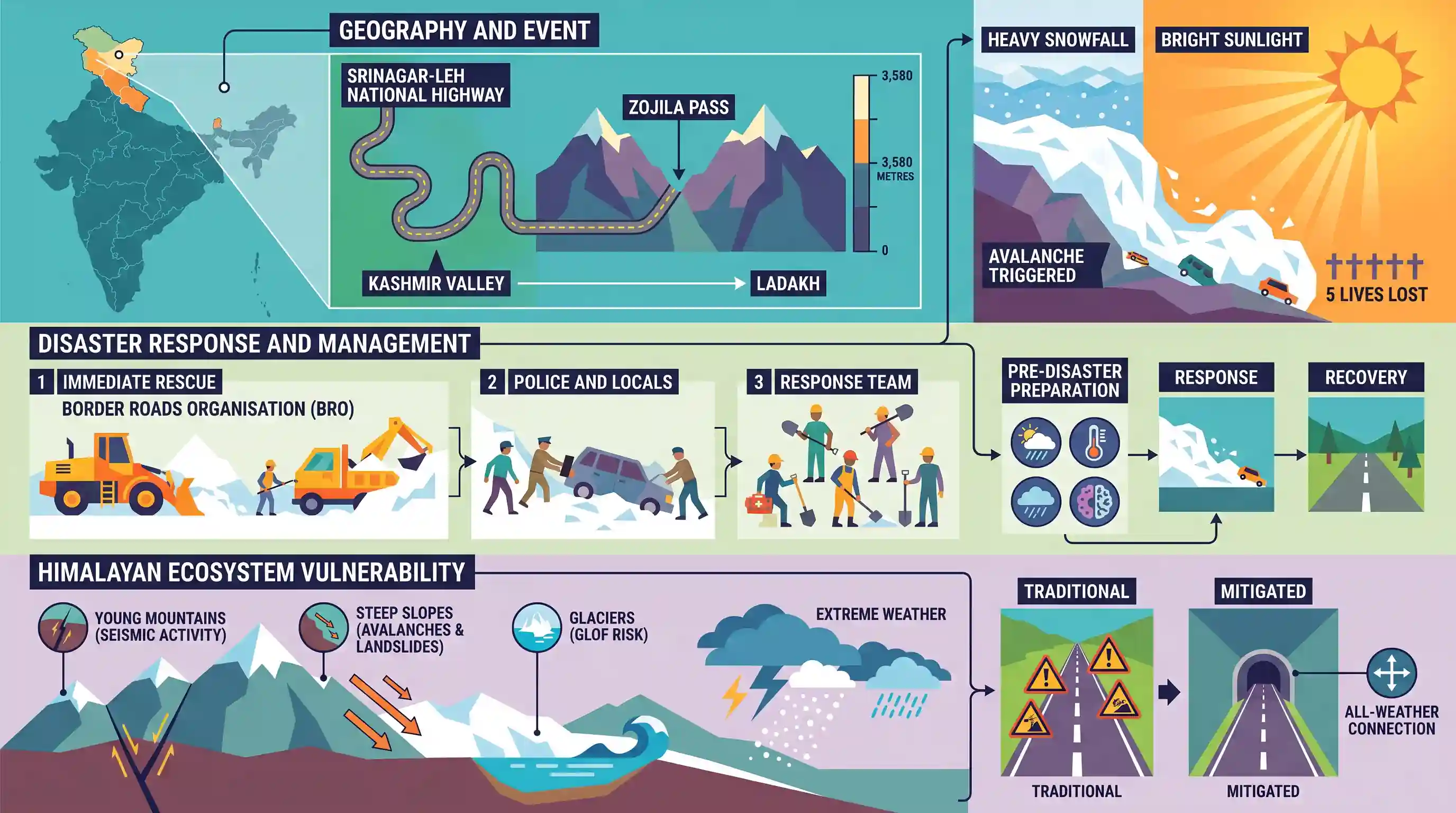
Five people lost their lives after a major snow avalanche struck the Srinagar-Leh National Highway near the Zojila Pass. The avalanche, triggered by bright sunlight following heavy snowfall, buried several vehicles traversing the 3,580-metre-high mountain pass that connects the Kashmir Valley with Ladakh. Rescue operations were carried out by the Border Roads Organisation, police, and locals. The incident highlights the acute vulnerability of Himalayan transport corridors to extreme weather events and natural disasters like avalanches and landslides.
Key Points
- A massive snow avalanche hit the Srinagar-Leh National Highway near Zero Point at the Zojila Pass, resulting in the deaths of five people.
- The avalanche buried two trucks and a load carrier crossing the 3,580-metre-high pass, which serves as a crucial link connecting the Kashmir Valley with Ladakh.
- Rescue operations were swiftly launched by the Border Roads Organisation (BRO)'s Project Beacon, local police, and volunteers.
- The avalanche was reportedly triggered by bright sunlight following recent spells of heavy snowfall in the region.
Important Terms
Border Roads Organisation (BRO)

A premier construction agency under the Ministry of Defence that develops and maintains road infrastructure in India's border areas and friendly neighboring countries.
UPSC context
GS Paper III (Internal Security & Infrastructure); tests knowledge of strategic connectivity and the role of defense-related agencies.
Project Beacon
The oldest project of the BRO, established in 1960 to maintain critical road infrastructure in the Kashmir region, including the strategic Srinagar-Leh highway.
UPSC context
GS Paper III (Infrastructure); specifically relevant for regional connectivity projects in sensitive border zones like Jammu and Kashmir.
Zojila Pass
A strategic high-altitude mountain pass in the Zanskar Range (approx. 3,528m) that serves as the only terrestrial link between the Kashmir Valley and Ladakh.
UPSC context
GS Paper I (Geography); critical for map-based questions and understanding India's strategic gateways in the Himalayas.
Zojila Tunnel Project
An under-construction 14.2 km bi-directional road tunnel designed to provide all-weather connectivity between Srinagar and Leh, bypassing the avalanche-prone Zojila Pass.
UPSC context
GS Paper III (Infrastructure); tests awareness of major national projects aimed at strategic mobility and disaster risk reduction.
Jammu and Kashmir Police
The primary law enforcement agency of the Union Territory, responsible for internal security, counter-insurgency, and coordinating first-response rescue operations during natural disasters in the region.
UPSC context
GS Paper III (Internal Security); relevant for the role of state/UT forces in disaster management and security.
Avalanche
A rapid flow of snow down a mountain slope, often triggered by temperature changes or heavy snowfall, posing a major risk to Himalayan transport corridors.
UPSC context
GS Paper III (Disaster Management); tests understanding of natural hazards in the fragile Himalayan ecosystem.
Prelims Trap
"Zojila Pass is located in the Pir Panjal range and connects Kashmir to Gilgit."
Zojila is in the Zanskar Range (Greater Himalayas) connecting Srinagar to Leh. Pir Panjal hosts the Banihal pass, and Burzil connects to Gilgit.
Static Concepts Connected
What are the key strategic mountain passes of Jammu, Kashmir, and Ladakh?
- Zojila Pass: Located in the Zanskar Range, it acts as the primary gateway connecting the Kashmir Valley (Srinagar) to Ladakh (Leh).
- Banihal Pass: Located in the Pir Panjal Range, it connects Jammu to Srinagar (Kashmir Valley) and hosts the Jawahar Tunnel.
- Burzil Pass: Located in the Greater Himalayas, it historically connected Srinagar to Gilgit.
- Khardung La: Located in the Ladakh Range, it connects Leh to the strategically critical Nubra Valley and Siachen Glacier.
What is a 'wet snow avalanche' and how does it form?
- The Trigger: Caused by bright sunlight, rain, or sudden temperature rises following heavy snowfall, which rapidly melts the top layer of the snowpack.
- The Mechanism: Liquid water seeps down, weakening the internal cohesion of the snow and lubricating the sliding surface underneath, causing the slope to fail.
- Destructive Impact: Though slower than dry slab avalanches, wet avalanches are incredibly dense and act like a concrete debris flow, easily destroying infrastructure.
Cross-Topic Patterns
Border Infrastructure & NATM Engineering
The Zojila Tunnel, bypassing the avalanche-prone pass, uses the New Austrian Tunnelling Method (NATM) to ensure all-weather strategic troop movement to Ladakh.
Climate Anomalies & Wet Avalanches
Increasing instances of rapid temperature spikes immediately following heavy snowfall alter Himalayan snowpack dynamics, turning typical winter hazards into highly destructive wet snow avalanches.

Expect a 'match the following' prelims question pairing strategic Himalayan passes with their respective ranges or connected regions in 2026.
Linked PYQs · 3
Linked PYQs · 3
- 2021MainsGS3
Describe the various causes and the effects of landslides. Mention the important components of the National Landslide Risk Management Strategy.
- 2019MainsGS3
Disaster preparedness is the first step in any disaster management process. Explain how hazard zonation mapping will help disaster mitigation in the case of landslides.
- 2020MainsGS3
Discuss the recent measures initiated in disaster management by the Government of India departing from the earlier reactive approach.
