Autonomous Vehicle Technology and Regulatory Challenges in Transport
Source:The Hindu ↗
Why It Matters
Autonomous vehicles represent a monumental leap in AI and robotics with far-reaching implications for urban infrastructure, employment, and ethics. Civil servants must understand these emerging technologies to formulate forward-looking regulations, address the socio-economic impact of job displacement, and navigate the moral complexities of algorithmic decision-making.
Summary
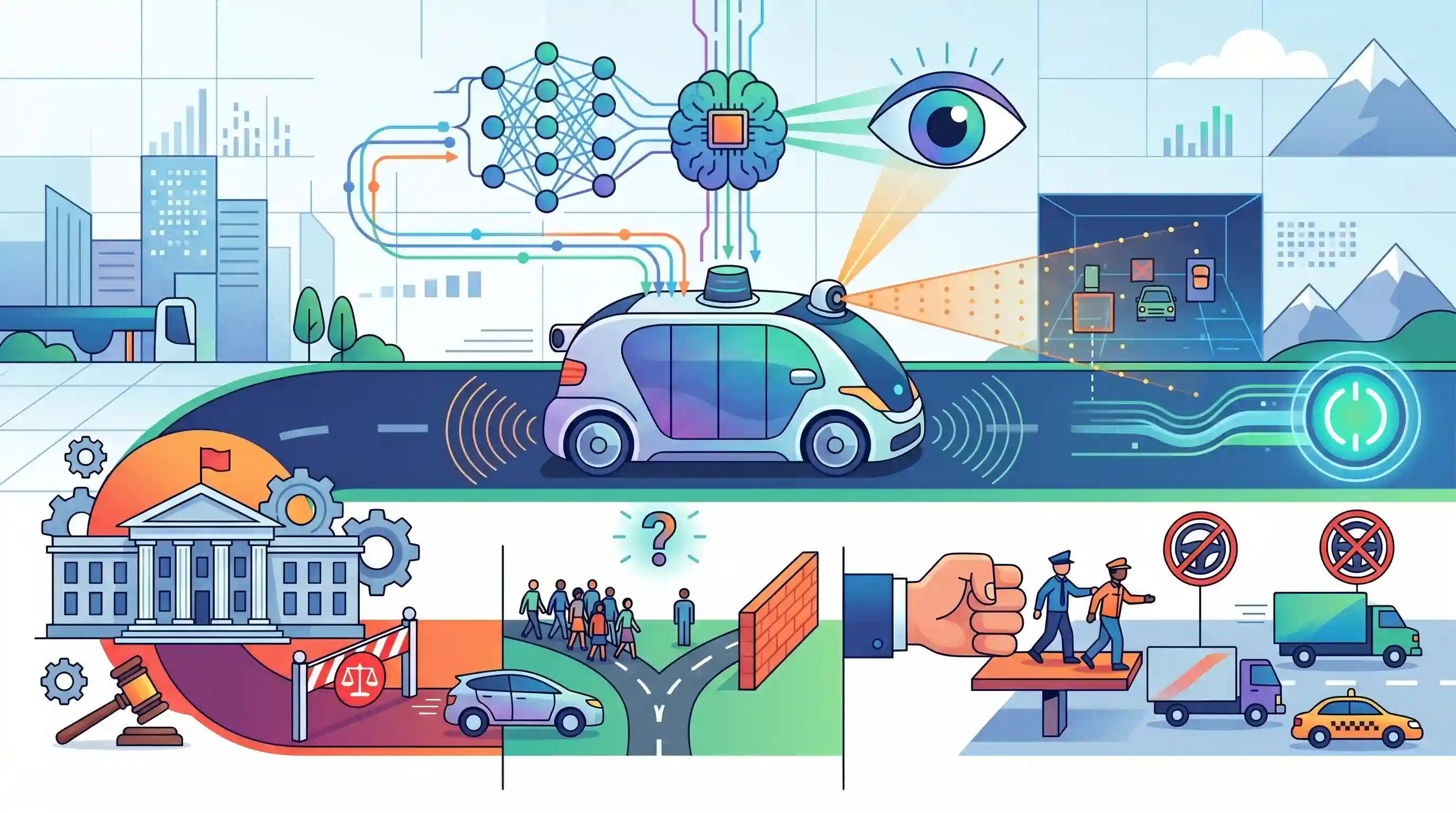
The article explores the rapid advancements and ongoing challenges in autonomous vehicle technology, commonly known as driverless cars or robotaxis. It highlights the technological foundations of these systems, which integrate Artificial Intelligence, neural networks, and diverse sensor configurations—ranging from Tesla's camera-centric approach to Waymo's reliance on LiDAR. As the industry pushes towards Level 5 full automation, it faces significant hurdles beyond just technological refinement. Key issues include regulatory frameworks, ethical dilemmas surrounding machine decision-making in critical situations, establishing legal liability in accidents, and the broader socioeconomic impact of disrupting traditional transport-related employment.
Key Points
- The development of autonomous technology is accelerating, heavily reliant on Artificial Intelligence, Machine Learning, and advanced sensor suites like LiDAR, Radar, and Cameras.
- Major industry players have diverging approaches: Waymo utilizes comprehensive sensor arrays including LiDAR for safety redundancy, whereas Tesla focuses primarily on camera-based 'vision-only' AI systems.
- The Society of Automotive Engineers (SAE) categorizes automation into six levels (0-5), with the industry currently striving to transition from Level 2/3 driver assistance to Level 4/5 fully autonomous robotaxis.
- The deployment of driverless cars raises complex ethical dilemmas, including the 'trolley problem' of algorithmic decision-making during unavoidable crashes, and questions of legal liability.
- Widespread adoption of autonomous vehicles has the potential to drastically reduce human-error-induced accidents but presents significant socioeconomic challenges, including the displacement of transport and logistics jobs.
Important Terms
LiDAR (Light Detection and Ranging)

A method for measuring distances by illuminating targets with laser light and measuring reflections. It creates high-resolution 3D maps, essential for autonomous navigation and remote sensing.
UPSC context
GS Paper 3 (Science and Technology); crucial for infrastructure mapping, disaster management, and emerging transport technologies.
SAE Levels of Driving Automation
The global standard (J3016) defining six levels of vehicle automation, from Level 0 (no automation) to Level 5 (full automation), providing a legal and technical framework.
UPSC context
GS Paper 3 (Technology Policy); used to classify vehicle safety and regulatory standards for self-driving vehicles.
Neural Networks
A subset of Machine Learning inspired by the human brain's structure, using interconnected 'neurons' to process complex data for pattern recognition and decision-making in autonomous systems.
UPSC context
GS Paper 3 (Artificial Intelligence); foundational technology for Deep Learning applications in robotics and computer vision.
Level 5 Automation
The highest level of vehicle autonomy where the automated system performs all driving tasks under all conditions, requiring no human intervention or presence.
UPSC context
GS Paper 3 (Infrastructure/Transport); represents the technological frontier and ultimate goal for urban mobility and logistics.
Ethical Dilemmas in AI
Moral challenges in AI decision-making, such as the 'Trolley Problem,' where algorithms must prioritize lives during unavoidable accidents, raising questions of bias and premeditated programming.
UPSC context
GS Paper 4 (Ethics); tests ability to analyze moral responsibility, legal liability, and utilitarianism in emerging technologies.
Legal Liability in Automation
The legal challenge of determining fault (manufacturer, software developer, or owner) when an autonomous system causes harm, shifting responsibility from human error to algorithmic failure.
UPSC context
GS Paper 2 (Governance/Law) and GS Paper 4; addresses the regulatory gap in holding non-human entities accountable for accidents.
Prelims Trap
LiDAR uses high-frequency radio waves to map high-resolution 3D environments for autonomous vehicles.
LiDAR stands for Light Detection and Ranging and uses pulsed laser light. It is RADAR that uses radio waves. UPSC frequently swaps these underlying physics concepts.
Static Concepts Connected
How do LiDAR, RADAR, and Cameras differ in autonomous vehicle sensors?
- LiDAR: Uses pulsed laser light to build precise 3D maps, though its performance degrades in heavy rain, snow, or fog.
- RADAR: Uses radio waves to detect objects and their speed; highly reliable in poor weather conditions but lacks high-resolution mapping capabilities.
- Optical Cameras: Uses optical lenses combined with Computer Vision AI to read signs, identify colors, and mimic human sight.
What is the 'Accountability Gap' and the 'Trolley Problem' in AI?
- Trolley Problem: A classic ethical dilemma where AI algorithms must make pre-calculated utilitarian choices during unavoidable crashes, deciding whose life to prioritize.
- Accountability Gap: The unresolved legal challenge of determining who bears liability (owner, software developer, or manufacturer) when an autonomous AI system causes an accident.
Cross-Topic Patterns
AI Ethics + Tort Law framework
The liability of autonomous crashes bridges GS3 tech and GS4 ethics, challenging traditional legal frameworks regarding human accountability versus corporate/developer liability.
Automation + Gig Economy vulnerability
Level 5 autonomy threatens massive job displacement in transport and logistics, directly linking to GS3 debates on jobless growth and the vulnerability of gig economy workers.

Expect a prelims question distinguishing LiDAR/RADAR physics, paired with a mains question on the 'accountability gap' in AI governance.
Linked PYQs · 5
Linked PYQs · 5
- 2023MainsGS3
Introduce the concept of Artificial Intelligence (AI). How does Al help clinical diagnosis? Do you perceive any threat to privacy of the individual in the use of Al in healthcare?
- 2015MainsGS3
What are the areas of prohibitive labour that can be sustainably managed by robots ? Discuss the initiatives that can propel research in premier research institutes for substantive and gainful innovation.
- 2024MainsGS4
The application of Artificial Intelligence as a dependable source of input for administrative rational decision-making is a debatable issue. Critically examine the statement from the ethical point of view.
- 2021MainsGS4
Impact of digital technology as reliable source of input for rational decision making is a debatable issue. Critically evaluate with suitable example.
- 2025PrelimsGS1
Consider the following types of vehicles : I. Full battery electric vehicles II. Hydrogen fuel cell vehicles III. Fuel cell-electric hybrid vehicles How many of the above are considered as alternative powertrain vehicles?
