Kavach 4.0 Commissioned on Delhi Mumbai Railway Route
Source:Indian Express ↗
Why It Matters
Kavach highlights India's push towards self-reliance (Atmanirbhar Bharat) in critical safety technology. It is highly relevant for GS-3 (Infrastructure and Science & Technology), specifically regarding railway modernization, accident prevention, and the application of technologies like RFID and radio communication.
Summary
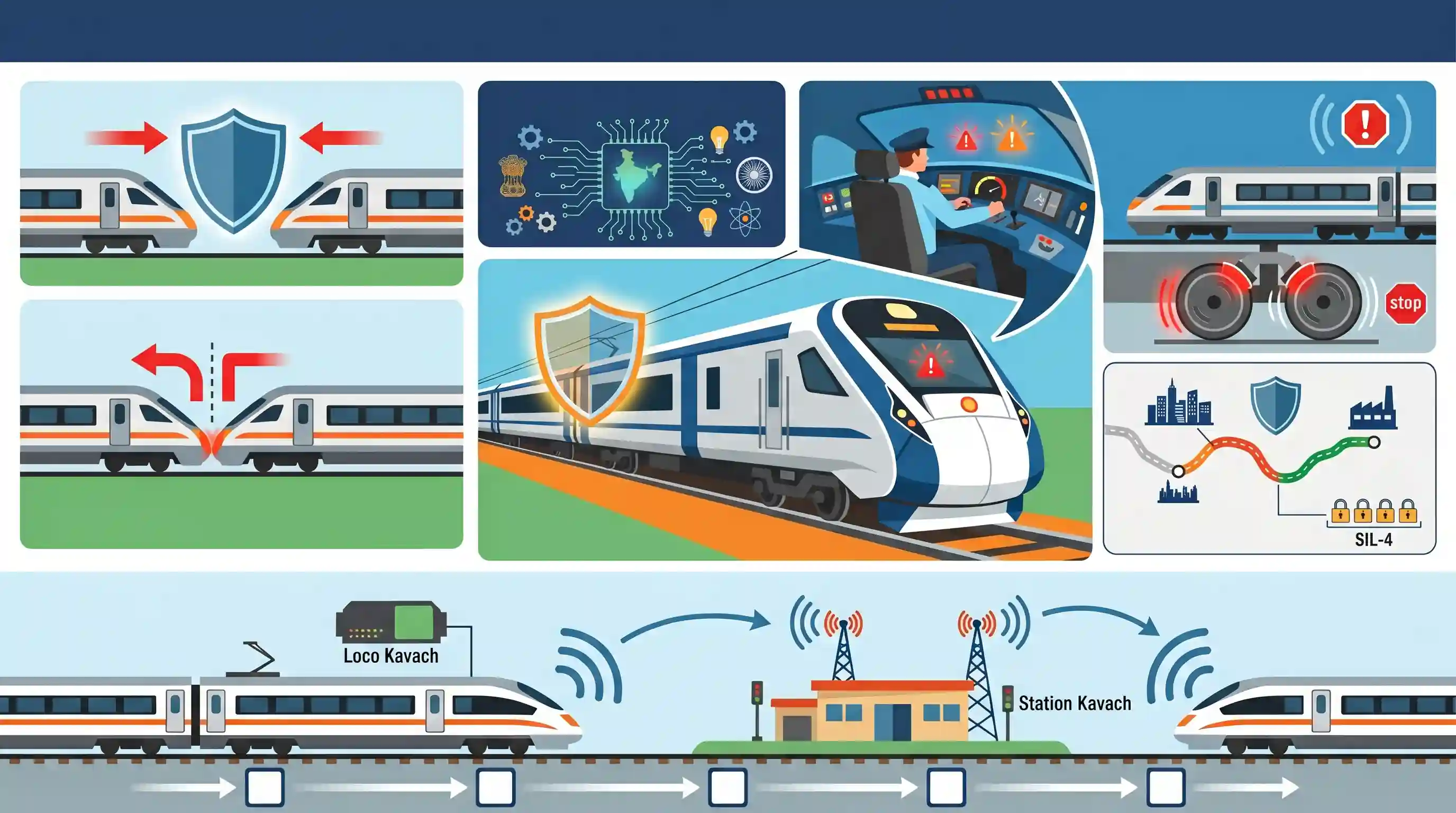
The Indian Railways has commissioned Kavach 4.0, an indigenously developed Automatic Train Protection (ATP) system, on the Vadodara-Nagda section of the crucial Delhi-Mumbai route. Designed to prevent over-speeding and train collisions (including head-on and rear-end), Kavach operates at the highest safety integrity level (SIL-4). The technology relies on a network of Station Kavach systems, RFID tags embedded in tracks for precise location tracking, Loco Kavach units in trains, and continuous radio communication to automatically trigger braking if pilots fail to respond to warnings.
Key Points
- Kavach 4.0, an indigenous Automatic Train Protection (ATP) system, has been commissioned on the 296-km Vadodara-Nagda section of the Delhi-Mumbai route.
- The system prevents train accidents caused by human error, such as Signal Passing at Danger (SPAD), and avoids head-on and rear-end collisions.
- Kavach relies on a combination of technologies, including RFID tags on tracks, Loco Kavach, Station Kavach, Optical Fibre Cables (OFC), and continuous radio communication.
- It automatically applies brakes if the locomotive pilot fails to adhere to speed limits or signal warnings, conforming to the rigorous SIL-4 safety standard.
Important Terms
Kavach

India's indigenously developed Automatic Train Protection (ATP) system designed to prevent collisions and over-speeding by automatically applying brakes if human error occurs.
UPSC context
GS Paper 3: Infrastructure and Science & Technology. Essential for discussing railway safety and indigenous technological advancements.
Kavach 4.0
The most advanced version of India's train protection technology, capable of supporting speeds up to 160 kmph and designed for complex, high-density rail corridors.
UPSC context
GS Paper 3: Science & Technology (Indigenization). Represents a milestone in the 'Atmanirbhar Bharat' initiative for critical infrastructure.
Safety Integrity Level-4 (SIL-4)
The highest global safety certification (IEC 61508) for electronic systems, indicating extremely high reliability with a failure probability of approximately 1 in 10,000 years.
UPSC context
GS Paper 3: Science & Technology. Key standard for assessing safety and reliability in critical public infrastructure projects.
RDSO (Research Designs and Standards Organisation)
The Lucknow-based research and development wing of the Ministry of Railways responsible for designing and testing indigenous technologies like the Kavach system.
UPSC context
GS Paper 3: Infrastructure. Relevant for questions on institutional frameworks driving railway modernization and technical self-reliance.
Signal Passed at Danger (SPAD)
A critical safety violation where a train overshoots a red signal, often caused by human error or low visibility, which Kavach is specifically designed to eliminate.
UPSC context
GS Paper 3: Disaster Management. Understanding the primary cause of rail accidents helps in analyzing the effectiveness of technological interventions.
Automatic Train Protection (ATP)
A category of railway safety technology that monitors train movement against signal/speed limits and intervenes automatically to maintain safe operations.
UPSC context
GS Paper 3: Infrastructure. Broad concept for discussing modern railway signalling systems and global safety benchmarks.
Prelims Trap
Kavach relies entirely on the NAVIC satellite system for real-time train location tracking.
Kavach relies on track-embedded Radio Frequency Identification (RFID) tags and UHF radio, not GPS/satellites. This ensures fail-proof, track-specific accuracy even in heavy fog.
Static Concepts Connected
How do RFID and NFC differ in communication and range?
- Range limits: RFID operates over longer distances up to 100 meters, whereas NFC requires devices to be within a few centimeters of each other.
- Data flow: RFID primarily uses one-way communication from a passive tag to an active reader, while NFC supports secure two-way data sharing.
- Application focus: RFID is ideal for high-speed tracking like Kavach and FASTag; NFC is designed for secure, close-proximity contactless payments.
What is Signal Passing at Danger (SPAD) in railway operations?
- Core definition: SPAD occurs when a train passes a red stop signal without authorization, which is a leading cause of head-on and rear-end collisions.
- Root causes: It is primarily caused by human error, such as driver fatigue, poor visibility due to extreme weather, or misjudgment of braking distances.
- Technological mitigation: Automatic Train Protection (ATP) systems like Kavach prevent SPAD by overriding the pilot and automatically applying brakes when a signal breach is imminent.
Cross-Topic Patterns
Atmanirbhar tech and export potential
Kavach’s SIL-4 certification makes it a globally competitive, low-cost alternative to the European Train Control System (ETCS), boosting India's push for indigenous technology exports.
RFID vs Satellite Tracking
UPSC frequently tests tracking methodologies. The functional distinction between physical track-level RFID (used in Kavach and FASTag) and space-based positioning (NAVIC/GPS) is a high-probability S&T comparison.

Expect a multi-statement question in 2026 contrasting Kavach’s terrestrial RFID/UHF communication with GPS/NAVIC satellite tracking.
Linked PYQs · 3
Linked PYQs · 3
- 2022PrelimsGS1
Consider the following communication technologies: 1. Closed-circuit Television 2. Radio Frequency Identification 3. Wireless Local Area Network Which of the above are considered Short-Range devices/technologies?
- 2021MainsGS3
“Investment in infrastructure is essential for more rapid and inclusive economic growth.” Discuss in the light of India's experience.
- 2022MainsGS3
Why is Public Private Partnership (PPP) required in infrastructural projects ? Examine the role of PPP model in the redevelopment of Railway Stations in India.
