Rare Earth Magnet Shortages and Automotive Supply Chain Crises
Source:Indian Express ↗
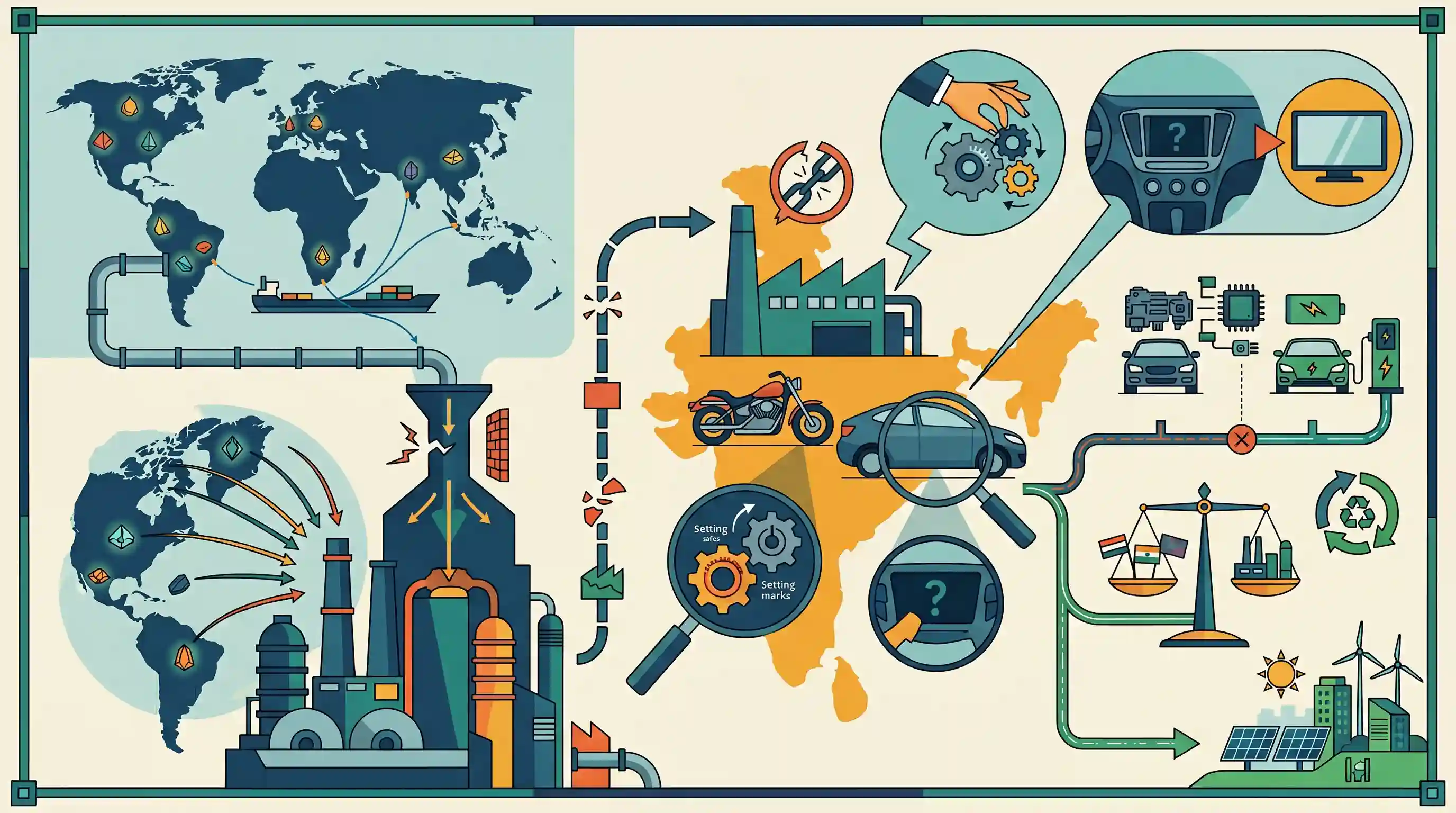
Why It Matters
The shortage of rare-earth magnets demonstrates the real-world impact of critical mineral supply chain disruptions on domestic manufacturing. As India promotes electric vehicle adoption and high-tech manufacturing, securing a reliable supply of rare earths is essential to reducing strategic vulnerabilities and import dependence.
Summary
Automakers in India, including two-wheeler manufacturer Royal Enfield, are adopting temporary hardware fixes to navigate an ongoing shortage of rare-earth (RE) magnets. To bypass the supply bottleneck, companies are tweaking gear sensors and even dropping electronic displays from vehicles. This shortage exposes the vulnerability of the automobile and electronics sectors to disruptions in the supply of critical minerals. It underscores the broader strategic imperative of securing resilient supply chains for rare-earth elements—which are essential for modern electronics and the transition to electric vehicles—amidst concentrated global processing capacities.
Key Points
- Automakers are resorting to temporary modifications, such as omitting display screens and altering sensors, to cope with a severe shortage of rare-earth (RE) magnets.
- Companies like Royal Enfield are tweaking gear sensors to navigate the limited availability of these essential components.
- Rare-earth magnets (such as neodymium magnets) are critical for modern automobile electronics, display screens, and electric vehicle (EV) motors.
- The supply bottleneck highlights broader vulnerabilities in global supply chains for critical minerals, underscoring the strategic need for resilient sourcing and reducing dependence on dominant suppliers like China.
Important Terms
Minerals Security Partnership (MSP)

A US-led alliance of 14 countries (including India) aimed at securing and diversifying global supply chains for critical minerals, specifically to reduce reliance on single-country processing hubs like China.
UPSC context
GS Paper 2 (International Relations) and GS Paper 3 (Resource Security). Tests knowledge of India's strategic alliances for securing green energy materials.
Critical Minerals
Minerals essential for economic development and national security, characterized by high supply risk. India has identified 30 such minerals (e.g., lithium, cobalt) vital for the green energy transition.
UPSC context
GS Paper 1 (Geography) and GS Paper 3 (Economy). Vital for understanding India's Net Zero 2070 targets and industrial policy.
Rare Earth Elements (REEs)
A set of 17 chemical elements (15 lanthanides plus scandium and yttrium) essential for high-tech industries, defense applications, and high-performance magnets used in electric vehicle motors.
UPSC context
GS Paper 3 (Science & Tech). Tests understanding of the "vitamins of modern industry" and their role in global technology competition.
Supply Chain Resilience Initiative (SCRI)
A strategic approach to diversify supply sources and reduce dependence on specific nations. The Supply Chain Resilience Initiative (SCRI) specifically involves India, Japan, and Australia to counter regional supply disruptions.
UPSC context
GS Paper 2 (International Relations/Groupings). Focuses on "De-risking" strategies and the shift toward reliable global trade models in the Indo-Pacific.
Permanent Magnet Synchronous Motors (PMSM)
An efficient electric motor commonly used in EVs that relies on rare-earth permanent magnets (like Neodymium) to achieve high torque and power density in a compact frame.
UPSC context
GS Paper 3 (Science & Tech). Relevant for the FAME-II scheme and the technical hurdles in India’s transition to electric mobility.
Khanij Bidesh India Limited (KABIL)
A joint venture company (NCP, HCL, MECL) under India's Ministry of Mines, mandated to identify and acquire strategic mineral assets overseas to ensure domestic mineral security.
UPSC context
GS Paper 3 (Economic Development). Highlights India’s institutional framework for "Mineral Diplomacy" and securing critical energy minerals from abroad.
Prelims Trap
India is self-sufficient in manufacturing rare-earth permanent magnets due to its vast monazite reserves.
Despite possessing the 5th largest rare-earth reserves globally, India lacks downstream processing capacity. It imports over 90% of its rare-earth permanent magnets from China.
Static Concepts Connected
What are Rare Earth Elements and their primary source in India?
- 17 Elements: A group of 17 elements (15 lanthanides plus scandium and yttrium) critical for high-tech electronics, EV motors, and green energy.
- Monazite Sand: The primary domestic source is Monazite, a radioactive beach placer sand found abundantly in coastal Odisha, Andhra Pradesh, Kerala, and Tamil Nadu.
What is the Minerals Security Partnership (MSP)?
- US-led Initiative: A US-led alliance of 14 countries and the EU aimed at securing resilient supply chains for critical minerals and reducing dependence on China.
- India's Role: India joined in 2023 to secure minerals like lithium, cobalt, and rare earths essential for its EV ecosystem and clean energy transition.
Cross-Topic Patterns
EV Transition vs. Import Dependency
While India pushes EV adoption to reduce crude oil dependency, this shift creates a new geopolitical vulnerability by swapping oil imports for rare-earth magnet and lithium imports from China.
PLI Schemes + Strategic Geopolitics
The ₹7,280-crore PLI for REPMs extends the traditional manufacturing focus of PLI schemes into strategic geopolitics, linking domestic subsidies directly to national supply chain security.

A 2026 multi-statement question linking India's monazite reserves, NdFeB magnet import dependence, and the MSP is highly likely.
Linked PYQs · 4
Linked PYQs · 4
- 2012PrelimsGS1
Recently, there has been a concern over the short supply of a group of elements called 'rare earth metals'. Why? 1. China, which is the largest producer of these elements, has imposed some restrictions on their export. 2. Other than China, Australia, Canada and Chile, these elements are not found in any country. 3. Rare earth metals are essential for the manufacture of various kinds of electronic items and there is a growing demand for these elements. Which of the statements given above is/are correct?
- 2025PrelimsGS1
Consider the following statements : Statement I: Some rare earth elements are used in the manufacture of flat television screens and computer monitors. Statement II : Some rare earth elements have phosphorescent properties. Which one of the following is correct in respect of the above statements?
- 2025PrelimsGS1
Consider the following statements : I. India has joined the Minerals Security Partnership as a member. II. India is a resource-rich country in all the 30 critical minerals that it has identified. III. The Parliament in 2023 has amended the Mines and Minerals (Development and Regulation) Act, 1957 empowering the Central Government to exclusively auction mining lease and composite license for certain critical minerals. Which of the statements given above are correct?
- 2024MainsGS2
‘The West is fostering India as an alternative to reduce dependence on China's supply chain and as a strategic ally to counter China's political and economic dominance.’ Explain this statement with examples.
