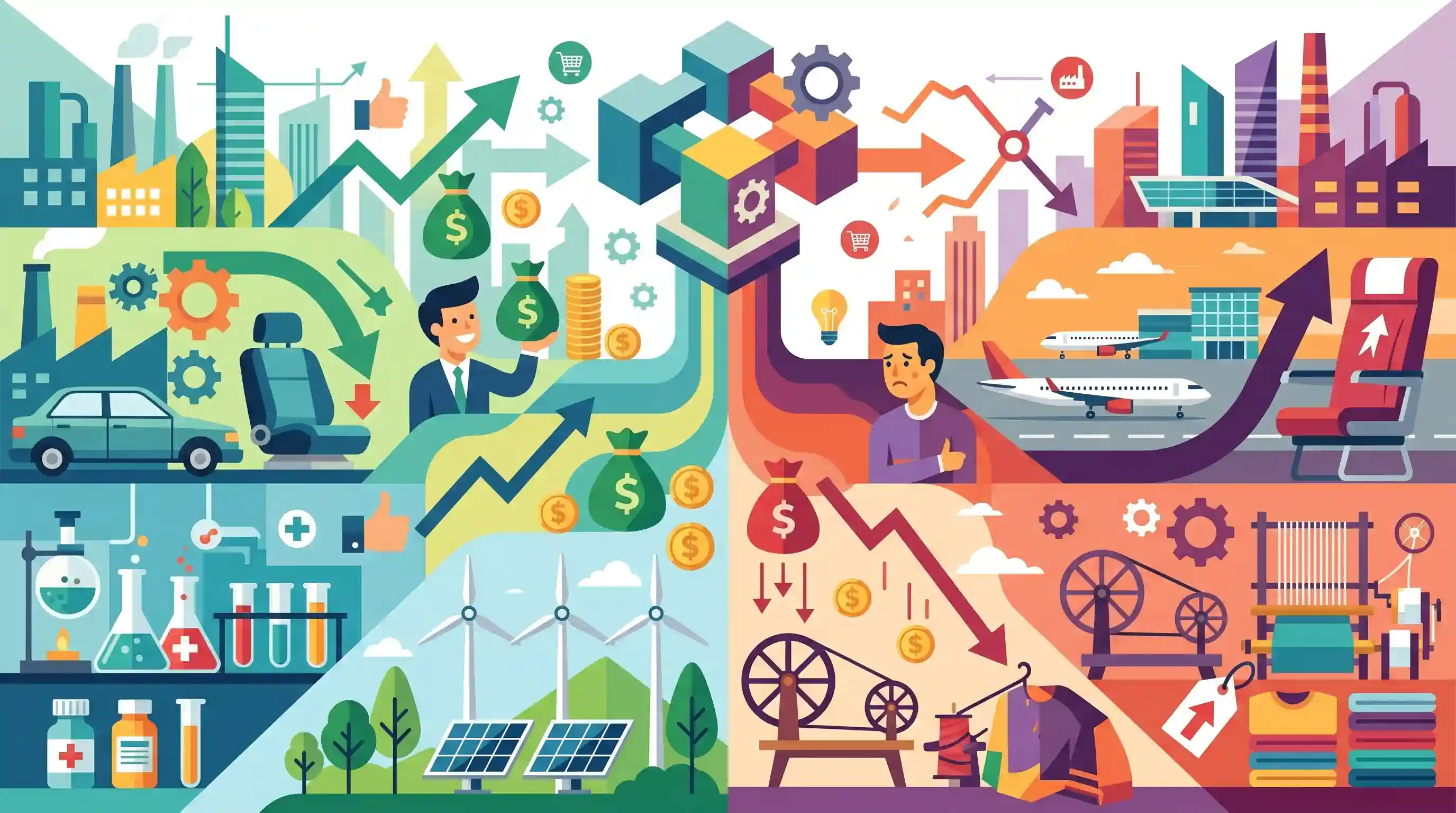
Industry Reactions and Sectoral Impacts of Recent GST Changes
Source:The Hindu ↗
Why It Matters
Sector-specific GST rate adjustments demonstrate the profound impact of indirect taxation on industrial growth, consumer demand, and inflation. For UPSC aspirants, understanding these micro-economic impacts is crucial for analyzing the effectiveness of India's tax reform and the role of the GST Council in balancing revenue generation with economic stimulus.
Summary
The recent decisions by the Goods and Services Tax (GST) Council have elicited mixed reactions across various industries. While the auto, pharmaceutical, and renewable energy sectors have hailed the rate rationalization—such as reducing GST on car seats to 18% and life-saving drugs/solar parts to 5%—other sectors are voicing concerns. The aviation industry faces headwinds due to a GST hike on non-economy class seats to 18%, while the textile sector is disappointed over the 18% levy on garments priced above ₹2,500. The divergence in responses highlights the varying impact of indirect tax reforms on industrial growth, consumer demand, and premiumization in India.
Key Points
- The recent GST Council meeting introduced targeted rate reductions that were welcomed by the auto, pharmaceutical, and renewable energy sectors.
- Car seats saw a reduction from 28% to 18% GST, which auto manufacturers believe will spur consumer demand.
- The renewable energy sector gained from a unified 5% GST rate on solar components, providing much-needed clarity and supporting green energy initiatives.
- Conversely, the aviation sector was negatively impacted by a GST hike on non-economy seats from 12% to 18%, causing concerns over reduced demand for premium travel.
- The textile industry and small entrepreneurs expressed disappointment over an 18% GST levy on garments priced above ₹2,500, citing potential harm to domestic premium apparel manufacturing.
Important Terms
Goods and Services Tax (GST)

A comprehensive, multi-stage, destination-based indirect tax levied on the supply of goods and services, replacing multiple Central and State taxes like excise, VAT, and service tax.
UPSC context
GS Paper III: Indian Economy and issues relating to planning, mobilization of resources, and growth. Core topic for taxation reforms.
GST Council
A constitutional body established under Article 279A, chaired by the Union Finance Minister and comprising State Finance Ministers, tasked with making recommendations on GST rates and policies.
UPSC context
GS Paper II: Constitutional bodies and Statutory, regulatory, and various quasi-judicial bodies. Tests understanding of federal fiscal governance.
Cooperative Federalism
A constitutional principle where the Union and States collaborate to solve common problems; GST is the flagship example, requiring consensus-based decision-making in the GST Council.
UPSC context
GS Paper II: Functions and responsibilities of the Union and the States, challenges pertaining to the federal structure.
Rate Rationalization
The process of simplifying the GST tax structure by merging, shifting, or adjusting tax slabs to reduce complexity, increase compliance, and correct market distortions.
UPSC context
GS Paper III: Economic Development. Crucial for understanding tax simplification and its impact on inflation and industrial growth.
Inverted Duty Structure
A situation where the tax rate on raw materials (inputs) is higher than the tax rate on finished products (outputs), leading to blocked credits for manufacturers.
UPSC context
GS Paper III: Industrial growth. Explains why certain sectors (like textiles or solar) push for specific GST rate changes.
Indirect Tax
A tax collected by an intermediary (like a retailer) from the person who bears the ultimate economic burden (the consumer), such as GST or Customs duty.
UPSC context
GS Paper III: Government Budgeting. Fundamental concept for understanding the shift from production-based to consumption-based taxation.
Prelims Trap
"To meet India's 2030 climate goals, all solar panels and renewable energy components are exempted from the Goods and Services Tax (GST)."
While India aggressively promotes renewables, components are not GST-exempt; they are taxed at a lower 5% slab. Total exemption breaks the input tax credit (ITC) chain, raising final costs.
Static Concepts Connected
How is voting power distributed in the GST Council under Article 279A?
- Centre's Weight: The vote of the Central Government holds a weightage of one-third of the total votes cast.
- States' Weight: The votes of all the State Governments combined hold a weightage of two-thirds of the total votes cast.
- Majority Required: Decisions require at least a three-fourths (75%) majority of the weighted votes of members present and voting.
How does India's multi-slab GST structure attempt to address tax equity?
- Regressive Baseline: Indirect taxes flatly apply to consumption, disproportionately impacting the poor. Multi-slab structures try to mitigate this regression.
- Essential vs Premium: Multi-slabs (0%, 5%, 12%, 18%, 28%) ensure essential items remain cheap while luxury/demerit goods (like premium flights) face high rates to enforce equity.
- Inverted Duty Avoidance: Varying rates require constant rationalization by the Council to avoid an inverted duty structure (taxes on inputs being higher than on the final product).
Cross-Topic Patterns
Fiscal policy as a climate tool
Lowering GST to 5% on solar parts directly reduces the Levelized Cost of Energy (LCOE), using fiscal policy to support India's Panchamrit target of 500 GW non-fossil capacity by 2030.
Inverted Duty Structure & PLI Synergy
Frequent rate tweaks on intermediate goods aim to correct inverted duty structures, complementing Production Linked Incentive (PLI) schemes to boost domestic manufacturing competitiveness.

Expect a multi-statement question blending the GST Council's Article 279A voting dynamics with the 'inverted duty structure' in 2026.
Linked PYQs · 5
Linked PYQs · 5
- 2017PrelimsGS1
What is/are the most likely advantages of implementing 'Goods and Services Tax (GST)'? 1. It will replace multiple taxes collected by multiple authorities and will thus create a single market in India. 2. It will drastically reduce the 'Current Account Deficit' of India and will enable it to increase its foreign exchange reserves. 3. It will enormously increase the growth and size of economy of India and will enable it to overtake China in the near future. Select the correct answer using the code given below:
- 2019MainsGS3
Enumerate the indirect taxes which have been subsumed in the Goods and Services Tax (GST) in India. Also, comment on the revenue implications of the GST introduced in India since July 2017.
- 2020MainsGS3
Explain the rationale behind the Goods and Services Tax (Compensation to States) Act of 2017. How has COVID-19 impacted the GST compensation fund and created new federal tensions?
- 2015MainsGS2
The concept of cooperative federalism has been increasingly emphasized in recent years. Highlight the drawbacks in the existing structure and the extent to which cooperative federalism would answer the shortcomings.
- 2025MainsGS2
Examine the evolving pattern of Centre-State financial relations in the context of planned development in India. How far have the recent reforms impacted the fiscal federalism in India?
