Australia Social Media Ban Implementation and Tech Accountability
Source:Indian Express ↗
Why It Matters
The psychological and social impact of social media on youth is a highly recurrent UPSC theme across GS1, GS4, and Essay papers. Australia's regulatory approach provides an excellent global case study for GS2 answers regarding the regulation of Big Tech, mechanisms to protect children in the digital space, and the trade-offs between online safety and data privacy.
Summary
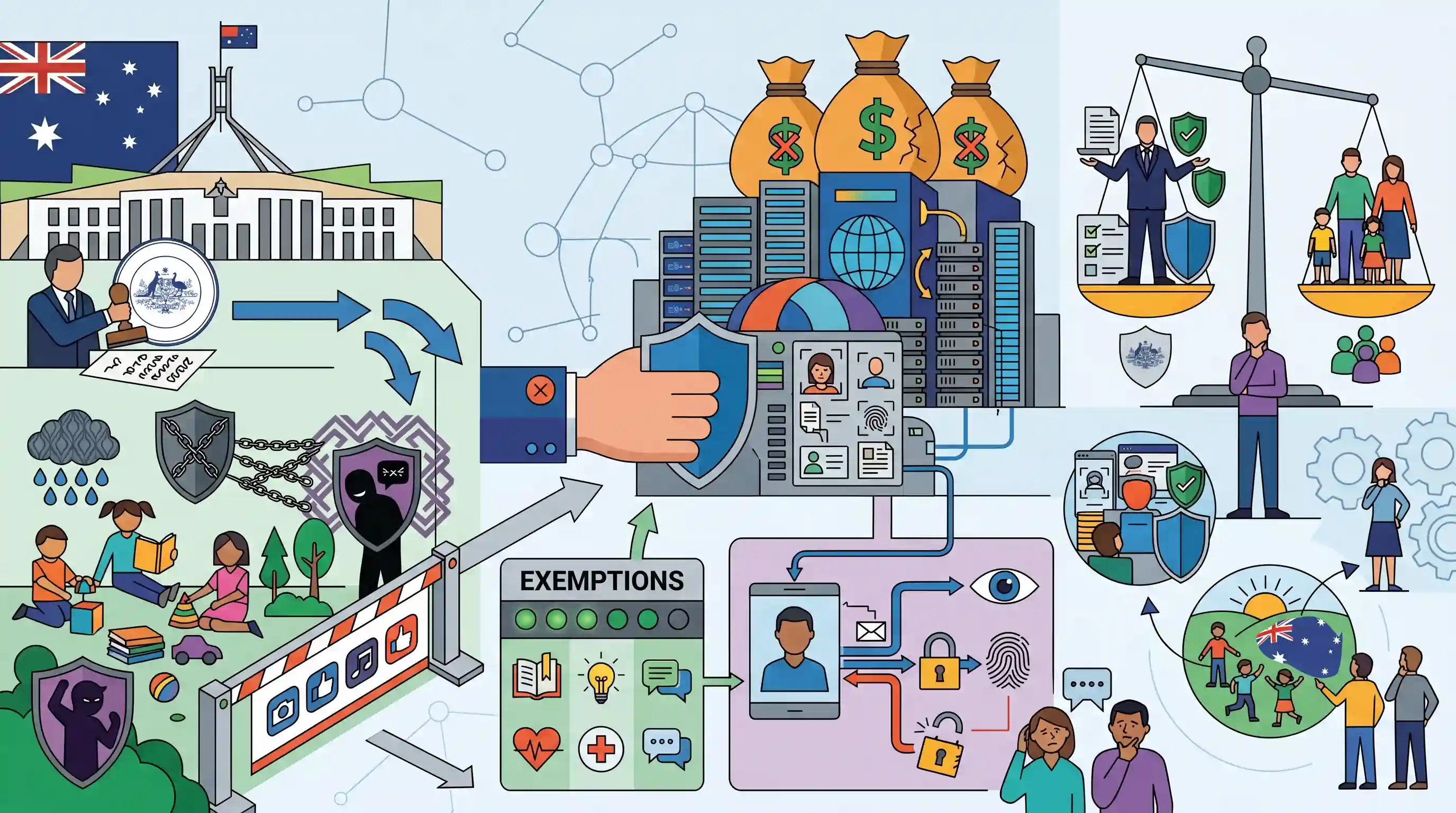
Australia has enacted pioneering legislation that bans children under the age of 16 from accessing social media platforms. The law aims to shield adolescents from the mental health impacts of the digital world, such as cyberbullying, social media addiction, and depression. A key feature of the legislation is that it places the onus of enforcement squarely on tech giants, requiring them to implement robust age-verification systems or face severe financial penalties. Parents and children will not be penalized. While educational, messaging, and health platforms are exempted, the mandate for age-verification technology has raised significant concerns about data privacy and digital rights. The move sets a major global precedent in the regulation of Big Tech and highlights the ethical debate over state intervention versus parental responsibility in protecting children online.
Key Points
- Australia has passed landmark legislation banning children under the age of 16 from using social media platforms to mitigate psychological and developmental harms.
- The legal burden of enforcing this ban falls entirely on social media companies (like Meta, TikTok, and X), which face massive fines if they fail to implement age-verification measures.
- Exemptions are provided for essential digital services, including messaging apps (like WhatsApp), health services, and educational platforms (like Google Classroom).
- The legislation mandates age verification technologies (such as biometrics or government ID checks), which has sparked significant debate regarding data privacy and the mass surveillance of users.
- Critics argue the ban is a form of state paternalism that may isolate vulnerable teens who rely on online communities, while proponents see it as a necessary measure to combat cyberbullying and tech addiction.
Important Terms
Online Safety Amendment (Social Media Minimum Age) Bill 2024

Australia's landmark legislation (2024) setting a minimum age of 16 for social media. It shifts legal responsibility to platforms to prevent underage access, aiming to curb digital harms like cyberbullying and addiction.
UPSC context
GS II (Government Policies) & GS III (Social Networking Sites). Tests global precedents in digital governance and platform accountability.
eSafety Commissioner (Australia)
Australia’s independent online safety regulator. It enforces the social media ban, issues "reasonable steps" guidelines for platforms, and holds the authority to impose fines up to AUD 49.5 million for non-compliance.
UPSC context
GS II (Statutory/Regulatory Bodies). Tests understanding of international regulatory models for technology and child protection.
Age-Verification Technology
Digital systems (such as biometrics, age estimation, or ID checks) used to confirm a user's age. They are central to debates regarding the balance between child safety and data privacy.
UPSC context
GS IV (Ethics in Technology) & GS III (Science & Tech). Evaluates the trade-offs between surveillance, privacy, and safety.
Meta
The parent company of Facebook and Instagram. In regulatory discourse, it represents "Big Tech" entities challenged by government mandates to balance profit-driven engagement with ethical responsibilities toward vulnerable minor users.
UPSC context
GS III (Social Networking Sites). Tests platform accountability and the societal impact of global technology conglomerates.
TikTok
A leading short-form video platform under global scrutiny. It represents the intersection of digital governance, adolescent mental health, and the challenges of regulating addictive, algorithm-driven social media.
UPSC context
GS III (Challenges to Internal Security). Relevant for discussions on data sovereignty and comparative international digital policies.
X (formerly Twitter)
A major social platform (formerly Twitter) central to the "free speech vs. online safety" debate. Its regulation highlights tensions between the digital sovereignty of nations and the global operations of tech firms.
UPSC context
GS II (Governance/Constitution). Tests the balance between fundamental rights and the state's duty to protect citizens from harm.
Snapchat
A messaging-focused social platform popular among teens. Its inclusion in the ban emphasizes the regulatory shift toward capturing all "age-restricted social media services," regardless of their primary functional focus.
UPSC context
GS III (Social Media Regulation). Tests knowledge of the diverse types of platforms captured under modern digital safety laws.
Prelims Trap
Parents or minors face legal penalties for bypassing the social media age restrictions.
The entire legal onus and massive financial penalties fall exclusively on tech platforms. The law deliberately exempts end-users from liability.
Static Concepts Connected
How does India's DPDP Act 2023 regulate minors' data?
- Parental Consent: Platforms must obtain verifiable parental consent before processing any personal data of children under 18 years of age.
- Behavioral Tracking: The Act strictly prohibits tracking, behavioral monitoring, and targeted advertising directed at children.
- Platform Onus: Data fiduciaries (tech companies) face severe financial penalties if they breach child data protection obligations, shifting the onus entirely onto platforms.
What is State Paternalism in governance?
- Definition: A policy where the state intervenes to restrict the freedom and responsibilities of citizens, justified by the intent to protect them from harm.
- Ethical Dilemma: It often conflicts with individual autonomy and parental rights, raising the debate over who is best suited to make decisions for a child's welfare.
Cross-Topic Patterns
DPDP Act and Global Tech Regulation
Like Australia, India's DPDP Act shifts enforcement onus to platforms, requiring verifiable parental consent and threatening massive fines (up to ₹250 crore) for breaching child data safety norms.
Mental Health + Corporate Cyber Ethics
Links GS2 health policies (tackling tech-induced depression) with GS4 corporate ethics, questioning tech platforms' deployment of predatory, engagement-maximizing algorithms.

A GS2 mains question evaluating 'state paternalism' versus 'parental responsibility' in digital regulation using global precedents is highly likely.
Linked PYQs · 4
Linked PYQs · 4
- 2025MainsGS2
The National Commission for Protection of Child Rights has to address the challenges faced by children in the digital era. Examine the existing policies and suggest measures the Commission can initiate to tackle the issue.
- 2023MainsGS1
Child cuddling is now being replaced by mobile phones. Discuss its impact on the socialization of children.
- 2024MainsEssay
Social media is triggering 'Fear of Missing Out' amongst the youth, precipitating depression and loneliness.
- 2025MainsGS4
In the present digital age, social media has revolutionised our way of communication and interaction. However, it has raised several ethical issues and challenges. Describe the key ethical dilemmas in this regard.
