Australian Elections and Indo-Pacific Strategic Partnership Continuity
Source:Indian Express ↗
Why It Matters
Australia is a critical strategic partner for India in the Indo-Pacific region. Understanding how domestic political stability in partner nations affects regional security architectures (like the Quad and AUKUS) is crucial for analyzing India's foreign policy and global strategic positioning.
Summary
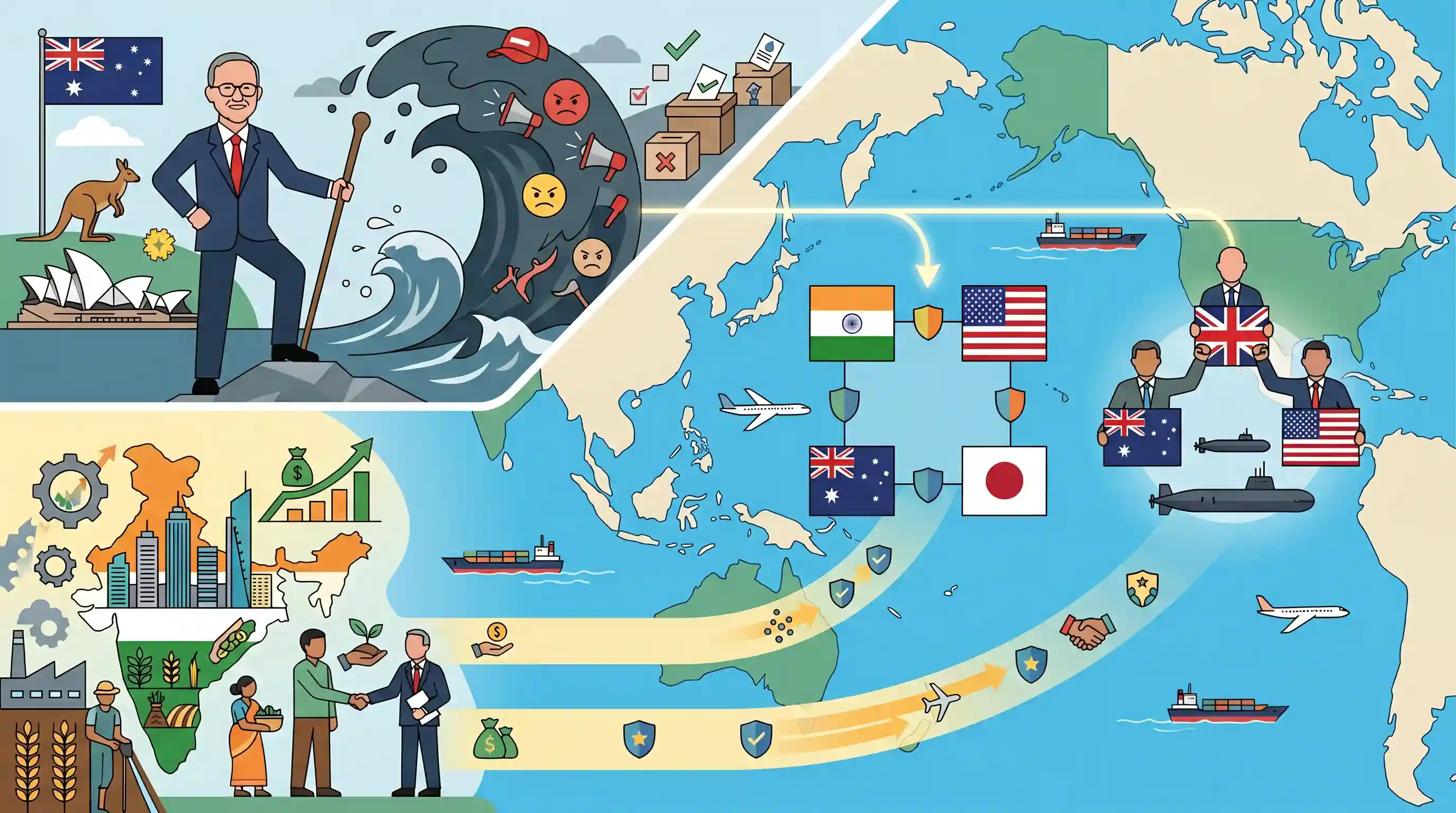
The article discusses the recent Australian elections, highlighting how Anthony Albanese's centrist political stance managed to hold its ground against the rising global tide of right-wing populism associated with figures like Donald Trump. This political stability in Canberra is significant for the geopolitical landscape of the Indo-Pacific. It assures continuity for crucial strategic partnerships, particularly the Quad and AUKUS alliances, which are aimed at maintaining a free and open Indo-Pacific. For India, the outcome is highly favorable as it ensures sustained engagement and deepening of bilateral ties, reinforcing joint efforts in regional security and economic cooperation without the disruptions often caused by drastic political shifts.
Key Points
- The recent Australian election results demonstrate that centrist politics can successfully resist global right-wing populist waves, exemplified by Donald Trump.
- The victory or strong standing of Anthony Albanese assures continuity in Australia's domestic and foreign policies.
- Stability in Canberra reinforces Australia's commitment to strategic Indo-Pacific alliances, notably the Quad and AUKUS.
- For India, this political continuity ensures sustained momentum in deepening bilateral relations and regional strategic cooperation.
Important Terms
Quadrilateral Security Dialogue (Quad)

An informal strategic forum comprising India, Japan, Australia, and the US. It aims to maintain a 'free, open, and inclusive' Indo-Pacific through maritime security, technology, and disaster relief cooperation.
UPSC context
GS Paper II: Important groupings. Tests knowledge of maritime security, regional stability, and India's strategic role in the Indo-Pacific.
AUKUS
A trilateral security partnership between Australia, the UK, and the US (2021). It focuses on sharing advanced defense technologies, notably assisting Australia in acquiring nuclear-powered submarines.
UPSC context
GS Paper II: Global groupings affecting India’s interests. Relevant for understanding the evolving security architecture of the Indo-Pacific.
Indo-Pacific
A strategic maritime construct encompassing the Indian and Pacific Oceans. It is the primary theater of India’s foreign policy, emphasizing rules-based order and freedom of navigation.
UPSC context
GS Paper II: Geopolitics. Essential for topics on maritime security, trade routes, and the 'Act East' policy.
Comprehensive Strategic Partnership (CSP)
The formal elevated status of India-Australia ties since 2020. It institutionalizes deep cooperation in defense (2+2 dialogue), trade (ECTA), critical minerals, and maritime security.
UPSC context
GS Paper II: Bilateral agreements. Tests understanding of India’s deepening strategic and economic engagement with key partner nations.
Australian Labor Party
Australia’s major centre-left political party, led by Anthony Albanese. Its current governance focuses on centrist stability, climate action, and sustained strategic alignment with India.
UPSC context
GS Paper II: Politics of developed countries. Tests how foreign leadership shifts impact India’s long-term strategic continuity.
Prelims Trap
AUKUS equips Australia with nuclear weapons, and the Quad acts as a formal military alliance in the Indo-Pacific.
AUKUS involves the transfer of nuclear-powered submarine technology, not nuclear weapons. Furthermore, the Quad is a diplomatic consultative forum, not a formal military alliance.
Static Concepts Connected
How do the mandates of Quad and AUKUS differ in the Indo-Pacific?
- Quad mandate: A consultative diplomatic forum focusing on public goods, critical tech, and maintaining a free Indo-Pacific without formal military binding.
- AUKUS mandate: A formal trilateral defense and technology pact aimed at equipping Australia with nuclear-powered (conventionally armed) submarines to counter regional threats.
- India's position: India is a core driver of the Quad but remains outside AUKUS, officially viewing it as a separate but complementary initiative.
What frameworks govern the current India-Australia bilateral strategic relationship?
- The CSP: Upgraded in 2020, this partnership institutionalizes bilateral defense, trade, and geopolitical cooperation through 2+2 Ministerial Dialogues.
- The ECTA: The 2022 Economic Cooperation and Trade Agreement eliminates tariffs on a vast majority of goods, significantly boosting India's service exports and trade integration.
- SCRI Framework: India, Australia, and Japan formed this initiative to de-risk critical material sourcing and reduce over-reliance on single nations like China.
Cross-Topic Patterns
Post-RCEP bilateral FTA shift
The Australia ECTA highlights India's strategic shift away from mega-regional blocs like RCEP toward rapid, deep bilateral trade agreements with complementary democratic economies.
Domestic politics shaping geopolitics
Albanese’s centrist continuity illustrates how the resilience of domestic democratic mandates in partner nations directly impacts the stability and momentum of Indo-Pacific security architectures.

Expect a 2026 Prelims question contrasting the Quad's non-military diplomatic mandate with AUKUS's nuclear-powered submarine technology.
Linked PYQs · 2
Linked PYQs · 2
- 2021MainsGS2
The newly tri-nation partnership AUKUS is aimed at countering China's ambitions in the Indo-Pacific region. Is it going to supersede the existing partnerships in the region? Discuss the strength and impact of AUKUS in the present scenario.
- 2020MainsGS2
What is the significance of Indo-US defence deals over Indo-Russian defence deals? Discuss with reference to stability in the Indo-Pacific region.
