Australia Social Media Ban and Digital Regulation Policies
Source:The Hindu ↗
Why It Matters
This development is crucial for UPSC aspirants as it touches upon global benchmarks for digital regulation, child protection rights in cyberspace, and the societal impacts of technology. It provides a contemporary case study for evaluating internet governance frameworks and the ethical dilemmas between child safety, free speech, and data privacy.
Summary
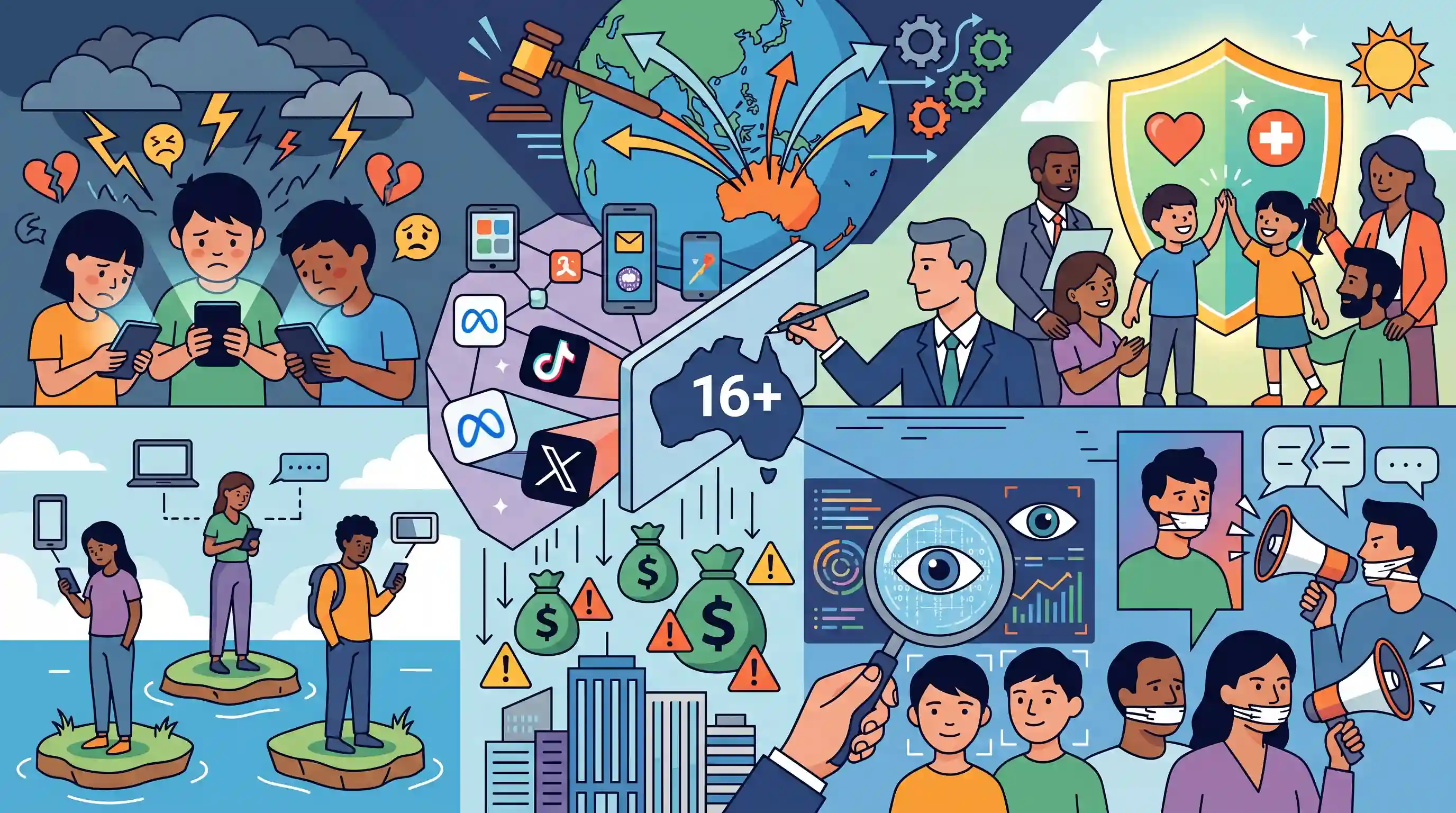
Australia has enacted a world-first ban restricting children under 16 from accessing social media platforms, effective December 2025. The policy aims to address escalating online harms and improve youth mental health by holding tech giants like Meta, TikTok, and X accountable, with non-compliance attracting massive fines. Platforms are required to deploy robust age-estimation technologies. Although championed by child advocates and the government as a necessary safeguard, the ban has sparked debates regarding its potential to isolate marginalized youths and infringe on free speech. It stands as a pivotal global test case for digital regulation and internet governance.
Key Points
- Australia has enforced a pioneering law banning children under 16 from using major social media platforms to combat online harms and protect youth mental health.
- Platforms like TikTok, Meta, and X face fines up to A$49.5 million if they fail to implement effective age-gating mechanisms such as age inference, selfies, or ID checks.
- While the government aims to empower families and encourage offline activities, critics argue the ban may isolate vulnerable groups like queer youth who rely on digital communities.
- The legislation serves as a global test case for internet governance, with nations like Denmark, New Zealand, and Malaysia closely monitoring its balance between child protection, free speech, and innovation.
Important Terms
Internet Governance

The multi-stakeholder process of developing shared principles, norms, and rules that shape the evolution and use of the Internet, balancing state sovereignty, private interests, and individual rights.
UPSC context
GS Paper II (Governance) & III (IT); focuses on digital sovereignty and the global regulation of tech.
Significant Social Media Intermediary (SSMI)
Platforms with over 5 million Indian users (under IT Rules 2021) that must follow stricter due diligence, such as appointing grievance officers and enabling content takedowns.
UPSC context
GS Paper III; tests knowledge of intermediary liability and internal security challenges from online content.
Meta
Parent company of Facebook, Instagram, and WhatsApp; a primary target of global regulations regarding data privacy, youth mental health, and algorithmic transparency.
UPSC context
GS Paper III; relevant to 'Big Tech' accountability and its impact on social psychology.
TikTok
A ByteDance-owned short-video platform; frequently at the center of international debates over national security, data sovereignty, and the 2020 ban in India.
UPSC context
GS Paper III (Internal Security); explores the intersection of foreign technology and national safety.
X (formerly Twitter)
A microblogging platform frequently highlighting the tension between state-mandated content moderation (like Australia's under-16 ban) and absolute free speech protections.
UPSC context
GS Paper II; concerns Article 19 (Free Speech) vs. reasonable restrictions in digital spaces.
Alphabet
The parent company of Google and YouTube; its video-sharing platform is a critical test case for balancing educational access with child protection regulations.
UPSC context
GS Paper III; involves IT advancements and the regulation of global digital monopolies.
Age-Estimation Technology
AI-driven tools—such as facial analysis or behavioral inferencing—used to verify user age; they raise critical concerns regarding biometric privacy and data over-collection.
UPSC context
GS Paper III (Ethics/IT); examines the trade-off between technical security and individual privacy rights.
Prelims Trap
"Under India's DPDP Act, children under 16 are completely banned from accessing social media platforms."
India does not enforce an outright age ban. The DPDP Act, 2023 merely restricts how minor data is handled, requiring "verifiable parental consent" for users under 18.
Static Concepts Connected
How does India's DPDP Act 2023 protect children online?
- Age Threshold: Defines a child as any individual under the age of 18.
- Parental Consent: Requires platforms to obtain verifiable consent from a lawful parent or guardian before processing a minor's personal data.
- Strict Prohibitions: Expressly bans targeted advertising, behavioral tracking, and data processing likely to cause detrimental well-being harms to children.
What is the 'Safe Harbour' protection for digital platforms in India?
- Section 79 Exemption: Under Section 79 of the IT Act, 2000, platforms are exempt from legal liability for third-party user-generated content.
- Due Diligence Condition: Immunity is conditional upon platforms acting merely as conduits, observing due diligence, and removing unlawful content upon official notice.
Cross-Topic Patterns
Age-gating vs. Right to Privacy
Mandating ID or biometric checks for age verification risks creating centralized data honeypots, conflicting with data minimization and proportionality principles of the Puttaswamy right-to-privacy judgment.
Erosion of Safe Harbour frameworks
Global laws are shifting tech giants from passive intermediaries (protected by Safe Harbour) to actively liable gatekeepers held strictly responsible for algorithmic harms and demographics.

Expect a 2026 GS2 question comparing India's DPDP 'parental consent' model with outright global age-bans for regulating youth social media.
Linked PYQs · 4
Linked PYQs · 4
- 2025MainsGS2
The National Commission for Protection of Child Rights has to address the challenges faced by children in the digital era. Examine the existing policies and suggest measures the Commission can initiate to tackle the issue.
- 2024MainsGS3
Social media and encrypting messaging services pose a serious security challenge. What measures have been adopted at various levels to address the security implications of social media? Also suggest any other remedies to address the problem.
- 2024MainsGS3
Describe the context and salient features of the Digital Personal Data Protection Act, 2023.
- 2023MainsGS1
Child cuddling is now being replaced by mobile phones. Discuss its impact on the socialization of children.
