Australia Japan Defense Partnership and Indo Pacific Security
Source:The Hindu ↗
Why It Matters
The deal highlights the evolving security architecture of the Indo-Pacific. It demonstrates the rise of bilateral and minilateral security partnerships (independent of the US umbrella) aimed at balancing China. For UPSC aspirants, Japan's departure from strict pacifism and its emergence as a defense exporter are critical geopolitical shifts that affect India's strategic calculations and the broader Quad framework.
Summary
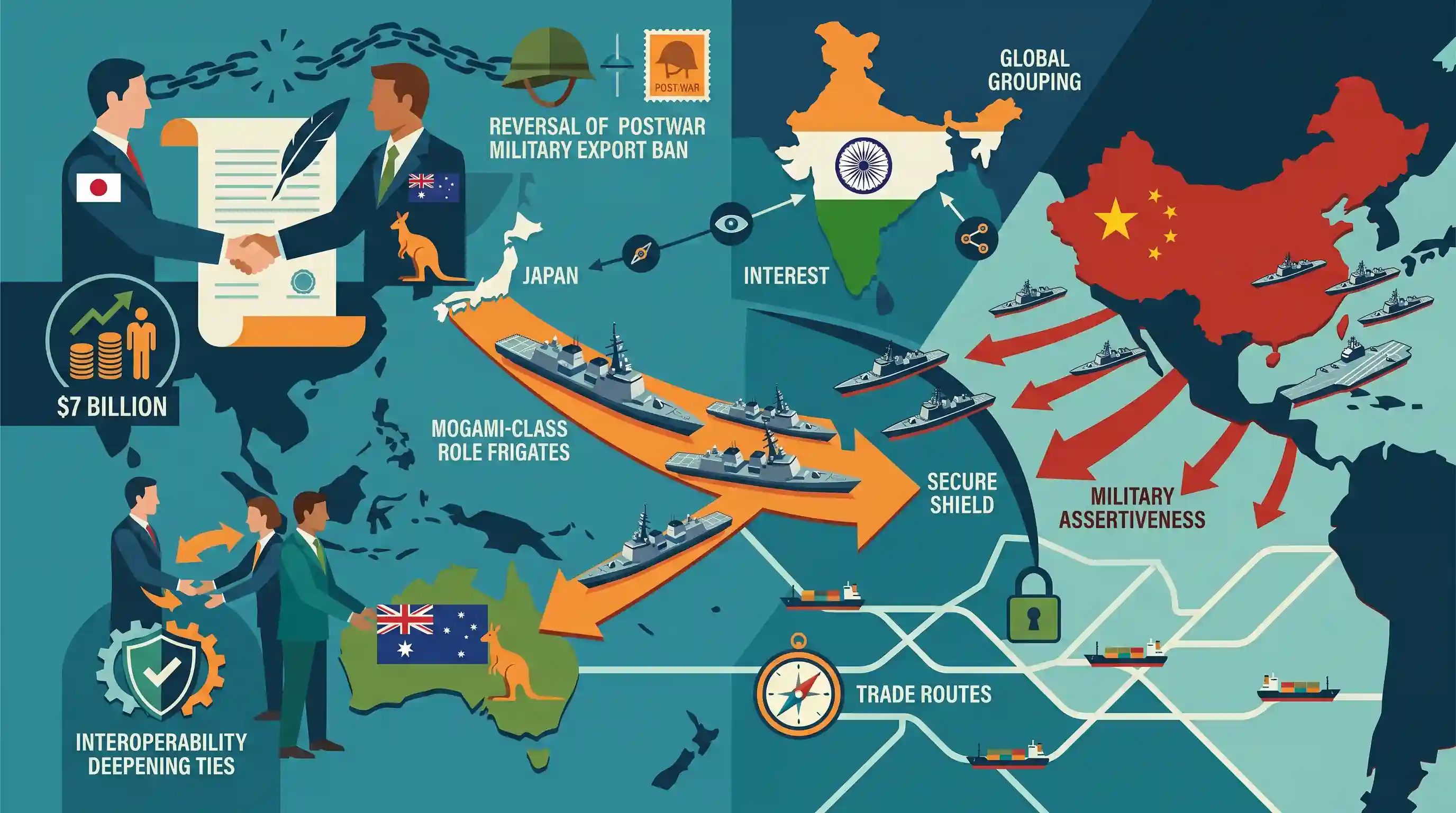
Australia and Japan have signed contracts to begin a $7 billion defense deal under which Japan will supply Mogami-class multi-role frigates to Australia. The agreement represents a historic shift for Japan, marking its most consequential military export since reversing its postwar military export ban in 2014. The deepening defense ties aim to bolster maritime security and interoperability in the Indo-Pacific, specifically to protect critical trade routes and counter China's growing military assertiveness in the region.
Key Points
- Australia and Japan have signed initial contracts for a $7 billion deal where Japan will supply Mogami-class multi-role frigates to the Royal Australian Navy.
- The agreement marks Japan's most significant military export since lifting its post-WWII military export ban in 2014, underscoring a major shift from its postwar pacifist defense posture.
- The deal seeks to strengthen defense ties between Tokyo and Canberra outside of their respective alliances with the United States.
- The strategic objective of the warships is to defend critical maritime trade routes and counter China's expanding military footprint in the Indian and Pacific Oceans.
Important Terms
Mogami-class Frigate

An advanced Japanese stealth multi-role frigate featuring high automation, reduced crew requirements, and multi-domain capabilities including anti-submarine and air defense.
UPSC context
Relevant for GS-III (Security) and GS-II (International Relations) regarding maritime modernization and defense technology cooperation in the Indo-Pacific.
Three Principles on Transfer of Defense Equipment and Technology
Japan's 2014 policy framework that replaced the postwar arms export ban, allowing the transfer of defense equipment to bolster international peace and security.
UPSC context
Crucial for GS-II (International Relations) topics on Japan's shift from pacifism and its impact on regional security architectures.
Interoperability
The ability of different military organizations to use common equipment, doctrines, and communication systems to operate effectively together during joint missions.
UPSC context
A key concept in GS-II (International Relations) and GS-III (Security) relating to military alliances and joint exercises like Malabar.
Mitsubishi Heavy Industries
A major Japanese multinational engineering and defense corporation and the lead contractor for the Mogami-class frigates under the Australia-Japan defense deal.
UPSC context
Relevant for GS-III (Industry/Security) as a symbol of the global defense industrial base and its role in strategic partnerships.
Special Strategic Partnership
The highest level of diplomatic and security alignment between Australia and Japan, focusing on a free and open Indo-Pacific and defense integration.
UPSC context
Central to GS-II (Bilateral Agreements) as it shapes the regional balance of power alongside the Quad framework.
Indo-Pacific Maritime Security
A strategic concept and geographic region where maritime security, trade routes, and territorial integrity are contested by major powers, primarily China and the Quad.
UPSC context
Core topic for GS-II (International Relations) concerning global geopolitics, Sea Lines of Communication (SLOCs), and regional stability.
Prelims Trap
"Japan’s pacifist constitution strictly prohibits the export of all military equipment and lethal weapons to foreign nations."
Japan lifted its absolute arms embargo in 2014, adopting the "Three Principles on Defense Equipment Transfer" to permit conditional military exports to strategic partners.
Static Concepts Connected
How does Article 9 shape Japan's evolving defense and export posture?
- War Renunciation: Article 9 of the Japanese Constitution permanently renounces war as a sovereign right and prohibits the maintenance of military forces with war potential.
- Self-Defense Forces: Japan maintains Self-Defense Forces strictly for national defense. A 2014 reinterpretation allowed limited "collective self-defense" to aid allies under attack.
- Export Easing: Recent policy revisions replaced the decades-old absolute arms export ban with frameworks allowing defense equipment transfers to bolster regional deterrence.
What defines Middle Power Diplomacy in contemporary International Relations?
- Strategic Hedging: Middle powers form overlapping minilateral partnerships to manage risks, maintain regional stability, and reduce over-reliance on a single superpower's security umbrella.
- Rule-Based Advocacy: They champion international norms, like UNCLOS, utilizing coalition-building and resource pooling to constrain the unilateral actions of regional hegemons.
Cross-Topic Patterns
Securitization of the Quad network
While the formal Quad remains non-military, its members are weaving a web of hard-security bilateral pacts (like the Japan-Australia RAA) to bypass diplomatic constraints and deter China.
Maritime security & Supply Chain Resilience
Protecting SLOCs via naval interoperability directly secures the geo-economic objectives of the Supply Chain Resilience Initiative (SCRI) launched by India, Japan, and Australia.

Expect a prelims question on Japan's shifting defense posture, testing Article 9 limits against its new defense equipment export rules.
Linked PYQs · 3
Linked PYQs · 3
- 2021MainsGS2
The newly tri-nation partnership AUKUS is aimed at countering China's ambitions in the Indo-Pacific region. Is it going to supersede the existing partnerships in the region? Discuss the strength and impact of AUKUS in the present scenario.
- 2020MainsGS2
What is the significance of Indo-US defence deals over Indo-Russian defence deals? Discuss with reference to stability in the Indo-Pacific region.
- 2019MainsGS2
‘The time has come for India and Japan to build a strong contemporary relationship, one involving global and strategic partnership that will have a great significance for Asia and the world as a whole.’ Comment.
