Australia Draft Law To Impose Digital Levy On Big Tech Companies
Source:The Hindu ↗
Why It Matters
It showcases a leading global regulatory framework to curb the monopoly of Big Tech and protect traditional journalism. For UPSC aspirants, it serves as an excellent case study for GS-2 (Government Policies, Media Regulation) and GS-3 (Digital Economy, Equalisation Levy, Corporate Dominance), particularly relevant as India debates its own digital competition and media bargaining laws.
Summary
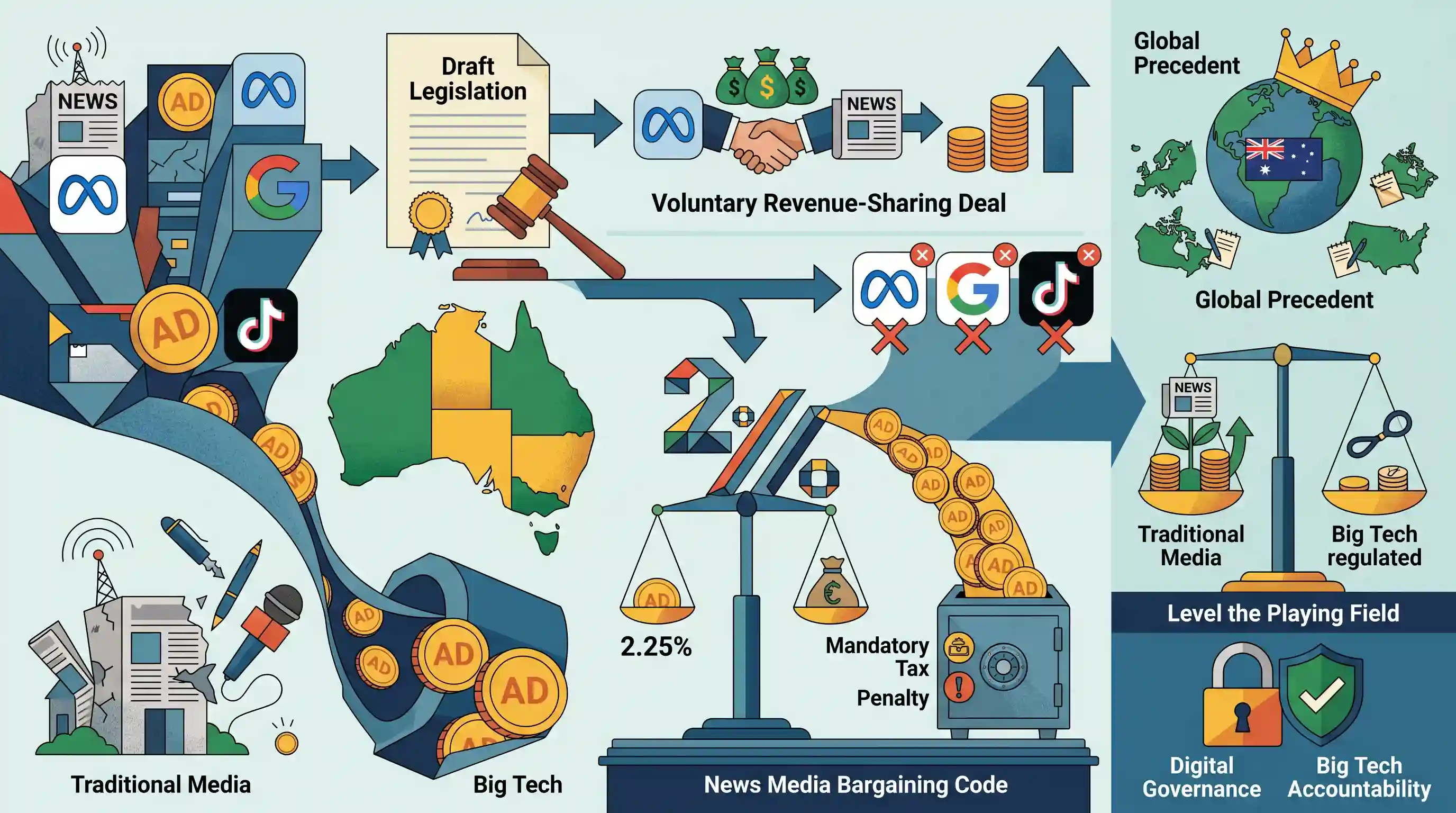
Australia is introducing draft legislation to force major technology platforms, specifically Meta, Google, and TikTok, to compensate domestic news publishers for their content. The regulatory mechanism mandates that if these tech giants fail to strike voluntary revenue-sharing agreements with media outlets, they will be subjected to a mandatory 2.25% tax on their Australian revenue. Grounded in the country's 'news media bargaining code', the policy aims to level the playing field between struggling traditional media and dominant digital platforms that monopolize online advertising revenue. This represents a significant global precedent in digital governance and Big Tech accountability.
Key Points
- Australia has unveiled draft laws requiring tech giants like Meta, Google, and TikTok to voluntarily strike deals to compensate local news publishers.
- If the companies refuse to make these deals, they will face a compulsory digital levy amounting to 2.25% of their Australian revenue.
- The proposed legislation enforces obligations under Australia's 'news media bargaining code' and seeks to prevent tech firms from simply stripping news content off their platforms.
- The move addresses the decline of traditional media revenues, as tech platforms absorb advertising dollars while heavily relying on news stories to attract user engagement.
Important Terms
News Media Bargaining Code (NMBC)

A 2021 Australian law mandating that tech giants pay local news publishers for content shared on their platforms to address bargaining power imbalances.
UPSC context
GS Paper II & III: Important for digital governance, media regulation, and addressing market dominance by Big Tech.
News Bargaining Incentive (NBI)
A proposed 2026 Australian mechanism imposing a 2.25% revenue tax on tech giants that refuse to strike voluntary news-payment deals.
UPSC context
GS Paper III: Relevant to digital taxation and government interventions in technology markets.
Digital Services Tax (DST)
A tax targeting the local revenue of multinational digital firms, designed to ensure they pay taxes where they generate profit.
UPSC context
GS Paper III: Economic development and issues related to international taxation and sovereign rights.
Big Tech Accountability
Measures ensuring large technology firms remain transparent and legally liable for their market influence, data usage, and impact on traditional industries.
UPSC context
GS Paper II: Governance, transparency, and the role of the state in regulating influential global entities.
Revenue-sharing Agreements
Commercial contracts where digital platforms compensate media companies for using their content, often incentivized by government regulations to sustain journalism.
UPSC context
GS Paper III: Digital economy and the sustainability of traditional media sectors.
Designated Platforms
Specific tech companies (e.g., Meta, Google) officially identified by regulators as having substantial market power, triggering mandatory compliance with specialized codes.
UPSC context
GS Paper III: Competition law and the regulation of monopolies in the digital age.
Prelims Trap
"India's Equalisation Levy is a direct tax governed under the Income Tax Act, 1961 to prevent tech giants from shifting profits."
This is a classic trap. The Equalisation Levy was introduced via the Finance Act 2016 as a separate direct tax, deliberately kept outside the Income Tax Act to bypass tax treaties.
Static Concepts Connected
What is India's Equalisation Levy on digital transactions?
- Origin & Purpose: Introduced in 2016 at 6% on B2B digital ad services to tax foreign digital companies generating revenue from Indian users without a physical permanent establishment.
- 2020 Expansion: Expanded in 2020 to include a 2% levy on non-resident e-commerce operators for the online sale of goods and services to Indians.
- Legal Nature: It is a direct tax but is imposed through the Finance Act rather than the Income Tax Act, allowing it to bypass Double Taxation Avoidance Agreements (DTAAs).
What are the two pillars of the OECD BEPS digital taxation framework?
- Pillar One: Reallocates taxing rights to market jurisdictions, ensuring multinational enterprises pay taxes where they generate user revenue, overriding the traditional "physical presence" requirement.
- Pillar Two: Introduces a Global Minimum Corporate Tax (GMCT) rate of 15% to prevent a "race to the bottom" where countries drastically lower tax rates to attract tech headquarters.
Cross-Topic Patterns
Competition Law + Digital Gatekeepers
Links to GS-2 Statutory Bodies. The CCI invokes Section 4 of the Competition Act to penalize tech monopolies for extracting unfair advertising revenue shares from local publishers.
Media Sustainability + Internal Security
Financial starvation of traditional media by Big Tech diminishes fact-based journalism. This amplifies unverified fake news on social networks, posing direct internal security and radicalization challenges (GS-3).

OECD Pillar 1/2, Equalisation Levy, and tech antitrust regulations will likely merge into a multi-statement Prelims question in 2026.
Linked PYQs · 5
Linked PYQs · 5
- 2018PrelimsGS1
With reference to India's decision to levy an equalization tax of 6% on online advertisement services offered by non-resident entities, which of the following statements is/are correct? 1. It is introduced as a part of the Income Tax Act. 2. Non-resident entities that offer advertisement services in India can claim a tax credit in their home country under the "Double Taxation Avoidance Agreements". Select the correct answer using the code given below:
- 2016PrelimsGS1
The term 'Base Erosion and Profit Shifting' is sometimes seen in the news in the context of
- 2025MainsGS2
The National Commission for Protection of Child Rights has to address the challenges faced by children in the digital era. Examine the existing policies and suggest measures the Commission can initiate to tackle the issue.
- 2023MainsGS2
Discuss the role of the Competition Commission of India in containing the abuse of dominant position by the Multi-National Corporations in India. Refer to the recent decisions.
- 2024MainsGS3
Social media and encrypting messaging services pose a serious security challenge. What measures have been adopted at various levels to address the security implications of social media? Also suggest any other remedies to address the problem.
