Macroeconomic Impact of Gold Imports and Dual Energy Transition
Source:Indian Express ↗
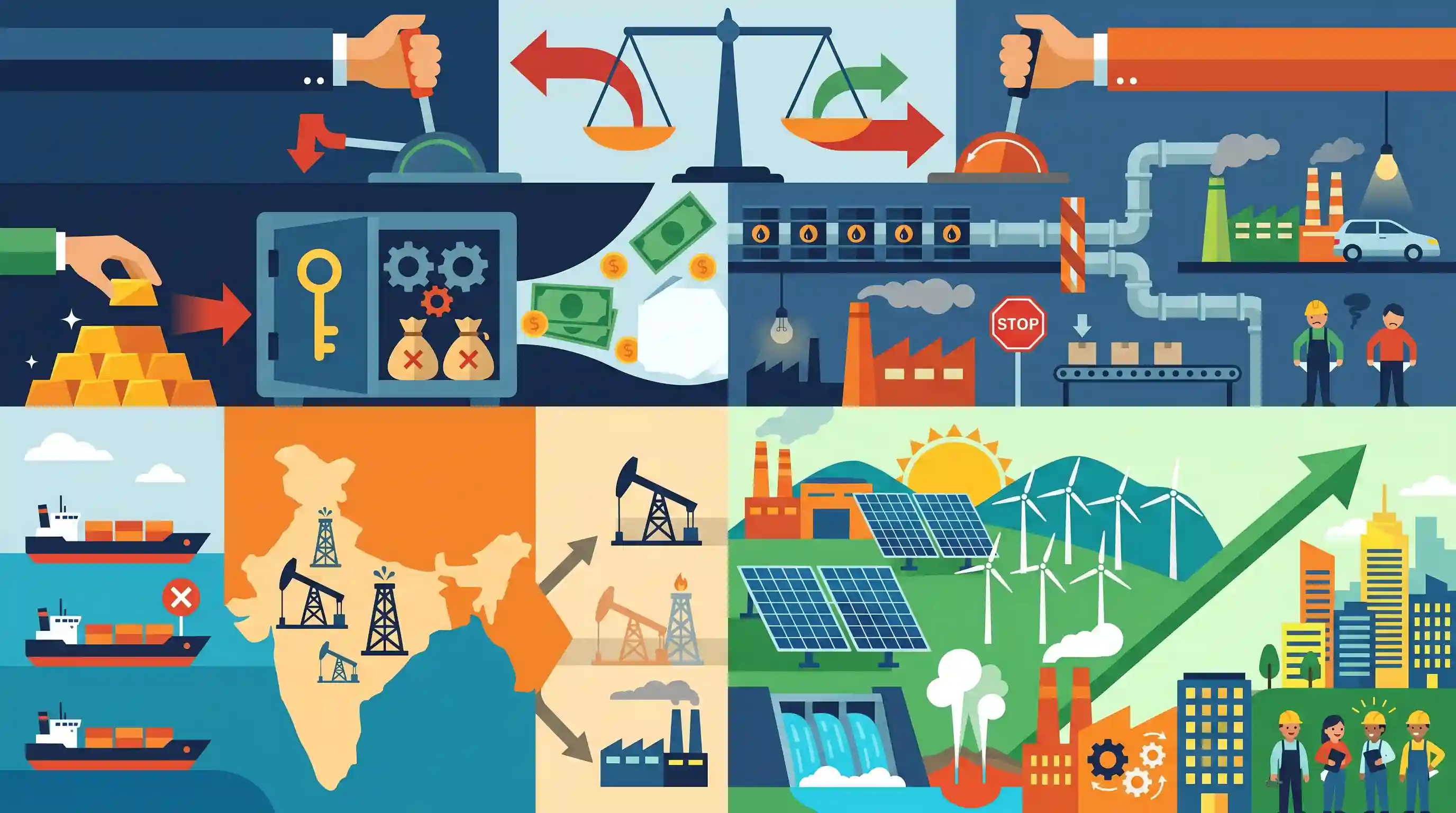
Why It Matters
It provides a crucial macroeconomic distinction between discretionary imports (gold) and essential inputs (oil), emphasizing the structural reforms and renewable energy transition required to insulate the Indian economy from geopolitical shocks and balance of payments crises.
Summary
The article analyzes the macroeconomic implications of curbing India's imports of gold and oil, clarifying that such measures are a response to balance of payments pressures rather than classic 'austerity'. While saving in gold locks up purchasing power and drains foreign exchange without adding to productive capacity, oil is an essential intermediate input. A sudden reduction in oil availability without adequate substitutes threatens output and employment, mirroring the risks of demand compression debated by Keynes and Hayek during the Great Depression. Consequently, India must urgently pursue a dual energy transition—moving from foreign to domestic sources, and from fossil fuels to renewables—to ensure long-term energy security and sustain economic growth.
Key Points
- The proposal to curb gold and oil imports is fundamentally about balance of payments and resource allocation, rather than macroeconomic 'austerity'.
- High gold imports act as a 'curse' on the Indian economy by locking up potential purchasing power and causing a leakage of aggregate demand without contributing to necessary production.
- Unlike gold, oil is a crucial intermediate input; merely reducing its supply without viable substitutes will compress aggregate demand and lead to a loss of output and employment.
- India faces an urgent need for a 'dual energy transition': shifting from foreign imports to domestic energy sources, and from fossil fuels to renewables like solar power and electricity.
- Classic macroeconomic debate (Keynes vs. Hayek) highlights that forced austerity (compressing demand) during an existing economic slowdown can further severely contract the economy.
Important Terms
Balance of Payments (BoP)

A systematic record of all economic transactions between residents of a country and the rest of the world over a specific period, typically a year.
UPSC context
GS Paper 3: External Sector. Key for understanding forex reserves, currency stability, and international trade health.
Current Account Deficit (CAD)
A situation where the value of a country's imports of goods, services, and transfers exceeds the value of its exports and income from abroad.
UPSC context
GS Paper 3: Economic Development. Tests analysis of import-export imbalances and their impact on the Indian Rupee.
Energy Security
The uninterrupted availability of energy sources at an affordable price, ensuring that energy needs for industrial and domestic use are met without strategic vulnerability.
UPSC context
GS Paper 3: Infrastructure and Energy. Crucial for evaluating national autonomy and sustainable economic growth.
Energy Transition
The structural shift from fossil-fuel-based energy systems (like coal and oil) to renewable and sustainable sources like solar, wind, and green hydrogen.
UPSC context
GS Paper 3: Environment and Energy. Relevant for India's Net Zero 2070 targets and climate change commitments.
Intermediate Input
Goods, such as crude oil or steel, used as inputs in the manufacturing of final products; they are not sold directly to end consumers.
UPSC context
GS Paper 3: Indian Economy. Tests understanding of value chains and the risks of supply-side disruptions.
Demand Compression
Deliberate policy measures, such as raising taxes or cutting spending, designed to reduce total expenditure in an economy to manage BoP crises.
UPSC context
GS Paper 3: Macroeconomics. Tests knowledge of fiscal stabilization versus growth trade-offs during economic downturns.
Gold Monetisation Scheme (GMS)
A government initiative aimed at mobilizing idle gold from households and institutions to reduce the country's reliance on gold imports.
UPSC context
GS Paper 3: Indian Economy. Important for mobilizing domestic capital and reducing the trade deficit.
Aggregate Demand
The total amount of goods and services demanded in the economy at a given overall price level and in a given time period.
UPSC context
GS Paper 3: Macroeconomics. Basic concept for analyzing output, employment, and the impact of policy interventions.
Prelims Trap
Household purchases of physical gold directly increase India's Gross Domestic Capital Formation (GDCF).
Physical gold hoarding acts as a 'leakage' from aggregate demand. It drains forex without entering the formal financial system to fund productive domestic investments.
Static Concepts Connected
How do gold and oil imports impact India's Balance of Payments?
- Trade Deficit: Gold and crude oil constitute the largest share of India's merchandise imports, significantly widening the trade deficit.
- CAD Expansion: The persistent trade deficit caused by these high-volume imports directly expands the CAD, putting downward pressure on the Rupee.
- Forex Drain: Financing these non-productive (gold) or structural (oil) imports requires continuous outflow of foreign exchange reserves, increasing external vulnerability.
What is the macroeconomic impact of physical gold hoarding?
- Demand Leakage: Physical gold locks up household savings, acting as a 'leakage' from aggregate demand since it doesn't enter the formal banking system to be lent out.
- Zero Multiplier Effect: Unlike bank deposits that fund business investments, idle physical gold does not create a multiplier effect for domestic capital formation or job creation.
Cross-Topic Patterns
Gold financialization schemes + BoP
The Gold Monetization Scheme (GMS) and Sovereign Gold Bonds (SGBs) address this exact macro problem by converting idle physical gold into financial savings, reducing the BoP drain.
Climate goals as BoP strategy
The 'dual energy transition' frames India's renewable energy push (Panchamrit) not just as an environmental obligation, but as a critical macroeconomic imperative to cut crude import reliance and stabilize CAD.

Expect a multi-statement question linking BoP pressures (gold/oil imports) with aggregate demand leakages and capital formation.
Linked PYQs · 2
Linked PYQs · 2
- 2015MainsGS3
Craze for gold in Indians has led to a surge in import of gold in recent years and put pressure on balance of payments and external value of rupee. In view of this, examine the merits of the Gold Monetization Scheme.
- 2022MainsGS3
Do you think India will meet 50 percent of its energy needs from renewable energy by 2030 ? Justify your answer. How will the shift of subsidies from fossil fuels to renewables help achieve the above objective ? Explain.
