Northwest India August Rainfall and IMD September Outlook
Source:The Hindu ↗
Why It Matters
Changing monsoon dynamics and increasing occurrences of extreme, localized rainfall events ('mini-cloudbursts') highlight the need for improved forecasting infrastructure and adaptive disaster management strategies.
Summary
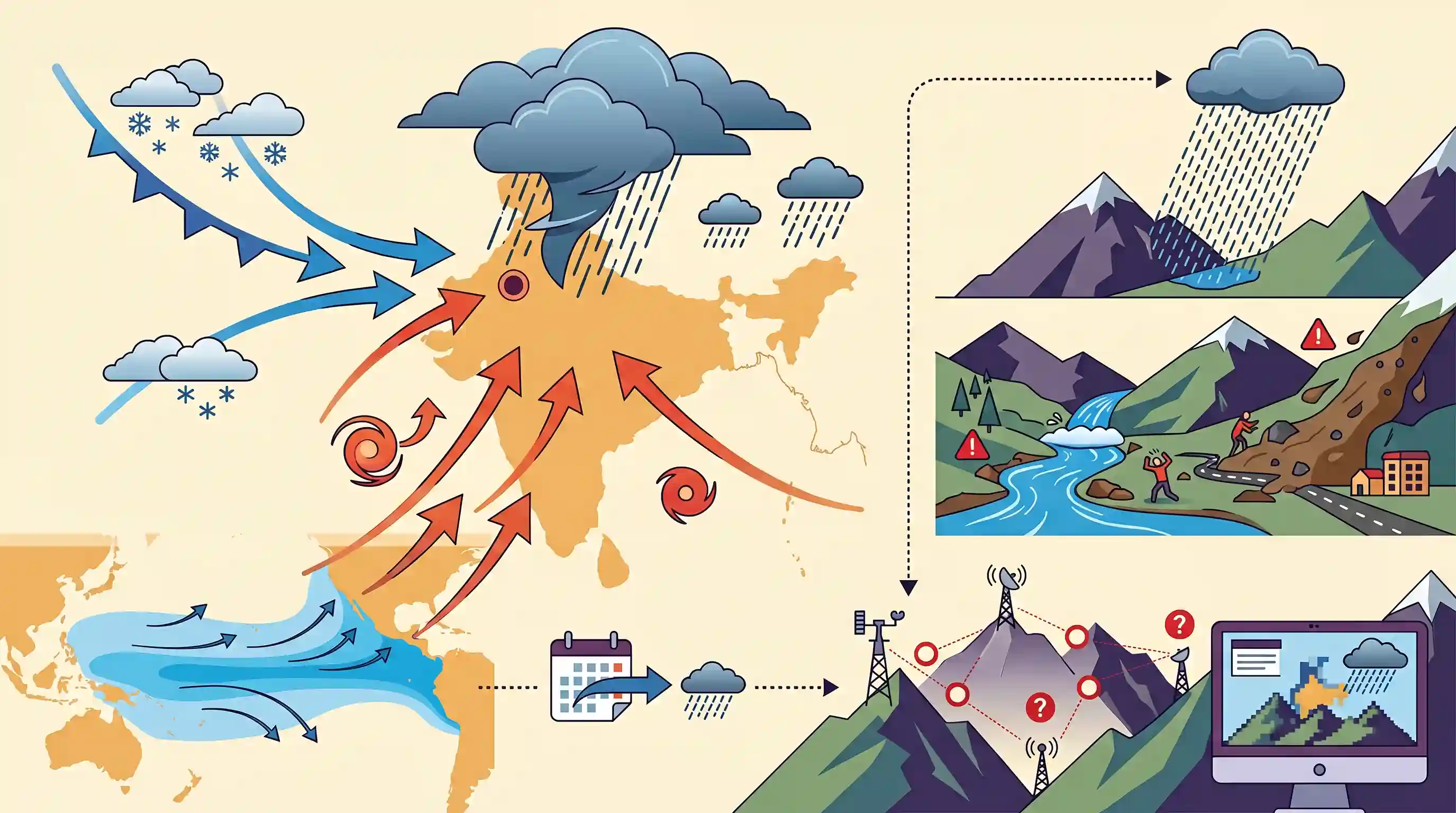
The India Meteorological Department (IMD) reports that Northwest India received its highest August rainfall since 2001, driven by the confluence of Western Disturbances and monsoon storms. Above-normal rainfall is expected to continue into September, aided by developing La Niña conditions. The IMD also highlighted an increasing trend in highly localized, intense rainfall events—termed 'mini-cloudbursts' (5 cm of rain per hour)—which frequently trigger deadly flash floods and landslides in states like Himachal Pradesh and Uttarakhand. However, accurately predicting such localized events remains a major meteorological challenge due to a sparse network of observation stations in mountainous regions.
Key Points
- Northwest India recorded 253.9 mm of rainfall in August, its second-highest for the month since 1901, primarily due to the confluence of Western Disturbances and monsoon storms.
- Above-normal rainfall is predicted to continue into September, supported by the development of La Niña conditions.
- The IMD highlighted a rising trend in 'mini-cloudbursts' (5 cm of rain per hour), which trigger devastating flash floods and landslides, though traditional cloudbursts (10 cm per hour) show no clear rising trend.
- Forecasting highly localized extreme rainfall events remains a significant challenge due to the lack of adequate meteorological station networks in rugged, mountainous terrains.
Important Terms
India Meteorological Department (IMD)

The principal government agency under the Ministry of Earth Sciences responsible for weather forecasting, meteorological observations, and seismology. It serves as a Regional Specialized Meteorological Centre for tropical cyclones.
UPSC context
GS Paper 1 & 3; tests knowledge of disaster-related institutions, early warning systems, and monsoon forecasting critical for agriculture.
La Niña
An oceanic-atmospheric phenomenon involving the cooling of sea surface temperatures in the central and eastern Pacific. It generally strengthens the Indian monsoon, leading to above-normal rainfall.
UPSC context
GS Paper 1 (Climatology); tests understanding of ENSO cycles and their direct impact on India's water security and climate variability.
Western Disturbances
Extratropical cyclonic storms originating in the Mediterranean region that bring winter precipitation to Northwest India. They are non-monsoonal but can interact with monsoon currents to cause extreme rain.
UPSC context
GS Paper 1 (Indian Climate); tests understanding of non-monsoonal rainfall sources, their importance for Rabi crops, and their role in extreme weather.
Mini-cloudbursts
A localized, high-intensity rainfall event defined by the IMD as receiving ≥5 cm of rain in one hour over a small geographical area (~20–30 sq km).
UPSC context
GS Paper 3 (Disaster Management); reflects emerging trends in extreme weather events and the difficulty of predicting localized hazards in mountainous terrain.
Cloudburst
An extreme rainfall event defined as ≥10 cm of rain per hour over an area of 20–30 sq km, often triggered by orographic lift in hilly regions.
UPSC context
GS Paper 1 & 3; tests physical geography mechanisms and disaster mitigation strategies for Himalayan states.
Flash Floods
Sudden, rapid flooding in low-lying areas or narrow valleys, usually occurring within 3–6 hours of heavy rainfall, cloudbursts, or glacial lake outbursts.
UPSC context
GS Paper 3 (Disaster Management); vital for studying vulnerability in the Himalayan ecosystem and urban drainage challenges.
Prelims Trap
Both traditional cloudbursts and mini-cloudbursts are showing a rapidly rising trend in the Himalayan region due to climate change.
IMD data shows an increasing trend only in 'mini-cloudbursts' (5 cm/hr). Traditional cloudbursts (10 cm/hr) currently show no statistically clear rising trend, a subtle nuance UPSC often exploits.
Static Concepts Connected
What drives the extreme rainfall interaction between Western Disturbances and the Monsoon?
- Confluence mechanism: The moisture-laden south-west monsoon trough merges with extratropical Western Disturbances, creating extreme atmospheric instability and vertical cloud growth.
- Summer occurrence: While traditionally associated with winter precipitation, Western Disturbances occur year-round. Their summer interaction with the monsoon is a primary trigger for extreme North Indian floods.
What is the threshold definition of a cloudburst in India?
- Traditional Cloudburst: According to the IMD, a traditional cloudburst is defined as 10 cm (100 mm) or more of rainfall per hour.
- Spatial extent: The rainfall must occur over a highly localized geographical area, roughly 20-30 square kilometers.
- Mini-cloudburst: An increasingly frequent phenomenon bringing at least 5 cm of rain per hour, capable of triggering flash floods in mountainous terrain.
Cross-Topic Patterns
Orographic lift + Doppler Radar limits
Steep Himalayan topography directly impedes Doppler Weather Radars by blocking microwave line-of-sight, linking physical geography principles (orographic lift) with meteorological technology gaps.
Mini-cloudbursts + NDMA guidelines
The shift from traditional cloudbursts to 'mini-cloudbursts' necessitates updating NDMA's flash-flood early warning frameworks, linking climate shifts directly to GS3 Disaster Management policy.

2026 Prelims will likely test the precise 10cm/hr vs 5cm/hr cloudburst definitions paired with Western Disturbance-Monsoon interaction.
Linked PYQs · 3
Linked PYQs · 3
- 2022MainsGS3
Explain the mechanism and occurrence of cloudburst in the context of the Indian subcontinent. Discuss two recent examples.
- 2015MainsGS1
How far do you agree that the behaviour of the Indian monsoon has been changing due to humanizing landscapes? Discuss.
- 2021MainsGS3
Describe the various causes and the effects of landslides. Mention the important components of the National Landslide Risk Management Strategy.
