Youth Representation and Dynastic Politics in Indian Elections
Source:Indian Express ↗
આ શા માટે મહત્વનું છે
Highlights the systemic flaws in Indian democracy where demographic reality (a young nation) is not reflected in legislative representation, crucial for GS Paper 2 topics on Parliament composition, RPA, and electoral reforms.
સારાંશ
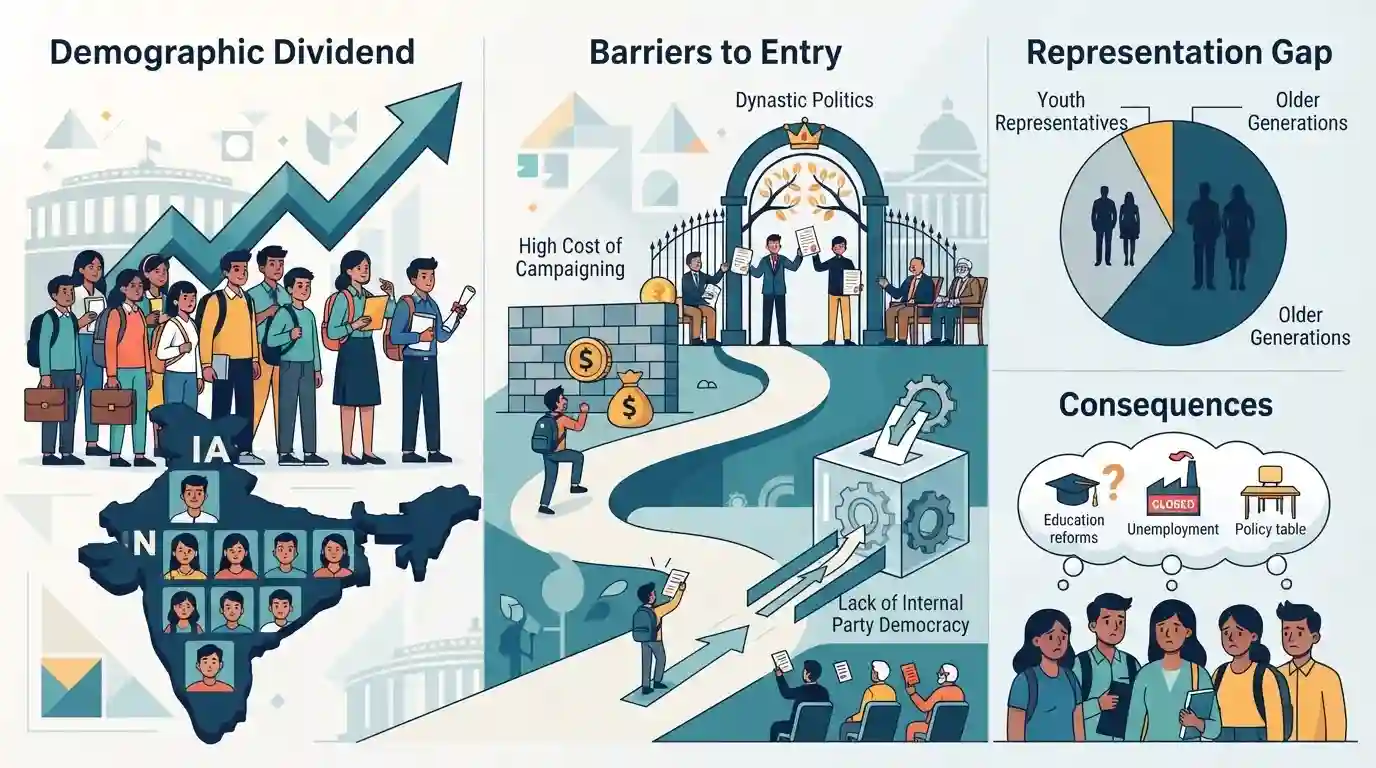
The article underscores the irony of India’s demographic dividend against the limited representation of Gen Z and youth in state assemblies and Parliament. It points out that young leaders who do secure representation overwhelmingly belong to established political families, indicating the firm grip of dynastic politics. Structural barriers such as the high cost of campaigning, lack of internal party democracy, and reliance on political patronage marginalize first-generation aspirants. Consequently, this representation gap results in youth-centric issues like employment and education not receiving the urgent legislative attention they require, calling for targeted electoral reforms.
મુખ્ય મુદ્દા
- Despite having a large youth demographic, Gen Z representation remains disproportionately low in the Parliament and State Legislative Assemblies.
- A significant majority of young elected representatives come from entrenched political families, highlighting the prevalence of dynastic politics.
- High barriers to entry—including massive electoral expenses, lack of internal party democracy, and the need for political patronage—deter first-generation youth leaders.
- The lack of adequate youth representation leads to a policy gap on issues critical to younger demographics, such as education, skill development, and employment.
- Reforms promoting internal party democracy and lowering the financial barriers of elections are essential to encourage broader youth participation.
મહત્વપૂર્ણ શબ્દો
Demographic Dividend

The economic growth potential resulting from a population's shifting age structure, specifically when the working-age segment (15-64 years) outnumbers dependent populations (children and the elderly).
UPSC context
GS Paper 1 (Society) & GS 3 (Economy). Focuses on harnessing youth potential through education, skill development, and employment.
Internal Party Democracy
The decentralized and transparent functioning of political parties, ensuring that candidates and leaders are chosen through fair internal elections rather than dynastic succession or centralized high commands.
UPSC context
GS Paper 2 (Polity). Directly tied to discussions on dynastic politics, criminalization of politics, and broader electoral reforms.
Electoral Reforms
Systematic legislative and institutional changes aimed at making elections fairer, more transparent, and representative by eliminating malpractices, increasing voter participation, and reducing the influence of money and muscle power.
UPSC context
Core GS Paper 2 topic. Tests knowledge of Election Commission initiatives, committee recommendations, and the integrity of democratic processes.
Representation of the People Act
The primary legislation governing the conduct of elections in India. It details administrative procedures, candidate qualifications and disqualifications, and the registration of political parties (under Section 29A).
UPSC context
Explicitly listed in the GS Paper 2 syllabus. Crucial for understanding the statutory framework of elections and candidate regulation.
પ્રિલિમ્સ ટ્રેપ
"The Election Commission of India can deregister a political party if it fails to conduct internal organizational elections."
Under Section 29A of the RPA, the ECI registers political parties but lacks the statutory power to deregister them for failing to hold internal elections.
સંલગ્ન સ્થિર ખ્યાલો
Does the ECI have the power to enforce internal party democracy?
- Section 29A (RPA): Mandates registration of political parties, but the Act lacks specific provisions enforcing democratic candidate selection or organizational elections.
- Deregistration Limits: The Supreme Court ruled that the ECI cannot deregister a party for violating its own internal constitution, except in cases of fraud or surrender.
- Law Commission Recommendations: The 170th and 255th reports recommended amending the RPA to legally empower the ECI to penalize or deregister non-compliant parties.
What are the constitutional age requirements for contesting elections in India?
- Lok Sabha & Assemblies: Articles 84(b) and 173(b) of the Constitution set the minimum age to contest these elections at 25 years.
- Rajya Sabha & Councils: The minimum age is set at 30 years for the Upper Houses at both the Union and State levels.
- Voting vs Contesting: While the 61st Amendment Act lowered the voting age to 18, the minimum age to contest elections remained unchanged.
આંતર-વિષય પેટર્ન
Electoral Funding & Political Inequality
The opacity of political funding and rising campaign costs disproportionately favor entrenched dynastic candidates, effectively blocking first-generation youth from entry despite recent Supreme Court rulings on Electoral Bonds.
Demographic Dividend vs. Governance Deficit
India’s economic narrative relies heavily on its young workforce. Their marginalization in legislative policy-making risks misaligning crucial initiatives (NEP, Skill India) with actual employment realities.

Expect a multi-statement question on internal party democracy, focusing specifically on ECI's inability to deregister parties under RPA.
સંલગ્ન PYQ · 3
સંલગ્ન PYQ · 3
- 2024MainsGS2
Examine the need for electoral reforms as suggested by various committees with particular reference to "one nation one election" principle.
- 2023MainsGS2
Discuss the contribution of civil society groups for women's effective and meaningful participation and representation in state legislatures in India.
- 2017MainsGS2
To enhance the quality of democracy in India the Election Commission of India has proposed electoral reforms in 2016. What are the suggested reforms and how far are they significant to make democracy successful?
