Uttar Pradesh leases JPNIC under public private partnership model
Source:Indian Express ↗
Why It Matters
Illustrates the practical application of PPP models and asset monetization strategies by state governments to manage large public infrastructure, a key topic under GS3 Infrastructure and Investment models.
Summary
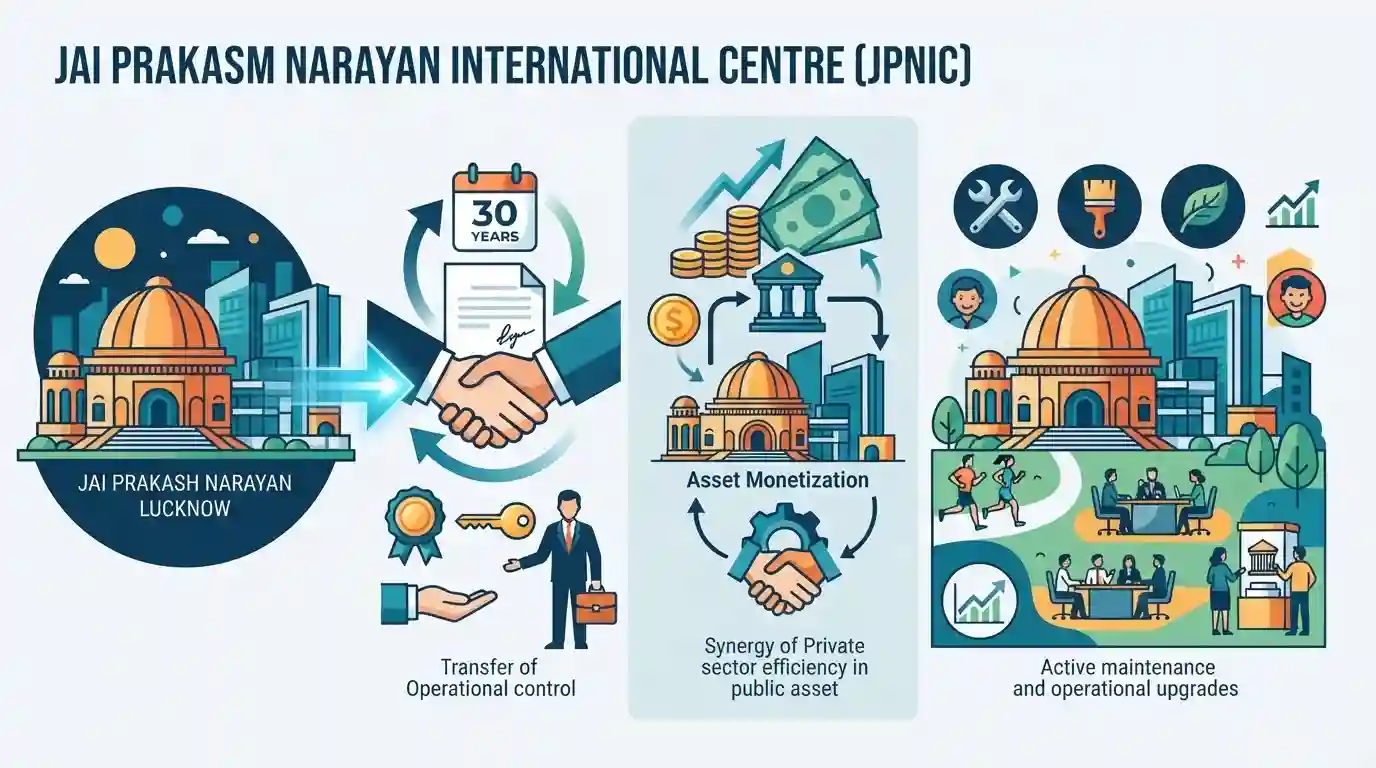
The Uttar Pradesh government has decided to lease the Jai Prakash Narayan International Centre (JPNIC) in Lucknow to private firms for a period of 30 years. This decision highlights the state's approach to infrastructure management through Public-Private Partnerships (PPP) and asset monetization, aiming to utilize private sector efficiency for the upkeep and operation of public assets.
Key Points
- The Uttar Pradesh government has handed over the Jai Prakash Narayan International Centre (JPNIC) in Lucknow to private firms.
- The handover is structured as a 30-year lease, indicating a long-term Public-Private Partnership (PPP).
- This move underscores the growing trend of asset monetization by state governments to manage and maintain large-scale urban infrastructure.
Important Terms
Public-Private Partnership (PPP)

A collaborative investment model between government agencies and private sector entities to finance, construct, operate, and maintain public infrastructure while sharing financial and operational risks.
UPSC context
GS Paper III (Infrastructure & Investment Models); tests models of resource mobilization and public-private coordination in development.
Asset Monetization
The structured process of leasing out public-funded, underutilized infrastructure assets to private operators to unlock capital value for new developmental projects.
UPSC context
GS Paper III (Indian Economy & Infrastructure); tests fiscal deficit management, public asset optimization, and revenue-generation strategies.
Jai Prakash Narayan International Centre (JPNIC)
A major, state-funded civic and cultural infrastructure project in Lucknow, Uttar Pradesh, recently leased to private operators to complete and manage its operations.
UPSC context
GS Paper II (Government Policies) & GS III (Infrastructure); tests case studies of public-private partnerships in stalled urban projects.
Lucknow Development Authority (LDA)
A statutory urban planning and development body established under state legislation to oversee Lucknow's master plan, urban infrastructure, and civic land management.
UPSC context
GS Paper II (Local Governance & Statutory Bodies); tests functioning, finance models, and governance of urban planning authorities.
Prelims Trap
Asset monetization under the National Monetisation Pipeline involves the permanent sale or transfer of public ownership to private players.
Monetization only leases operating rights for a structured tenure; ownership remains with the state and the asset reverts back, unlike disinvestment.
Static Concepts Connected
What distinguishes Asset Monetization from Disinvestment?
- Ownership structure: Government retains legal ownership of the asset, transferring only leasehold or concession rights.
- Revenue recycling: Concession fees or lease revenues are reinvested specifically into new greenfield infrastructure creation.
- Asset reversion: The asset mandatorily reverts to the public entity after the lease period ends.
What were the key recommendations of the Vijay Kelkar Committee (2015)?
- Risk allocation: Allocate risk to the party (public or private) best suited to manage and mitigate it.
- Dispute resolution: Establish an Infrastructure PPP Adjudication Tribunal (IPAT) to resolve concession disputes swiftly.
- Focus shift: Reorient PPP philosophy from maximizing government revenue to delivering quality public services.
Cross-Topic Patterns
Municipal Finance + Fiscal Federalism
State-level asset leasing enables municipal bodies to unlock capital from stagnant public real estate, bypassing constitutional debt borrowing limits.
Sustainable Cities + PPP Dilemmas
Leasing public civic centers test-runs the balance between private commercial operations and maintaining inclusive, accessible public utility spaces.

Analytical questions comparing Asset Monetization versus Disinvestment alongside Kelkar Committee PPP tenets are highly probable in GS-3.
Linked PYQs · 3
Linked PYQs · 3
- 2022MainsGS3
Why is Public Private Partnership (PPP) required in infrastructural projects ? Examine the role of PPP model in the redevelopment of Railway Stations in India.
- 2014MainsGS3
Explain how Private Public Partnership arrangements, in long gestation infrastructure projects, can transfer unsustainable liabilities to the future. What arrangements need to be put in place to ensure that successive generations' capacities are not compromised?
- 2017MainsGS3
Examine the development of Airports in India through joint ventures under Public-Private Partnership (PPP) model. What are the challenges faced by the authorities in this regard?
