Judicial Pronouncements on EWS Reservation and New Criminal Laws
Source:courtbook ↗
Why It Matters
Judicial interpretations of new laws (like the BNSS) and guidelines on contemporary issues (EWS implementation, CSAM regulation on social media, disability rights) are critical for understanding the evolving landscape of Indian Polity, Governance, and Social Justice.
Summary
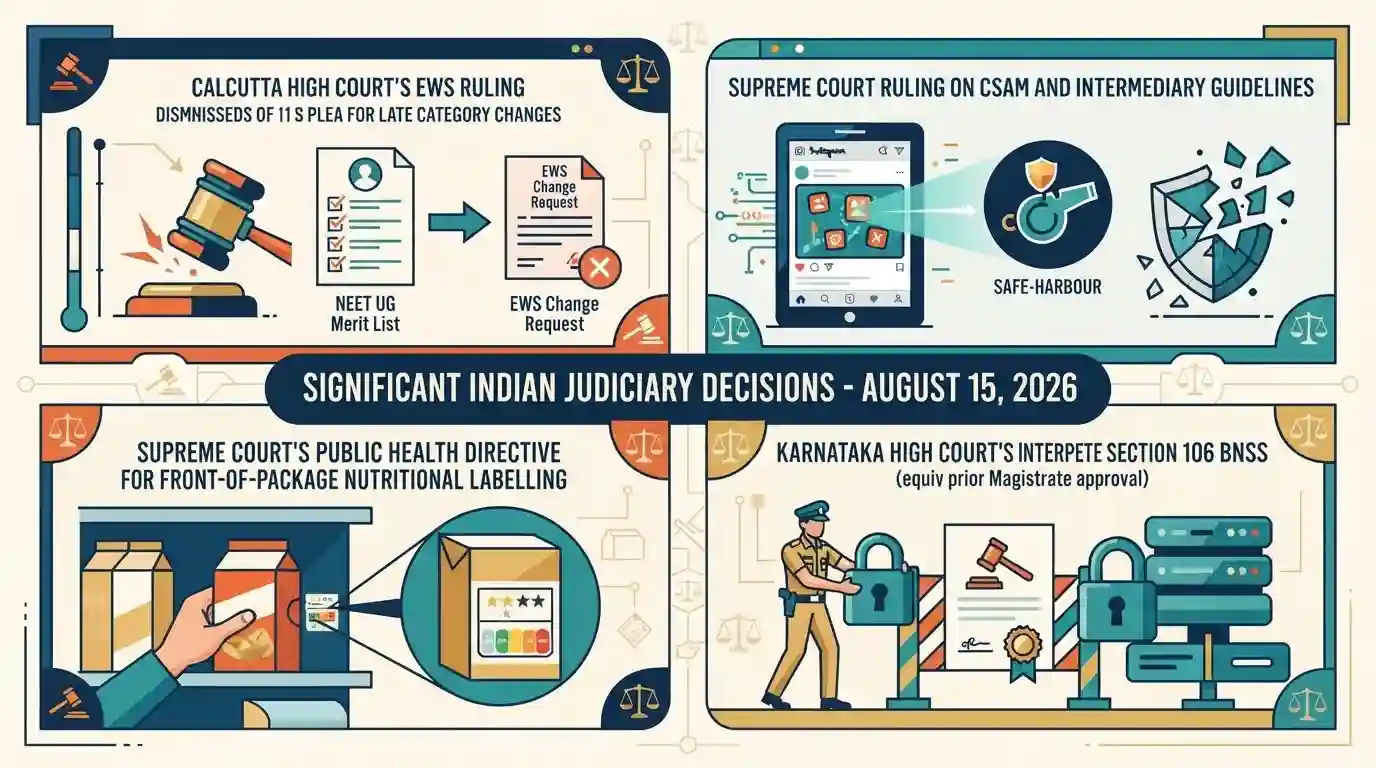
This article provides a roundup of significant judicial decisions from the Supreme Court and various High Courts in India issued on August 15, 2026. Key rulings address diverse areas of polity and governance. The Calcutta High Court dismissed a plea to change a candidate's category to EWS after the NEET UG merit list publication, ensuring strict adherence to reservation procedure timelines. The Supreme Court emphasized the mandatory reporting of Child Sexual Abuse Material (CSAM) by social media intermediaries, stripping away safe-harbour protections for such content. Additionally, the Apex Court pressed for mandatory front-of-package nutritional labelling on pre-packaged foods to safeguard public health. Meanwhile, the Karnataka High Court interpreted Section 106 of the newly enacted Bharatiya Nagarik Suraksha Sanhita (BNSS), ruling that police cannot issue debit-freeze orders on bank accounts without prior Magistrate approval, marking an important check on police powers under the new criminal procedural framework.
Key Points
- The Calcutta High Court ruled that a candidate cannot switch to the Economically Weaker Section (EWS) category for NEET UG counselling after the publication of the final merit list.
- The Supreme Court clarified that social media platforms are legally obligated under the IT Act and POCSO to proactively report Child Sexual Abuse Material (CSAM) and cannot claim safe-harbour immunity.
- Addressing the rise of lifestyle diseases, the Supreme Court emphasized the urgent need for mandatory front-of-package nutritional labelling on pre-packaged foods.
- In a significant interpretation of the new criminal laws, the Karnataka High Court ruled that under Section 106 of the BNSS, police must obtain prior Magistrate approval before issuing a debit-freeze order on a bank account.
- The Delhi High Court mandated that film producers must ensure accessibility features (like audio descriptions and closed captions) for persons with disabilities before the theatrical release of films.
Important Terms
Calcutta High Court

Established on July 1, 1862, under the High Courts Act, 1861, it is India's oldest High Court, holding jurisdiction over West Bengal and the Andaman and Nicobar Islands.
UPSC context
Core topic in Mains Paper V (State Judiciary) testing historical facts, jurisdiction, and state-centric judgments.
Bharatiya Nagarik Suraksha Sanhita (BNSS)
Enacted in 2023 to replace the Code of Criminal Procedure (CrPC), 1973, it is the primary legislation governing criminal procedure and law enforcement powers in India.
UPSC context
Tested in Mains Paper V and Judicial Service exams as a vital modern legal reform.
Bharatiya Nyaya Sanhita (BNS)
The primary penal code of India enacted in 2023, replacing the colonial Indian Penal Code (IPC) of 1860, codifying crimes, offenses, and punishments.
UPSC context
Relevant for Mains Paper V and Judicial Service exams, testing new legal definitions and penal code transitions.
Supreme Court of India
The highest constitutional court and final court of appeal in India, established under Article 124, possessing extensive original, appellate, and advisory jurisdictions.
UPSC context
Core focus of Mains Paper V (Union Judiciary), testing constitutional articles, powers, and landmark judicial decisions.
Protection of Children from Sexual Offences (POCSO) Act
A gender-neutral law enacted in 2012 to safeguard children under 18 from sexual abuse, assault, and pornography, mandating child-friendly trial procedures.
UPSC context
Tested under social justice, welfare schemes, and child rights in Mains Paper IV and V.
Food Safety and Standards Act
A 2006 law consolidating old food regulations and establishing the Food Safety and Standards Authority of India (FSSAI) to ensure science-based standards for food.
UPSC context
Tested in Mains Paper IV (Science/Environment) and Paper V (Polity/Governance) regarding public health regulation.
Prelims Trap
The 103rd Constitutional Amendment Act, 2019, enabled EWS reservations by amending Articles 15(5) and 16(5) of the Constitution.
The 103rd Amendment inserted Articles 15(6) and 16(6). Articles 15(5) and 16(5) relate to OBC reservations and religious office exceptions respectively.
Static Concepts Connected
What are the core constitutional aspects of the 103rd Amendment (EWS reservation)?
- New Articles: Inserted Articles 15(6) and 16(6) to enable 10% reservation in educational institutions and public employment for economically weaker sections.
- Basic Structure: The Supreme Court in Janhit Abhiyan (2022) ruled that the 10% quota does not violate the basic structure or the 50% reservation ceiling.
- Exclusionary Criteria: It specifically excludes classes already covered under SC, ST, and OBC categories to prevent double benefits.
How does the BNSS differ from the CrPC regarding property seizure and attachment?
- Section 106 vs 102: Section 106 of the BNSS retains police powers to seize suspicious property during investigation, matching the older Section 102 of the CrPC.
- Section 107 Innovation: Introduces a new statutory mechanism requiring a Magistrate's order for the formal attachment and forfeiture of the 'proceeds of crime'.
- Judicial Oversight: High Courts have clarified that even under Section 106, severe actions like debit-freezing bank accounts require judicial approval to prevent police overreach.
Cross-Topic Patterns
Administrative law vs Equity
Calcutta High Court's refusal to change categories post-merit list highlights the triumph of administrative finality and estoppel over individual claims of equity.
Article 21 and Food Safety
The Supreme Court linking front-of-package labeling to Article 21 expands the Right to Life to encompass informed nutritional choices and preventive public health.

Constitutional articles of EWS reservation and comparative police powers under BNSS vs CrPC are highly likely to feature in WBCS Mains.
Linked PYQs · 3
Linked PYQs · 3
- 2021WBCS_PRELIMSGS1
The recently much talked about 'toolkit' is basically
- 2024WBCS_PRELIMSGS1
Which Fundamental Rights cannot be suspended during a National Emergency under Article 359?
- 2023WBCS_PRELIMSGS1
Which Union Ministry is associated with the pilot phase of The Open Network for Digital Commerce?
