Bankipur By-Election Result and Shifting Regional Political Dynamics
Source:Indian Express ↗
কেন এটি গুরুত্বপূর্ণ
Understanding by-elections, the role of alternative political formations (like Jan Suraaj), and changes in voter behavior is essential for analyzing the evolution of India's party system, the Representation of the People Act's statutory guidelines on vacancies, and federal coalition dynamics under GS Paper II.
সারসংক্ষেপ
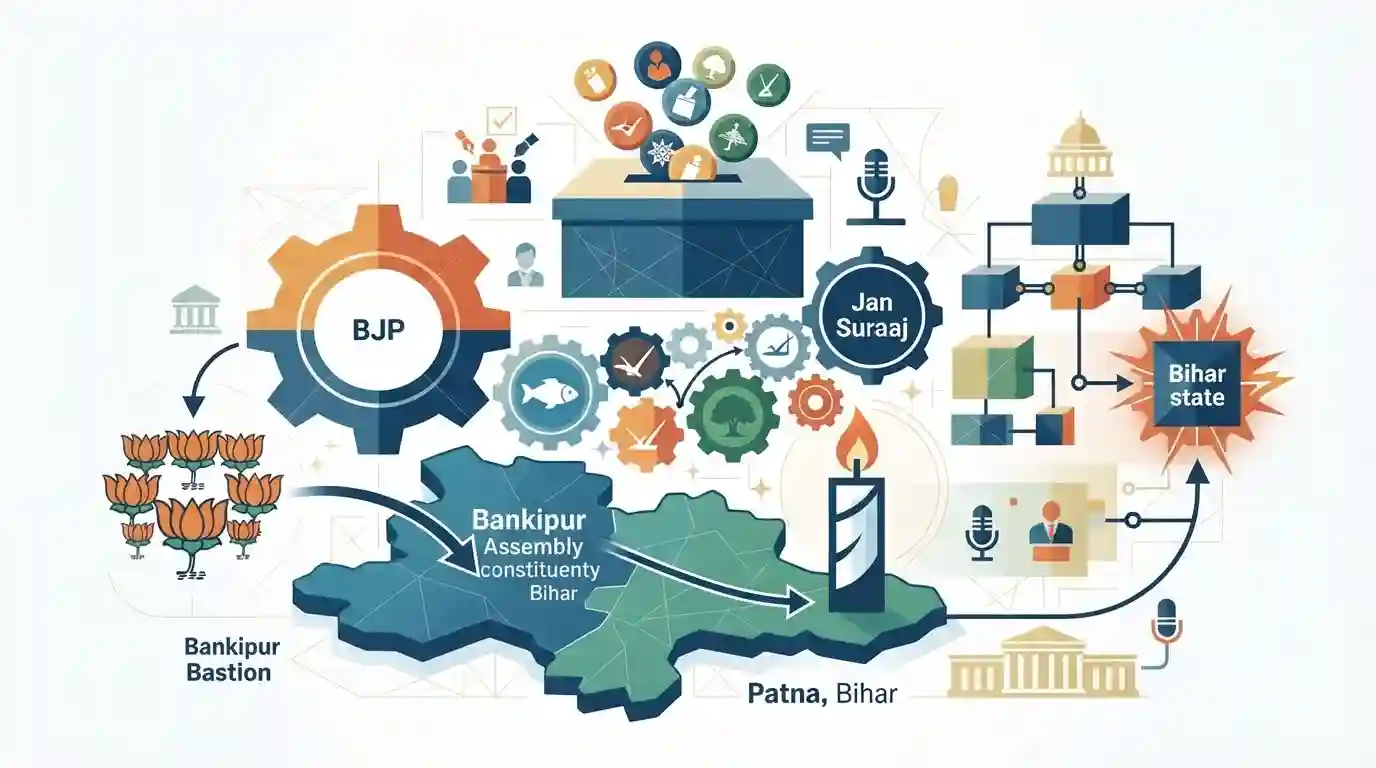
The Bankipur Assembly by-election in Bihar delivered a major political shift as the ruling BJP lost its long-held bastion in Patna. Prashant Kishor's Jan Suraaj party scored a landmark victory, highlighting the changing dynamic of regional politics, coalition calculations, and changing voter behavior in the state.
মূল বিষয়
- The Bankipur by-election in Patna, Bihar, resulted in a significant defeat for the BJP in one of its most established urban bastions.
- The election marked the legislative entry of Prashant Kishor (PK) and his political platform, Jan Suraaj, signaling a shifting paradigm in Bihar's regional politics.
- The outcome serves as an empirical warning to the BJP and its coalition allies that traditional support bases can shift when faced with grassroots-driven alternative political forces.
- By-elections are legally mandated under Section 151A of the Representation of the People Act, 1951, requiring vacancies to be filled within six months, and serve as key barometers of localized voter sentiment.
- The defeat highlights changing voter behavior, urban disenchantment, and the limitations of conventional caste-based party coalitions in the face of programmatic local mobilization.
গুরুত্বপূর্ণ শব্দ
Representation of the People Act, 1951

The primary law regulating the conduct of elections in India, including rules on candidate qualifications, corrupt practices, political party registration, and electoral disputes, complementing the earlier 1950 Act that handles voter rolls.
UPSC context
Crucial for GS Paper II (Polity and Governance), specifically statutory bodies, electoral reforms, and disqualification rules.
Bharatiya Janata Party (BJP)
A major national political party in India. Its long-held dominance in several strongholds, like the Bankipur constituency, reflects its deep organizational roots and widespread influence in state and national politics.
UPSC context
Relevant for GS Paper II under topics of political parties, regionalization vs. nationalization, and democratic dynamics.
Jan Suraaj
A grassroots political movement in Bihar launched by political strategist Prashant Kishor in 2022, which transitioned into a full political party in 2024 with a focus on governance, education, and employment.
UPSC context
Illustrates GS Paper II topics of regional political parties, civil society movements evolving into political players, and voting behavior.
প্রিলিমস ফাঁদ
The Election Commission must conduct by-elections for all legislative vacancies within six months without any statutory exceptions.
Section 151A of the RPA, 1951 explicitly waives this requirement if the remaining term is less than a year, or if the ECI certifies it as impracticable.
সংযুক্ত স্থির ধারণা
What rules and exceptions govern legislative by-elections under RPA 1951?
- Six-month mandate: Section 151A mandates that casual vacancies in Parliament or State Assemblies must be filled within six months of occurrence.
- Statutory exceptions: By-elections are deferred if the remaining term is under one year, or if ECI and the Centre deem holding it difficult.
- Constitutional backing: ECI derives its scheduling authority from Article 324, ensuring independence from executive delays during casual vacancies.
How does the Model Code of Conduct apply during by-elections?
- Territorial limitation: Unlike general elections, the MCC is restricted strictly to the districts containing the by-poll constituency.
- Executive restrictions: Ministers are barred from announcing specific welfare schemes or official grants targeted at the poll-bound constituency.
আন্তঃবিষয় প্যাটার্ন
ONOE vs Federal Flexibility
Frequent by-elections fuel the simultaneous polls (ONOE) debate, contrasting administrative cost-efficiency with the need for continuous local representation and federal flexibility.
Post-Caste Voting Behaviour
The rise of issue-based alternative fronts highlights a structural shift in voting behaviour, moving away from caste coalitions toward localized programmatic delivery.

RPA Section 151A exceptions paired with MCC territorial limits during by-elections will likely feature as a conceptual Prelims MCQ in 2026.
সংযুক্ত PYQ · 2
সংযুক্ত PYQ · 2
- 2017PrelimsGS1
Consider the following statements: 1. The Election Commission of India is a five-member body. 2. Union Ministry of Home Affairs decides the election schedule for the conduct of both general elections and bye-elections. 3. Election Commission resolves the disputes relating to splits/mergers of recognised political parties. Which of the statements given above is/are correct?
- 2020PrelimsGS1
Consider the following statements: 1. According to the Constitution of India, a person who is eligible to vote can be made a minister in a State for six months even if he/she is not a member of the Legislature of that State. 2. According to the Representation of People Act, 1951, a person convicted of a criminal offence and sentenced to imprisonment for five years is permanently disqualified from contesting an election even after his release from prison. Which of the statements given above is/are correct?
