Recent Security and Ecological Rulings Highlight Governance Challenges
Source:Indian Express ↗
কেন এটি গুরুত্বপূর্ণ
This article covers critical governance and security issues—ranging from the vulnerable security status of migrant laborers in conflict-prone zones, ecological carrying capacity violations in tourist hotspots like Udaipur, and India's diplomatic position on human rights violations in PoK.
সারসংক্ষেপ
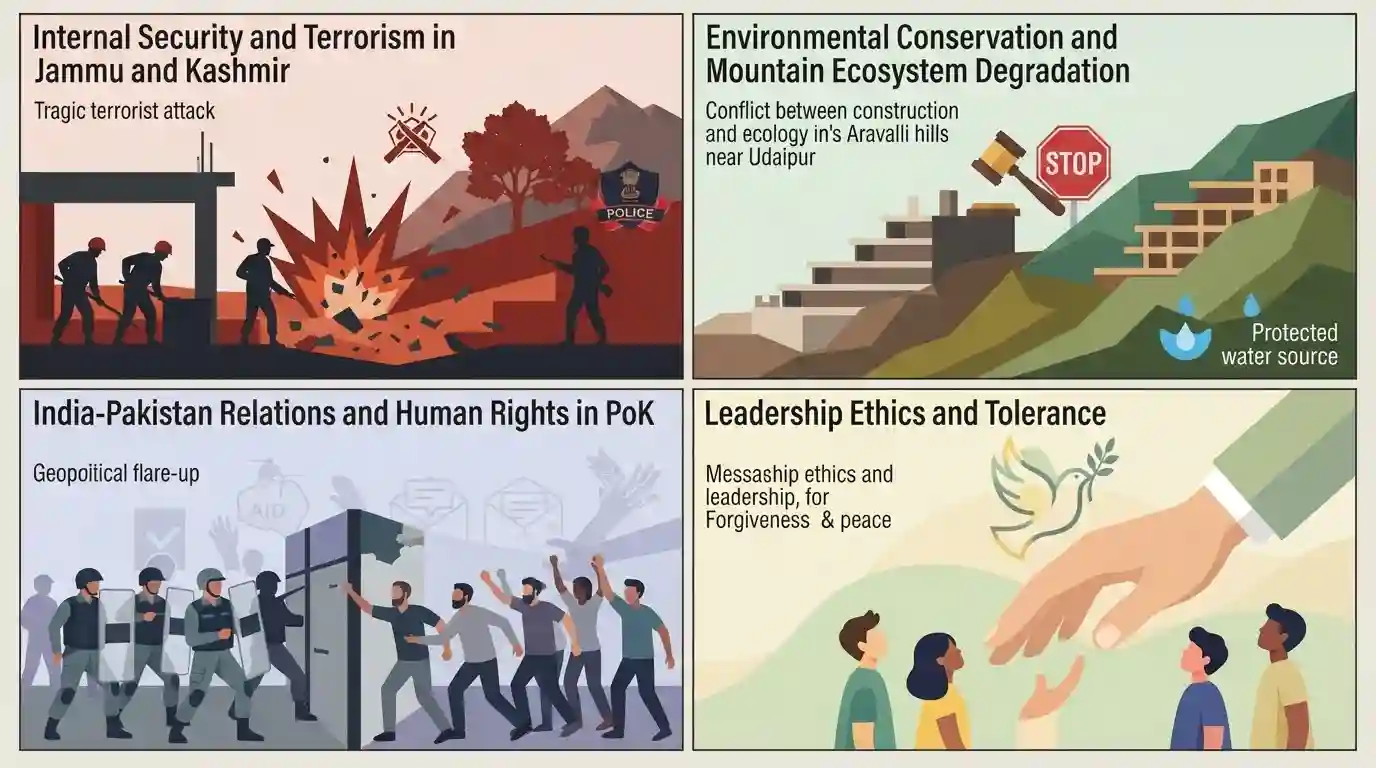
The news excerpt outlines several key developments: a tragic terrorist attack targeting migrant workers in South Kashmir; a major geopolitical and human rights flare-up in Pakistan-occupied Kashmir (PoK) following a violent crackdown by Pakistan's security forces; judicial intervention by the Rajasthan High Court halting commercial hotel construction on the ecologically fragile Aravalli hills around Udaipur; and prime ministerial remarks emphasizing forgiveness and compassion toward protesting youth.
মূল বিষয়
- A terrorist attack in Kulgam, Jammu & Kashmir, targeted non-local migrant laborers from Chhattisgarh, resulting in one death and highlighting the security threat posed by target killings.
- India flagged the 'ruthless' use of force by Pakistan authorities in Pakistan-occupied Kashmir (PoK), where a crackdown on peaceful protesters resulted in the death of 40 civilians.
- The Rajasthan High Court severely criticized the state government for allowing rampant hotel development to replace the Aravalli hills in Udaipur, questioning the role of private agencies in drafting the state's 2018 Hill Policy.
- The Prime Minister emphasized tolerance and compassionate leadership by stating he forgives youth who protested against him, highlighting the ethical need to guide rather than reprimand misguided children.
গুরুত্বপূর্ণ শব্দ
2018 Hill Policy

The Rajasthan government's 2018 framework regulating hill construction. The Rajasthan High Court severely criticized it in 2026 for lacking ecological safeguards, bypassing statutory environment/pollution authorities, and seemingly being drafted by "private agencies" enabling unchecked commercial development.
UPSC context
Relevant for GS-3 (Environment/EIA) and GS-2 (Governance/Policy Formulation), highlighting judicial review of state development policies versus ecological preservation.
Rajasthan High Court
The apex judicial body of Rajasthan. In 2026, it intervened decisively against rampant, unregulated construction and mining in the ecologically fragile Aravalli hills, halting hotel projects and scrutinizing state hill policies for bypassing environmental consultations.
UPSC context
Relevant for GS-2 (Judiciary/PILs) and GS-3 (Environmental Conservation), illustrating judicial activism in enforcing sustainable development and holding executive policy accountable.
Hockey India
The governing body for hockey in India. In August 2026, it faced widespread criticism and internal disputes over changing the national team's traditional blue jersey to saffron ahead of the World Cup, citing "turf visibility" issues.
UPSC context
Relevant for GS-2 (Sports Governance/Transparency) and current affairs, touching on how national symbols and sports administration intersect with political and public sentiment.
প্রিলিমস ফাঁদ
The Public Trust Doctrine grants the State absolute ownership to alienate public ecological resources for commercial use if it generates revenue.
The doctrine makes the State a non-proprietary trustee, not an owner. It explicitly bars the State from transferring public ecological commons to private commercial ownership.
সংযুক্ত স্থির ধারণা
What is the Public Trust Doctrine and its constitutional basis in India?
- Core Principle: Derived from Roman law, it posits that resources like air, water, and forests are held by the state in trust for the general public's use.
- Constitutional Basis: Read into Article 21 (Right to Life) and Article 48A (Directive Principles of State Policy) by the Supreme Court of India.
- Key Precedent: Established in M.C. Mehta v. Kamal Nath (1997), ruling that the State acts as a non-proprietary caretaker and cannot permit conversion of ecological commons into private commercial ownership.
What are the key geographical and ecological characteristics of the Aravalli Range?
- Age and Barrier: One of the world's oldest fold mountain systems, running southwest-to-northeast from Gujarat to Delhi, serving as a critical barrier to the Thar Desert's eastward expansion.
- Water Divide: Acts as a key water divide separating the drainage of the Indus basin (Sutlej/Beas) and the Ganga basin (Yamuna).
- Legal Protection: The Supreme Court (2025) defined hills uniformly as features 100m or higher above local terrain to prevent piecemeal ecological and mining-led degradation.
আন্তঃবিষয় প্যাটার্ন
Migrant security as asymmetric warfare
Terrorist targeting of non-local laborers in Kashmir exploits economic vulnerabilities, threatening national integration and demanding integrated security-development policies for migrant worker safety.
Judicial checks on outsourced policymaking
The Rajasthan High Court's rejection of outsourced hill bylaws highlights growing judicial scrutiny of states delegating ecological and master-plan policymaking to private, non-accountable entities.

SC's 2025 landscape-level 100m height definition of Aravallis and Public Trust Doctrine application will likely feature in 2026 GS3/Prelims.
সংযুক্ত PYQ · 4
সংযুক্ত PYQ · 4
- 2025MainsGS3
Terrorism is a global scourge. How has it manifested in India? Elaborate with contemporary examples. What are the counter measures adopted by the State? Explain.
- 2023MainsGS3
Winning of 'Hearts and Minds' in terrorism-affected areas is an essential step in restoring the trust of the population. Discuss the measures adopted by the Government in this respect as part of the conflict resolution in Jammu and Kashmir.
- 2019MainsGS1
How can the mountain ecosystem be restored from the negative impact of development initiatives and tourism?
- 2019MainsGS3
Define the concept of carrying capacity of an ecosystem as relevant to an environment. Explain how understanding this concept is vital while planning for sustainable development of a region.
