Attukal Pongala Festival and Inter-Faith Communal Harmony
Source:Indian Express ↗
Why It Matters
This event provides an excellent contemporary case study for Mains GS1 (Indian Society) and GS4 (Ethics) to illustrate communal harmony, the Indian model of secularism, and syncretic cultural traditions. It also holds factual relevance for Prelims regarding the Attukal Pongala festival.
Summary
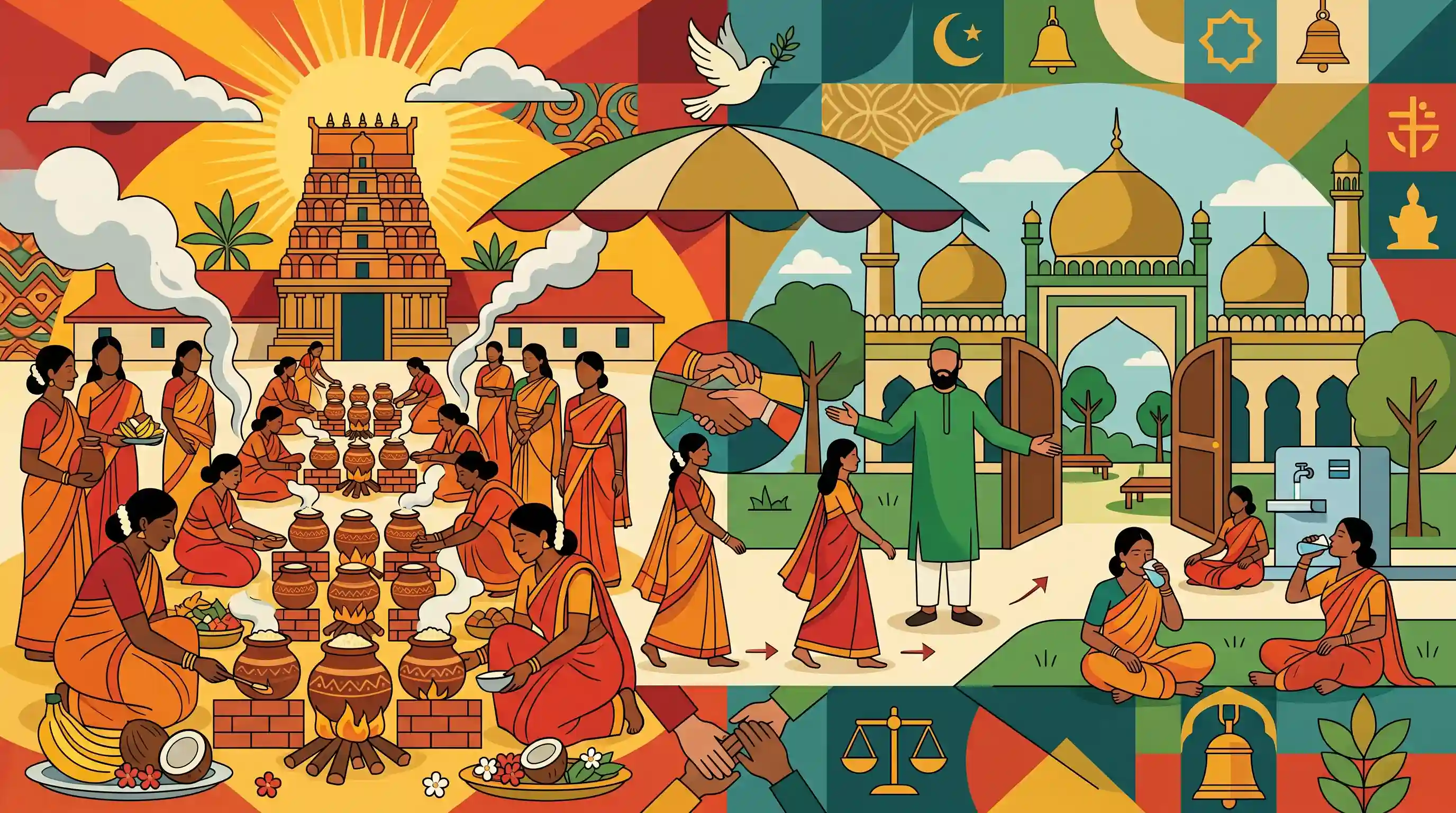
Ahead of the renowned Attukal Pongala festival in Thiruvananthapuram, Kerala, a local imam has urged mosque committees to open their premises to assist Hindu women devotees. The festival, celebrated at the Attukal Bhagavathy Temple and known as the 'Sabarimala of Women', attracts millions of women who gather to prepare a ritualistic sweet offering. The imam's request to provide resting spaces, drinking water, and other facilities to the devotees highlights a profound example of inter-faith cooperation and communal harmony. This gesture reinforces the foundational Indian values of tolerance, pluralism, and a unique model of secularism that respects and accommodates diverse religious practices.
Key Points
- Ahead of the Attukal Pongala festival, a Kerala imam has appealed to mosque committees in Thiruvananthapuram to open their doors to Hindu women devotees, offering them water, shade, and resting places.
- Attukal Pongala is a major annual festival celebrated at the Attukal Bhagavathy Temple, often referred to as the 'Sabarimala of Women'.
- The festival holds a Guinness World Record for the largest religious gathering of women on a single day.
- The imam's appeal serves as a powerful testament to Kerala's syncretic culture and India's broader ethos of communal harmony, mutual respect, and pluralistic secularism.
Important Terms
Attukal Pongala

A 10-day festival in Thiruvananthapuram, Kerala, where millions of women offer a ritualistic sweet dish (Pongala) to the presiding deity, holding the Guinness World Record for largest female religious gathering.
UPSC context
GS Paper I (Art and Culture); tests knowledge of regional festivals and their socio-cultural impact.
Sabarimala of Women
A popular moniker for the Attukal Pongala festival, highlighting its status as a massive, women-only pilgrimage and ritual event comparable to the Sabarimala pilgrimage for men.
UPSC context
GS Paper I (Culture/Society); significance of gender-specific religious practices in India.
Attukal Bhagavathy Temple
An ancient shrine in Kerala dedicated to Goddess Kannaki (incarnation of Parvati), known for its architectural blend of Kerala and Tamil styles and the annual Attukal Pongala festival.
UPSC context
GS Paper I (Culture); important religious and cultural landmark in South India.
Indian Secularism
A positive model based on "Sarva Dharma Sambhava" (equal respect for all religions). Unlike the Western model of strict separation, it allows state-supported religious reform and equal support for all faiths.
UPSC context
GS Paper II (Polity/Constitution); distinguishes India's unique constitutional philosophy from Western concepts.
Communal Harmony
A state of peaceful coexistence between different religious communities. It involves mutual respect and cooperation, as demonstrated by mosques opening their doors to Hindu devotees during religious festivals.
UPSC context
GS Paper I (Social Issues) and GS Paper II (Social Justice); critical for national integrity and social fabric.
Mosque Committees
Often referred to as Mahal Committees in Kerala, these administrative bodies manage mosque affairs and frequently spearhead inter-faith dialogue, social welfare, and community support initiatives.
UPSC context
GS Paper II (Governance/Society); explores the role of local religious institutions in community development and harmony.
Prelims Trap
"Attukal Pongala is a major harvest festival celebrated across South India, similar to Makar Sankranti."
It is not a pan-South Indian harvest festival. It is a specific 10-day temple festival in Thiruvananthapuram, Kerala, dedicated to Goddess Bhagavathy (Kannaki).
Static Concepts Connected
What is the historical and literary significance of the Sangam epic Silappatikaram?
- Authorship: Written by Ilango Adigal, a Jain monk and brother of the Chera king Senguttuvan.
- Core Narrative: Focuses on Kannaki, who famously curses the city of Madurai after the unjust execution of her husband Kovalan.
- Cultural Impact: Led to the Pattini cult (worship of Kannaki as the goddess of chastity), directly linking to deities like Attukal Bhagavathy.
How does the Indian model of secularism contrast with the strict Western model?
- Western Model: Based on a strict, mutually exclusive separation between religion and the state.
- Indian Model: Rooted in 'Sarva Dharma Sambhava', meaning equal respect and accommodation for all religions.
- Positive Intervention: Allows state intervention in religious affairs for social reform, emphasizing active communal harmony over rigid state-church division.
Cross-Topic Patterns
Sangam literature's living legacy
Attukal Amma is believed to be Kannaki from Silappatikaram, showing how ancient Sangam literary traditions remain alive through continuous worship and massive modern-day festivals.
Kerala-Dravidian architectural syncretism
The temple bridges the steep-roofed Kerala timber style with Dravidian gopurams, reflecting the historical cross-pollination between Chera and Chola/Pandya cultural domains.

Expect a Prelims pair-matching question linking Sangam epics (Silappatikaram) to modern temple festivals (Attukal) and their deities.
Linked PYQs · 3
Linked PYQs · 3
- 2022MainsGS1
Are tolerance, assimilation and pluralism the key elements in the making of an Indian form of secularism? Justify your answer.
- 2017MainsGS1
The spirit of tolerance and love is not only an interesting feature of Indian society from very early times, but it is also playing an important part at the present. Elaborate.
- 2019MainsGS1
What are the challenges to our cultural practices in the name of secularism?
