Politicisation of US Scientific Institutions and Research Autonomy
Source:Indian Express ↗
Why It Matters
It provides a critical perspective on how political interference and the dismantling of institutional autonomy can cripple a nation's scientific capabilities, offering vital lessons for India's governance of its own research ecosystem and diaspora policies.
Summary
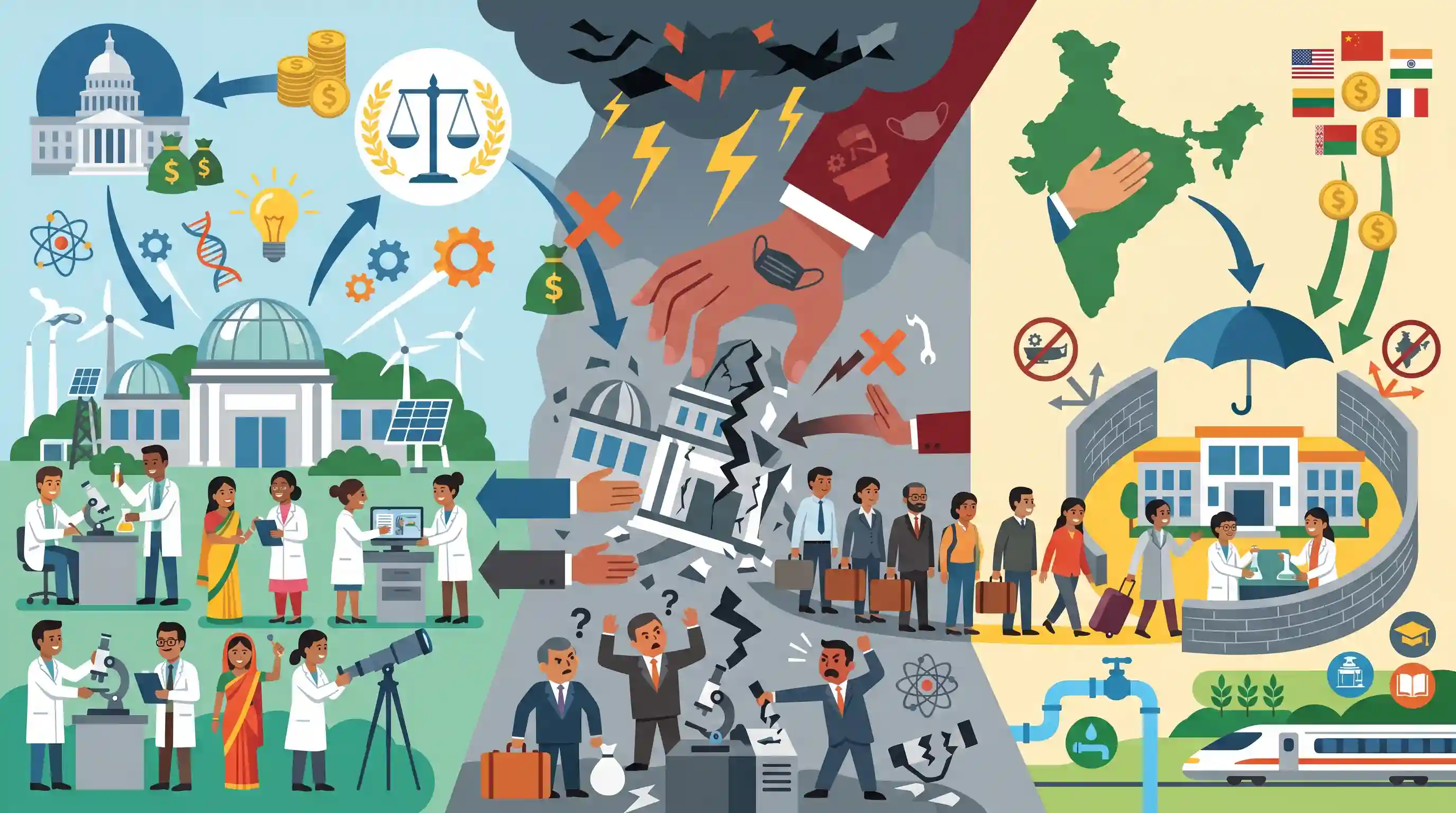
The article critiques political movements in the US that aim to dismantle or politicise its premier scientific and research institutions. It argues that undermining institutional autonomy, meritocracy, and state funding for science will destroy the very ecosystem that made American innovation world-leading. This serves as a cautionary tale on the vital link between robust, independent institutions and scientific progress. For India, it underscores the importance of shielding research bodies from political interference and highlights how shifts in the US ecosystem could impact the highly-skilled Indian diaspora, potentially creating new 'brain gain' dynamics.
Key Points
- The politicisation of scientific institutions and the undermining of civil service meritocracy threaten to dismantle the research ecosystem that drove American innovation.
- Historically, robust state funding combined with institutional autonomy has been the foundation of global scientific leadership.
- Dismantling autonomous scientific bodies for political reasons can cause severe long-term damage to a nation's technological and economic edge.
- A decline in the US scientific ecosystem could alter global talent migration, potentially leading to a reverse brain-drain (brain gain) for India or shifting the Indian scientific diaspora to other regions.
Prelims Trap
"The private sector accounts for the largest share of India's Gross Domestic Expenditure on R&D (GERD)."
Unlike the US where the private sector drives R&D, India's GERD (~0.64% of GDP) is primarily funded and driven by the government/public sector.
Static Concepts Connected
What is the structural difference in R&D funding between India and developed nations?
- GERD Ratio: India spends roughly 0.64% of its GDP on R&D, compared to 2.5%–3.5% spent by developed nations like the US and China.
- Public vs Private: In India, the government contributes over 50% of R&D expenditure. In the US, the private sector contributes over 70%.
- Anusandhan NRF: India established the Anusandhan National Research Foundation (ANRF) to bridge this gap, explicitly aiming to crowd-in private sector R&D investment.
What are India's prominent initiatives to leverage the scientific diaspora?
- VAIBHAV Fellowship: Connects the Indian STEM diaspora with Indian higher education institutions for collaborative, joint research projects.
- VAJRA Scheme: Allows overseas scientists to undertake a specific research stint in India as adjunct or visiting faculty for a few months.
- Ramanujan Fellowship: Targets highly skilled Indian researchers working abroad, offering them lucrative fellowships to return to India on a regular basis.
Cross-Topic Patterns
US Science Policy + India-US iCET
Disruptions in US institutions like the NSF could stall critical technology partnerships under the India-US iCET, directly impacting India's defense, space (NISAR), and semiconductor ambitions.
Reverse Brain Drain + Higher Education
A hostile US research environment pushes STEM talent back, directly linking foreign policy shifts to India's urgent need for Higher Education reforms (NEP 2020) to absorb this influx.

US tech protectionism + India's reverse brain drain + Anusandhan NRF will likely feature as a linked Mains GS2/GS3 question in 2026.
Linked PYQs · 3
Linked PYQs · 3
- 2020MainsGS2
Institutional quality is a crucial driver of economic performance". In this context suggest reforms in Civil Service for strengthening democracy.
- 2020MainsGS2
Indian diaspora has a decisive role to play in the politics and economy of America and European Countries'. Comment with examples.
- 2023MainsGS2
Indian diaspora has scaled new heights in the West. Describe its economic and political benefits for India.
