Bribery Allegations Involving TVK MLAs Reach Madras High Court
Source:The Hindu ↗
Why It Matters
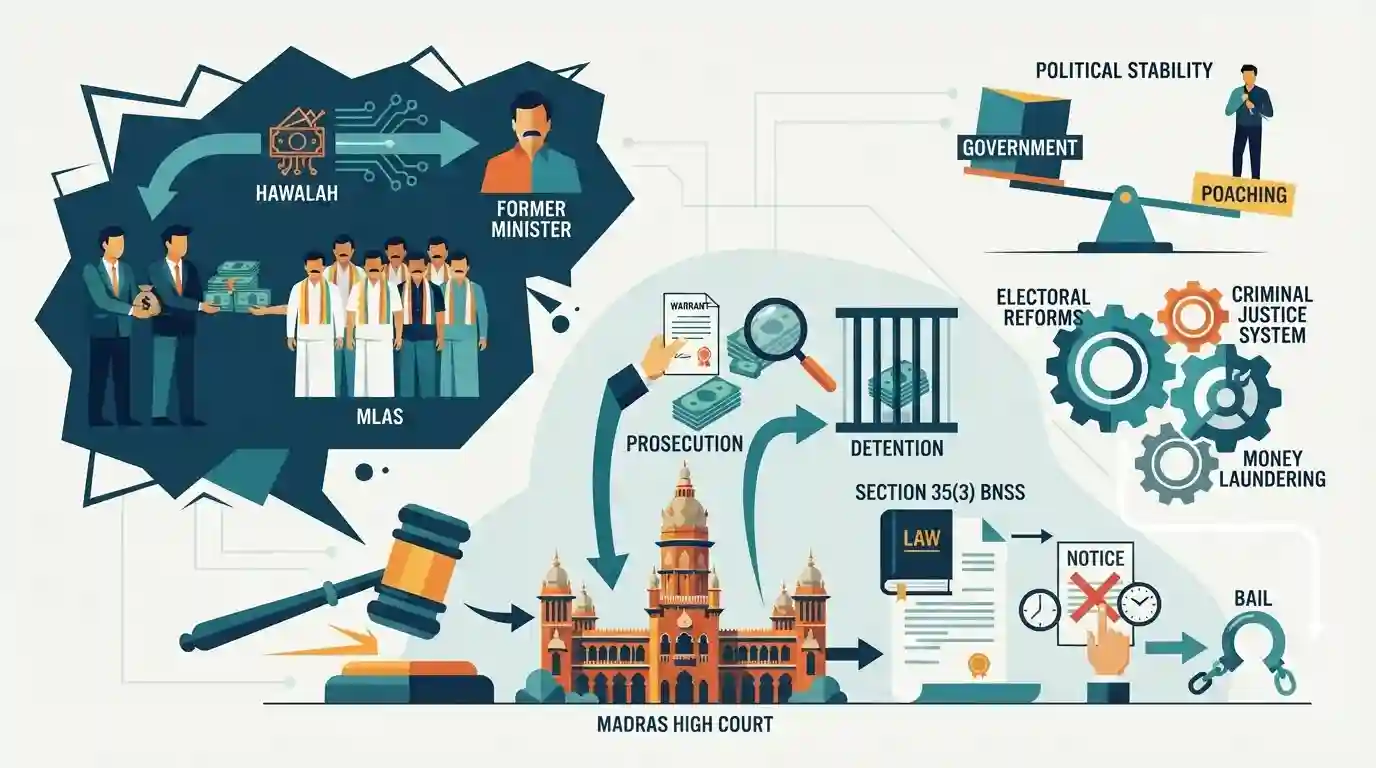
This case provides a concrete contemporary example of the persistent problem of political horse-trading and the use of black money (Hawala) to destabilize elected governments. It is also highly relevant for Governance as it tests the practical application of arrest protocols under the newly implemented Bharatiya Nagarik Suraksha Sanhita (BNSS).
Summary
Two individuals accused of attempting to bribe MLAs of the ruling Tamilaga Vettri Kazhagam (TVK) party in Tamil Nadu have approached the Madras High Court for bail. The prosecution claims the accused acted on behalf of a former DMK Minister to offer massive sums—channeled through illegal Hawala transactions—to poach legislators and destabilize the government. The defense is contesting the arrests on procedural grounds, citing a failure by the police to issue a prior notice of appearance as required under Section 35(3) of the newly enacted Bharatiya Nagarik Suraksha Sanhita (BNSS). The case underscores persistent challenges related to political horse-trading, electoral corruption, money laundering, and the enforcement of contemporary criminal justice reforms in India.
Key Points
- Two accused have moved the Madras High Court seeking bail after being arrested for allegedly attempting to bribe MLAs of the ruling Tamilaga Vettri Kazhagam (TVK) in Tamil Nadu.
- The lower sessions court denied bail due to the involvement of massive Hawala transactions allegedly meant to destabilize the government.
- The prosecution alleges a conspiracy orchestrated by former DMK Minister V. Senthilbalaji, offering ₹35 crore per MLA and ₹5 crore to middlemen.
- The petitioners argue their arrest violated Section 35(3) of the Bharatiya Nagarik Suraksha Sanhita (BNSS), which mandates serving a notice of appearance prior to arrest for offenses punishable by up to seven years.
- The incident showcases the nexus between unaccounted wealth (Hawala networks) and political corruption (horse-trading) aiming to undermine democratic mandates.
Important Terms
Bharatiya Nagarik Suraksha Sanhita (BNSS)

India's newly enacted criminal procedure law that replaced the Code of Criminal Procedure (CrPC), 1973, effective July 1, 2024, modernizing processes related to arrest, investigation, trial, and bail.
UPSC context
GS Paper II (Polity and Governance — Criminal Justice Reforms); tests understanding of procedural law reforms and individual rights protection.
Madras High Court
Established in 1862, it is one of India's oldest High Courts, holding constitutional and appellate jurisdiction over the state of Tamil Nadu and the Union Territory of Puducherry.
UPSC context
GS Paper II (Polity — Judiciary); tests knowledge of the structure, jurisdiction, and historical evolution of High Courts in India.
Principal District and Sessions Court
The highest court of civil and criminal jurisdiction at the district level in India, presided over by a District Judge for civil matters and a Sessions Judge for criminal trials.
UPSC context
GS Paper II (Polity — Subordinate Judiciary); tests understanding of the hierarchical judicial structure, powers, and local-level justice delivery.
Tamilaga Vettri Kazhagam (TVK)
A regional political party in Tamil Nadu and Puducherry, founded in 2024 by actor-turned-politician C. Joseph Vijay, playing an active role in the state's legislative assembly and regional politics.
UPSC context
GS Paper II (Polity — Regional Parties & Elections); tests analytical grasp of regional political dynamics, coalition politics, and multi-party systems.
Dravida Munnetra Kazhagam (DMK)
A prominent Dravidian regional political party in Tamil Nadu founded in 1949 by C. N. Annadurai, advocating for state autonomy, social justice, and linguistic pride.
UPSC context
GS Paper II (Polity — Federalism and Regional Identity); tests awareness of regionalism, state-center dynamics, and regional party history.
Prelims Trap
Notices of appearance under Section 35(3) of BNSS can be legally served via electronic channels like WhatsApp or SMS.
The Supreme Court explicitly clarified that statutory notices of appearance under Sec 35(3) BNSS cannot be validly served electronically to prevent arbitrary police actions.
Static Concepts Connected
What is Section 35(3) of the BNSS and how does it protect personal liberty?
- Mandatory Notice: Obligates police to issue a notice of appearance instead of immediate arrest for offenses carrying up to seven years' imprisonment.
- Arrest Exception: Arrest is allowed only if the accused fails to comply or if written justifications, such as flight risk, are formally recorded.
- Liberty Protection: Acts as a critical safeguard against arbitrary state power and prevents unnecessary pre-trial incarceration for minor offenses.
What constitutes 'Bribery' as a corrupt practice under Section 123 of the RPA, 1951?
- Statutory Definition: Section 123(1) defines bribery as any gift, offer, or promise of gratification to induce candidates or electors to act in a certain way.
- Broad Scope: Encompasses both pecuniary and non-pecuniary benefits, including promises of legislative favors, ministerial berths, or material support.
- Disqualification Penalty: Proven corrupt practices lead to the annulment of the candidate's election and disqualification under Section 8A of the Act.
Cross-Topic Patterns
BNSS Procedural Safeguards + Judicial Discretion
Checks how new criminal laws (BNSS) balance state police power with individual liberty, a core GS-2 theme tested via statutory versus constitutional rights.
Hawala Networks + PMLA + Electoral Corruption
Illustrates how shadow financial systems bypass banking channels to directly fund political subversion, linking money laundering threats (GS-3) to electoral integrity (GS-2).

The interface between BNSS arrest safeguards (Sec 35) and RPA 1951 corrupt practices is ripe for a multi-statement Prelims question.
Linked PYQs · 4
Linked PYQs · 4
- 2025MainsGS2
Discuss the 'corrupt practices' for the purpose of the Representation of the People Act, 1951. Analyze whether the increase in the assets of the legislators and/or their associates, disproportionate to their known sources of income, would constitute 'undue influence' and consequently a corrupt practice.
- 2020MainsGS2
There is a need for simplification of procedure for disqualification of persons found guilty of corrupt practices under the Representation of Peoples Act". Comment.
- 2021MainsGS3
Discuss how emerging technologies and globalisation contribute to money laundering. Elaborate measures to tackle the problem of money laundering both at national and international levels.
- 2013MainsGS3
Money laundering poses a serious security threat to a country's economic sovereignty. What is its significance for India and what steps are required to be taken to control this menace?
