SC ST Atrocities Decline and Relief Measures in Rajasthan
Source:thestatesman ↗
Why It Matters
The implementation of the SC/ST (Prevention of Atrocities) Act and state-level administrative reforms for marginalized communities are critical areas of study for RPSC RAS aspirants, reflecting the intersection of social justice, law enforcement, and governance in Rajasthan.
Summary
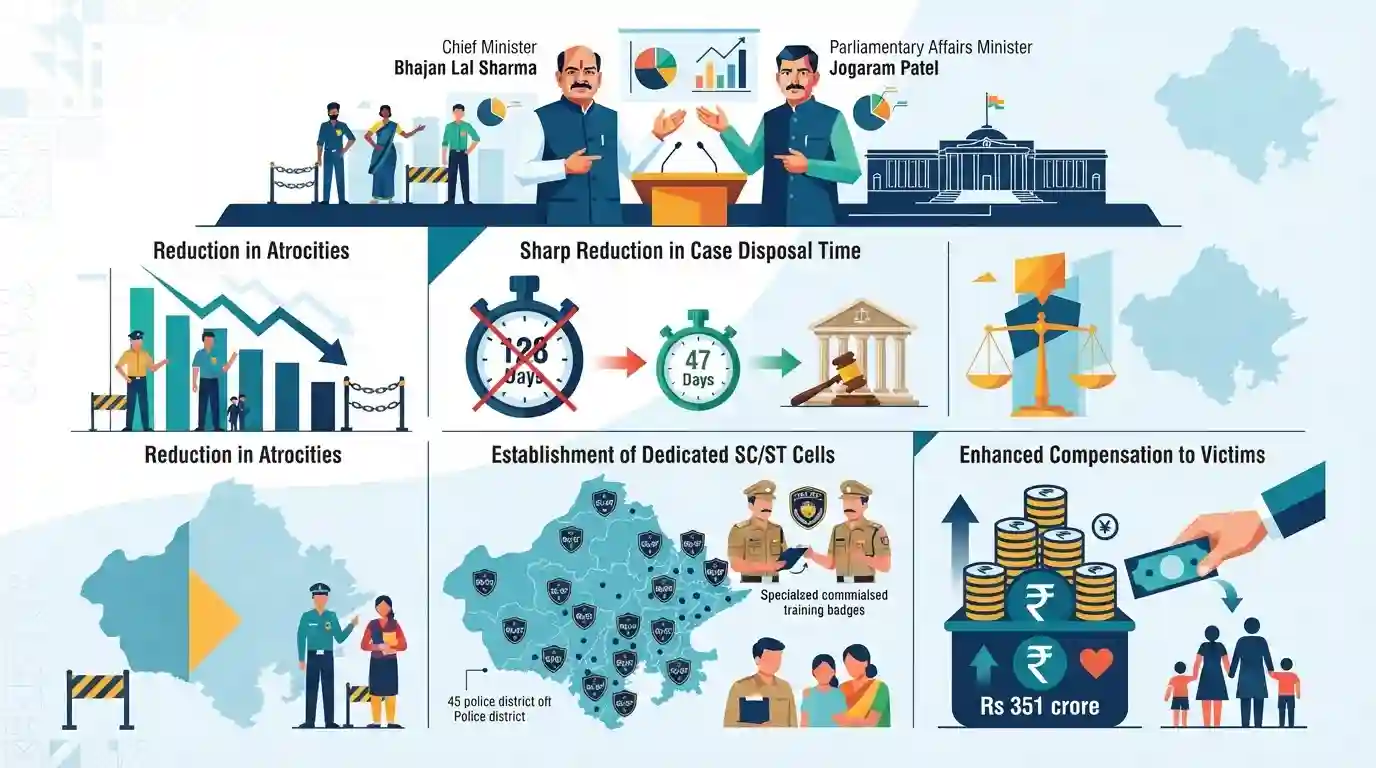
Rajasthan Chief Minister Bhajan Lal Sharma and Parliamentary Affairs Minister Jogaram Patel highlighted in the State Legislative Assembly that atrocities against SC and ST communities have significantly declined under the current administration. Key indicators of improved law enforcement and justice delivery include a sharp reduction in case disposal time under the SC/ST (Prevention of Atrocities) Act from 128 days to just 47 days, and the establishment of dedicated SC/ST cells in 45 police districts. Additionally, the state provided Rs 351 crore in compensation to victims in 2024-25, demonstrating an enhanced focus on social justice and the protection of vulnerable sections.
Key Points
- Incidents of atrocities against SCs and STs in Rajasthan dropped by 28% under the current BJP government, and by 15.88% in 2025 compared to 2024.
- The average time for case disposal under the SC/ST Act has dramatically reduced from 128 days to 47 days.
- SC/ST special police cells have been successfully established in 45 out of 50 police districts in the state.
- The state government distributed Rs 351 crore in compensation to victims' families between 2024 and 2025.
- A State Level Vigilance and Monitoring Committee meeting was convened, fulfilling the mandate to hold such reviews biannually.
Important Terms
Scheduled Castes and Scheduled Tribes (Prevention of Atrocities) Act

A landmark 1989 legislation enacted to prevent caste-based discrimination, violence, and hate crimes against marginalized communities. It mandates special courts, stringent punishments, and comprehensive rehabilitation to ensure swift justice and safeguard constitutional rights.
UPSC context
Crucial for GS Paper 2 (Social Justice); tests understanding of statutory safeguards, vulnerable sections, and rights enforcement mechanisms.
SC/ST Cells
Specialized units within state police departments established to monitor, investigate, and fast-track cases under the SC/ST (Prevention of Atrocities) Act. They aim to prevent caste bias in policing and streamline the delivery of swift justice.
UPSC context
Relevant for GS Paper 2 (Welfare Mechanisms) and GS 3 (Police Reforms), testing institutional capacity to protect marginalized groups.
State Level Vigilance and Monitoring Committee
A high-powered statutory body chaired by the Chief Minister under the SC/ST PoA Rules, 1995. Mandated to meet bi-annually, it reviews the Act's implementation, relief efforts, prosecution rates, and the overall performance of law enforcement.
UPSC context
Important for GS Paper 2 (Governance); tests knowledge of executive accountability and statutory monitoring frameworks for vulnerable communities.
Prelims Trap
The State Level Vigilance Committee under the SC/ST Act is chaired by the State Minister of Social Justice.
Under Rule 16 of the SC/ST Rules 1995, the State Level Vigilance and Monitoring Committee must be chaired exclusively by the Chief Minister.
Static Concepts Connected
What are the institutional safeguards under the SC/ST (Prevention of Atrocities) Rules?
- Investigating Officer: Investigations must be conducted by a police officer not below the rank of Deputy Superintendent of Police (DSP).
- Special Prosecutors: Special/Exclusive Public Prosecutors appointed for trials in Special Courts must have at least seven years of legal practice.
- Protection Cell: A Protection Cell must be set up at state headquarters under a high-ranking officer (DGP/ADGP/IGP) to monitor enforcement and identify atrocity-prone areas.
How are Vigilance and Monitoring Committees structured under the SC/ST Rules?
- State-Level (SLVMC): Chaired by the Chief Minister, this high-power committee is mandated to meet biannually (January and July) to review Act implementation.
- District-Level (DVMC): Chaired by the District Magistrate, this committee must hold review meetings at least quarterly at the district level.
- Core Mandate: They review the prosecution of cases, victim rehabilitation, and the overall enforcement of the SC/ST Act provisions.
Cross-Topic Patterns
Federalism and central legislation enforcement
While 'Police' is a State subject, the enforcement of central legislation like the SC/ST Act relies strictly on state-mandated institutional mechanisms (SLVMCs, specialized cells), linking federalism to social justice outcomes.
Judicial pendency and Special Courts
The reduction in case disposal time (128 to 47 days) mirrors broader judicial reform debates on how Special Courts and dedicated prosecution structures can effectively tackle high judicial pendency.

Expect a 2026 prelims statement mixing up the mandatory investigating officer rank (DSP) and the SLVMC chairmanship (CM) under the Act.
Linked PYQs · 4
Linked PYQs · 4
- 2025RPSC_PRELIMSGS1
What is the objective of the Chief Minister Swanidhi Yojana in Rajasthan?
- 2024RPSC_PRELIMSGS1
Consider the financial benefits to BPL families: A. Improve BPL families B. Provide BPL families to empower street vendors C. To provide economic and housing facilities D. Question not attempted
- 2025RPSC_PRELIMSGS1
Who is eligible for the Aastha scheme in Rajasthan?
- 2025RPSC_PRELIMSGS1
What has been formed in place of the Chief Minister Rajasthan Economic Reforms Advisory Council (CMRETAC)?
