Aviation Turbine Fuel and Commercial LPG Price Revisions
Source:The Hindu ↗
Why It Matters
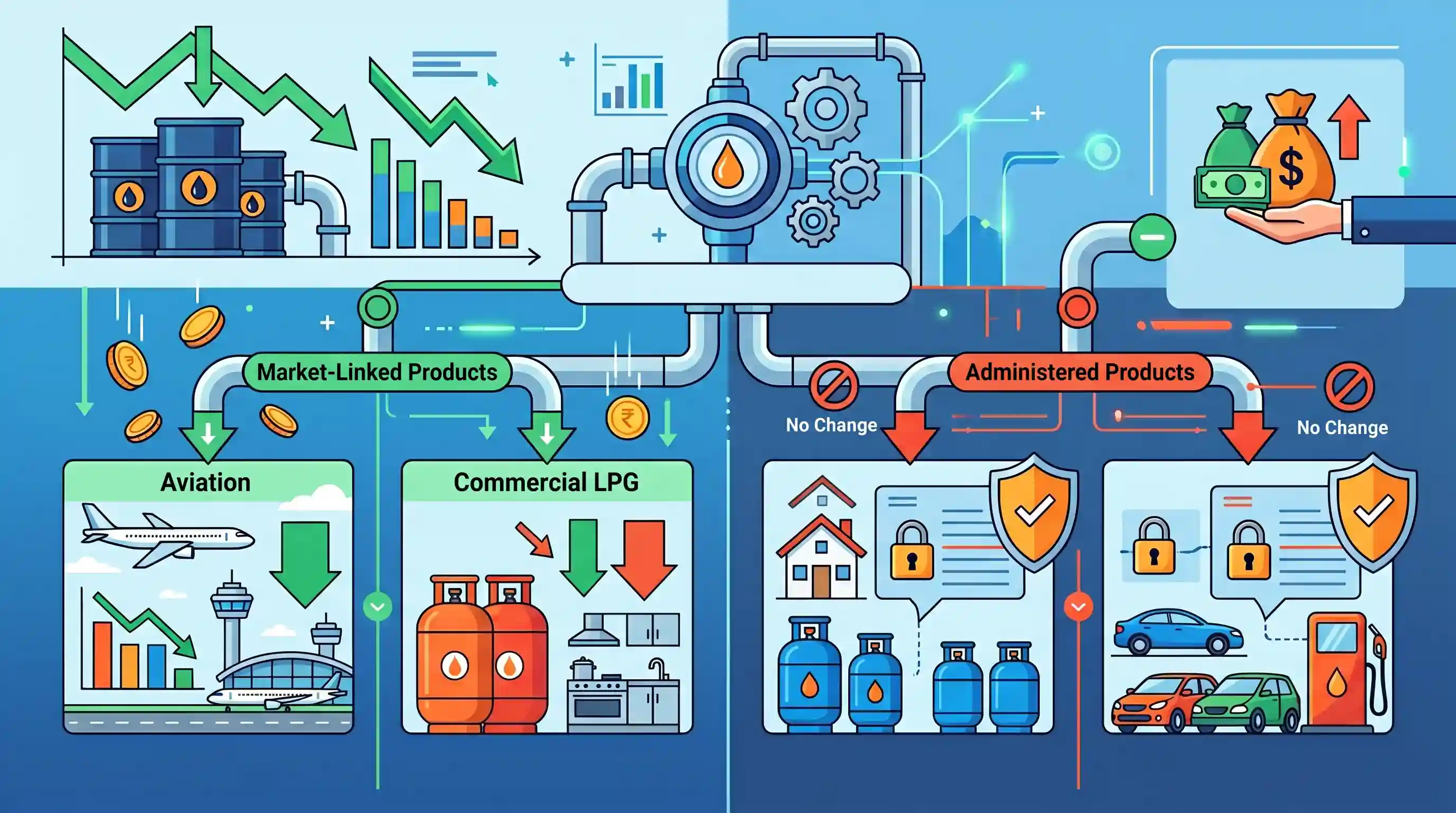
Illustrates India's fuel pricing dynamics, highlighting the distinction between market-linked products (ATF, commercial LPG) and those subject to informal price freezes or government intervention (petrol, diesel, domestic LPG). This impacts sectoral profitability (like aviation) and general inflation.
Summary
State-owned Oil Marketing Companies (OMCs) in India have announced a 3% price reduction in Aviation Turbine Fuel (ATF) and a ₹24 cut in commercial LPG rates per 19-kg cylinder. This adjustment reflects a downward trend in international benchmark fuel prices. While these market-linked products saw a decrease, domestic LPG, petrol, and diesel prices remain unchanged, highlighting the differential pricing mechanisms at play in India's energy sector.
Key Points
- State-owned Oil Marketing Companies (OMCs) have cut Aviation Turbine Fuel (ATF) prices by 3% due to softening international benchmark prices.
- The price of commercial LPG (19-kg cylinder) has been reduced by ₹24, bringing relief to businesses like hotels and restaurants.
- Prices for domestic LPG (14.2-kg cylinder), petrol, and diesel remain frozen and have not been revised.
- ATF accounts for approximately 40% of an airline's operating cost, meaning this price reduction will ease financial pressure on commercial aviation.
- OMCs revise ATF and commercial LPG prices on the first of every month based on average international prices and the rupee-dollar exchange rate.
Important Terms
Oil Marketing Companies (OMCs)

State-owned entities (IOCL, BPCL, HPCL) that refine, distribute, and retail petroleum products. They balance market-linked pricing with social objectives like maintaining stable fuel prices during global volatility.
UPSC context
GS-3: Energy/Infrastructure. Important for energy security, inflation management, and fiscal health (subsidies/under-recoveries).
Indian Oil Corporation (IOCL)
India's largest state-owned oil and gas corporation and a Maharatna PSU. It leads the refining segment and operates the nation's most extensive retail fuel and pipeline networks.
UPSC context
GS-3: Energy. Significant as a major CPSE central to national energy security and petroleum infrastructure.
Bharat Petroleum Corporation Ltd. (BPCL)
A Maharatna public sector undertaking and India's second-largest fuel retailer. It operates major refineries and is diversifying into green energy and electric vehicle charging infrastructure.
UPSC context
GS-3: Infrastructure. Relevant to energy sector reforms, disinvestment policies, and the green energy transition.
Hindustan Petroleum Corporation Ltd. (HPCL)
A Maharatna subsidiary of ONGC engaged in refining and marketing petroleum products. It possesses a significant retail presence and large-scale LPG distribution infrastructure across India.
UPSC context
GS-3: Energy. Tests knowledge of PSU hierarchies and the role of marketing companies in price stabilization.
Aviation Turbine Fuel (ATF)
A specialized jet fuel refined from kerosene used in aircraft. Pricing is market-linked but subject to high state-level VAT, significantly impacting airline operational costs and ticket prices.
UPSC context
GS-3: Economy/Infrastructure. Crucial for the "GST on Fuel" debate and its impact on aviation sector viability.
Maharatna Status
The highest category of autonomy for Central Public Sector Enterprises (CPSEs). It allows firms to invest up to ₹5,000 crore in projects without prior government approval.
UPSC context
GS-3: Economy. Tests understanding of PSU governance, financial autonomy, and industrial policy.
Under-recoveries
The financial loss incurred by OMCs when the domestic retail price of fuel is kept lower than its international benchmark price to shield consumers from inflation.
UPSC context
GS-3: Fiscal Policy. Essential for understanding the impact of subsidies on the fiscal deficit and energy pricing.
Prelims Trap
Petrol and diesel prices in India are currently regulated by the government under the Administered Pricing Mechanism (APM).
Petrol and diesel were officially deregulated in 2010 and 2014. The occasional price freezes are informal "managed deregulation" by OMCs, not a formal return to APM.
Static Concepts Connected
How did India transition from the Administered Pricing Mechanism (APM) for fuels?
- Deregulation Timeline: Petrol was deregulated in 2010 and diesel in 2014, shifting away from government-fixed prices to market-linked pricing.
- Dynamic Pricing: Introduced in 2017, this system requires daily price revisions based on global crude and forex rates.
- Managed Deregulation: OMCs occasionally freeze retail prices during extreme global crude volatility to shield domestic consumers from imported inflation.
How does Sustainable Aviation Fuel (SAF) differ from conventional ATF?
- SAF Composition: A "drop-in" biofuel synthesized from waste oils, biomass, and agricultural residues, rather than petroleum distillation.
- Emission Benefits: Can reduce life-cycle CO2 emissions by up to 80% and can be blended directly without requiring aircraft engine modifications.
Cross-Topic Patterns
Managed deregulation & inflation targeting
The RBI closely monitors fuel price freezes by OMCs. This "managed deregulation" acts as a fiscal shock absorber against imported inflation, directly impacting the CPI trajectory and RBI's monetary policy stance.
Aviation taxes vs. UDAN scheme viability
High state-level VAT on ATF creates financial friction for airlines, countering the Centre's UDAN (regional connectivity) scheme. This regularly drives industry demands to bring ATF under the GST regime.

A Prelims multi-statement question contrasting formal APM with OMC-driven "managed deregulation" and its inflation impact is likely in 2026.
Linked PYQs · 2
Linked PYQs · 2
- 2025PrelimsGS1
Consider the following activities : I. Production of crude oil II. Refining, storage and distribution of petroleum III. Marketing and sale of petroleum products IV. Production of natural gas How many of the above activities are regulated by the Petroleum and Natural Gas Regulatory Board in our country?
- 2015MainsGS3
In what way could replacement of price subsidy with Direct Benefit Transfer (DBT) change the scenario of subsidies in India ? Discuss.
