Macroeconomic Resilience and GDP Growth Amid Global Headwinds
Source:Indian Express ↗
Why It Matters
Provides a comprehensive year-end review of India's economic resilience, essential for answering GS-3 questions on macroeconomic management, the interplay between fiscal and monetary policies, and strategies for sustaining growth amidst global uncertainties.
Summary
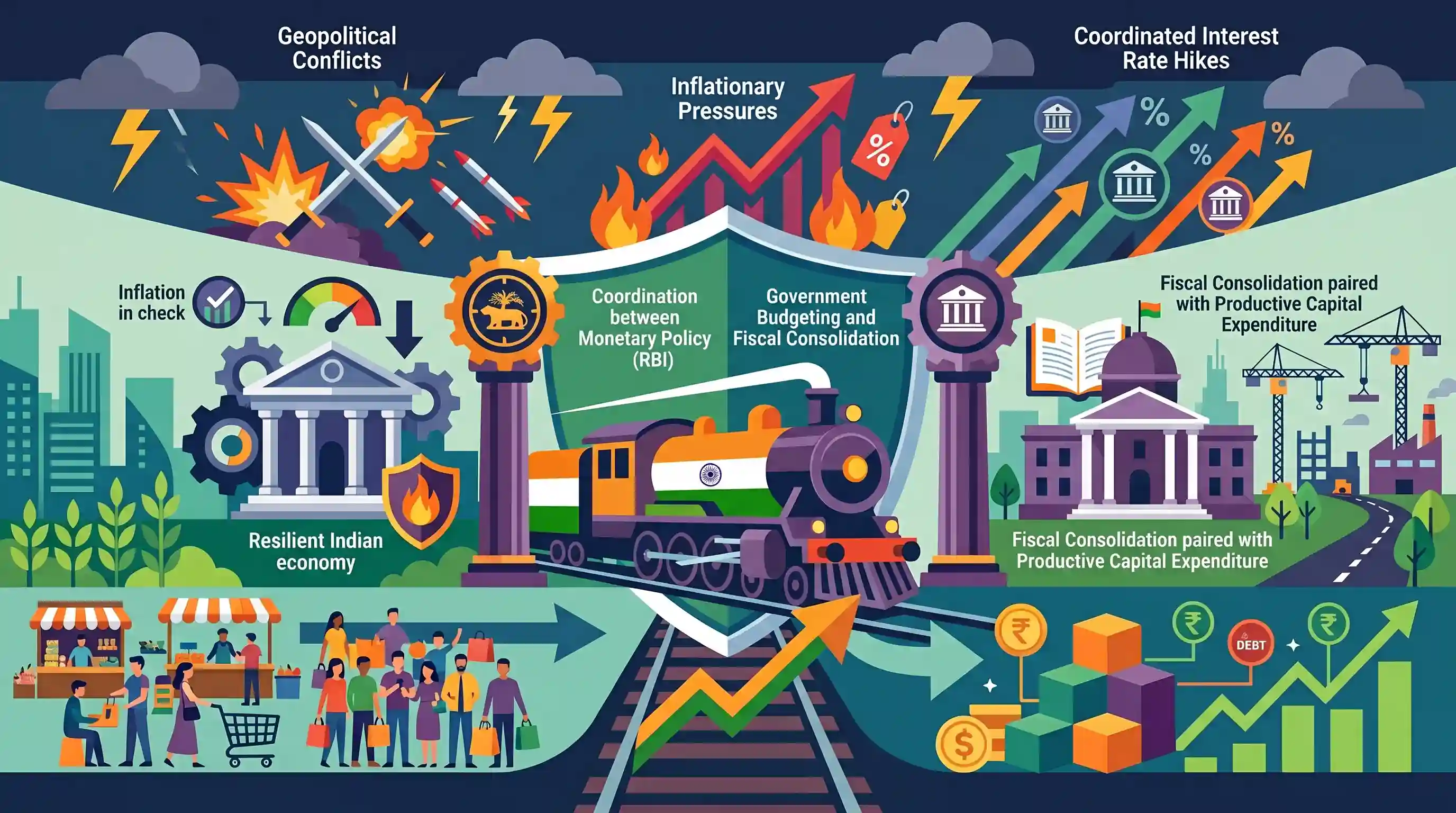
The article reviews India's macroeconomic performance at the close of the year, emphasizing its robust GDP growth and remarkable resilience against global economic headwinds. Despite 'storms' such as geopolitical conflicts, inflationary pressures, and coordinated interest rate hikes by global central banks, the Indian economy has maintained stability. This success is largely attributed to the effective coordination between the Reserve Bank of India's prudent monetary policy, which kept inflation in check, and the government's focus on fiscal consolidation paired with productive capital expenditure. Ultimately, strong domestic demand and sound macroeconomic fundamentals have enabled India to navigate external shocks successfully.
Key Points
- India demonstrated robust GDP growth at the year's end, remaining a bright spot amidst a challenging global economic environment.
- The economy successfully 'weathered the storms' of global headwinds, including geopolitical tensions, supply chain disruptions, and tight financial conditions.
- The Reserve Bank of India's (RBI) calibrated monetary policy interventions were crucial in managing inflation and anchoring price expectations without derailing growth.
- The government's continued commitment to fiscal consolidation, combined with sustained capital expenditure, has bolstered macroeconomic stability and enhanced resilience against external shocks.
Important Terms
Capital Expenditure (Capex)

Government spending aimed at creating or acquiring long-term physical and economic assets like infrastructure, schools, and hospitals. It typically has a high multiplier effect on economic growth.
UPSC context
GS Paper III (Government Budgeting); tests understanding of growth-oriented spending, the multiplier effect, and fiscal strategy.
Fiscal Consolidation
Policies implemented by the government to reduce fiscal deficits and minimize debt accumulation, typically by increasing revenue or curbing non-productive expenditure to ensure long-term fiscal health.
UPSC context
GS Paper III (Government Budgeting); crucial for discussing the FRBM Act, debt sustainability, and macroeconomic discipline.
Monetary Policy
The regulatory framework through which the Reserve Bank of India manages money supply and interest rates to maintain price stability while supporting economic growth.
UPSC context
GS Paper III (Indian Economy); essential for topics involving inflation targeting (CPI), liquidity management, and the MPC.
Macroeconomic Stability
The state of an economy characterized by low and stable inflation, manageable debt levels, and resilience against external shocks, providing a foundation for sustained economic growth.
UPSC context
GS Paper III (Indian Economy); tests ability to analyze resilience against global headwinds and external sector vulnerabilities.
Reserve Bank of India (RBI)
India's central bank and highest monetary authority, established in 1935. It regulates the banking system, manages foreign exchange reserves, and implements monetary policy to ensure financial stability.
UPSC context
GS Paper III (Indian Economy); central to questions on the financial system, banking reforms, and inflation control.
Prelims Trap
"Increased government borrowing for capital expenditure invariably crowds out private investment."
Aspirants confuse revenue-deficit borrowing with public capex. Strategic infrastructure capex currently 'crowds in' private investment by reducing logistics costs and creating baseline demand.
Static Concepts Connected
What is the Fiscal Multiplier effect in government spending?
- Definition: The ratio of a change in national income (GDP) to the initial change in government spending that caused it.
- Capex superiority: Capital expenditure has a much higher multiplier (approx. 2.45-3.25) than revenue expenditure, as it creates lasting economic assets and jobs.
- Counter-cyclical role: During global slowdowns, high-multiplier spending allows the government to sustain domestic growth without proportional inflationary pressure.
How does India's Flexible Inflation Targeting (FIT) framework operate?
- Headline CPI: The RBI targets headline Consumer Price Index (CPI-Combined) inflation, not core or WPI inflation.
- Target band: The statutory target is set at 4%, with an upper tolerance limit of 6% and a lower tolerance limit of 2%.
- Failure criteria: Considered a failure if average inflation remains outside the 2-6% band for three consecutive quarters.
Cross-Topic Patterns
Imported inflation + Supply-side fiscal policy
RBI's rate adjustments are heavily tested alongside government supply-side interventions (e.g., duty cuts on fuel/edible oils) during global commodity shocks.
PFCE + External Sector vulnerability
India's high Private Final Consumption Expenditure (PFCE) acts as a structural buffer, contrasting with export-led economies that suffer heavily during global protectionism waves.

Expect a 2026 Prelims question linking public capex 'crowding in' private investment with RBI's handling of imported inflation.
Linked PYQs · 5
Linked PYQs · 5
- 2019MainsGS3
Do you agree with the view that steady GDP growth and low inflation have left the Indian economy in good shape? Give reasons in support of your arguments.
- 2024MainsGS3
What are the causes of persistent high food inflation in India? Comment on the effectiveness of the monetary policy of the RBI to control this type of inflation.
- 2023PrelimsGS1
Consider the following statements: Statement-I: In the post-pandemic recent past, many Central Banks worldwide had carried out interest rate hikes. Statement-II: Central Banks generally assume that they have the ability to counteract the rising consumer prices via monetary policy means. Which one of the following is correct in respect of the above statements?
- 2021PrelimsGS1
With reference to Indian economy, demand-pull inflation can be caused/ increased by which of the following? 1. Expansionary policies 2. Fiscal stimulus 3. Inflation-indexing wages 4. Higher purchasing power 5. Rising interest rates Select the correct answer using the code given below.
- 2011PrelimsGS1
Economic growth is usually coupled with
